

The fastest, safest way to stop dog urine odours trapped in artificial grass is to apply a pet-safe enzyme cleaner directly to the affected zone. Turftails is built for exactly this: an enzyme-powered formula that digests urine compounds at the molecular level, contains no harsh chemicals or artificial perfumes, and covers up to 100m² per bottle. Right now, in the next five minutes, you can rinse the area with plain water to dilute surface salts, then apply Turftails and let the enzymes do the rest.
Why it works where other products fail:
- Enzyme action: breaks down urea, ammonia, and uric acid crystals rather than masking them
- Pet-safe and eco-friendly: no bleach, no solvents, safe for children and dogs once dry
- No rinsing required: the formula keeps working after the surface appears dry
- Coverage: one concentrated bottle treats up to 100m²
Key takeaways
An enzyme cleaner applied directly to the affected zone, with adequate dwell time and enough solution to reach the backing, is the most reliable way to remove dog urine odour from artificial grass for good.
| Point | Details |
|---|---|
| Act immediately | Rinse fresh urine with water, then apply enzyme cleaner within 24 hours for the easiest removal. |
| Enzymes beat vinegar | Vinegar masks odour temporarily; enzymes digest uric acid crystals and remove the source. |
| Saturate, don’t mist | The solution must reach the turf backing and infill where ammonia crystals concentrate. |
| Daily rinse habit | A quick rinse of the potty zone every day or two prevents build-up between enzyme treatments. |
| Turftails recommendation | One concentrated bottle covers up to 100m², is pet-safe, and requires no rinsing after application. |
Table of Contents
- Why does dog urine smell linger in artificial grass?
- When should you treat: fresh spots versus set-in smells?
- How to apply an enzyme cleaner to artificial grass
- Cleaners and habits that damage turf or make odours worse
- How to deal with stubborn or recurring odours
- Are enzyme cleaners safe for pets, children, and the environment?
- Why Turftails is the recommended enzyme cleaner
- An honest take on keeping turf fresh
- Get Turftails delivered to your door
- Useful sources
- FAQ
Why does dog urine smell linger in artificial grass?
The smell is not on the surface. It is underneath it.
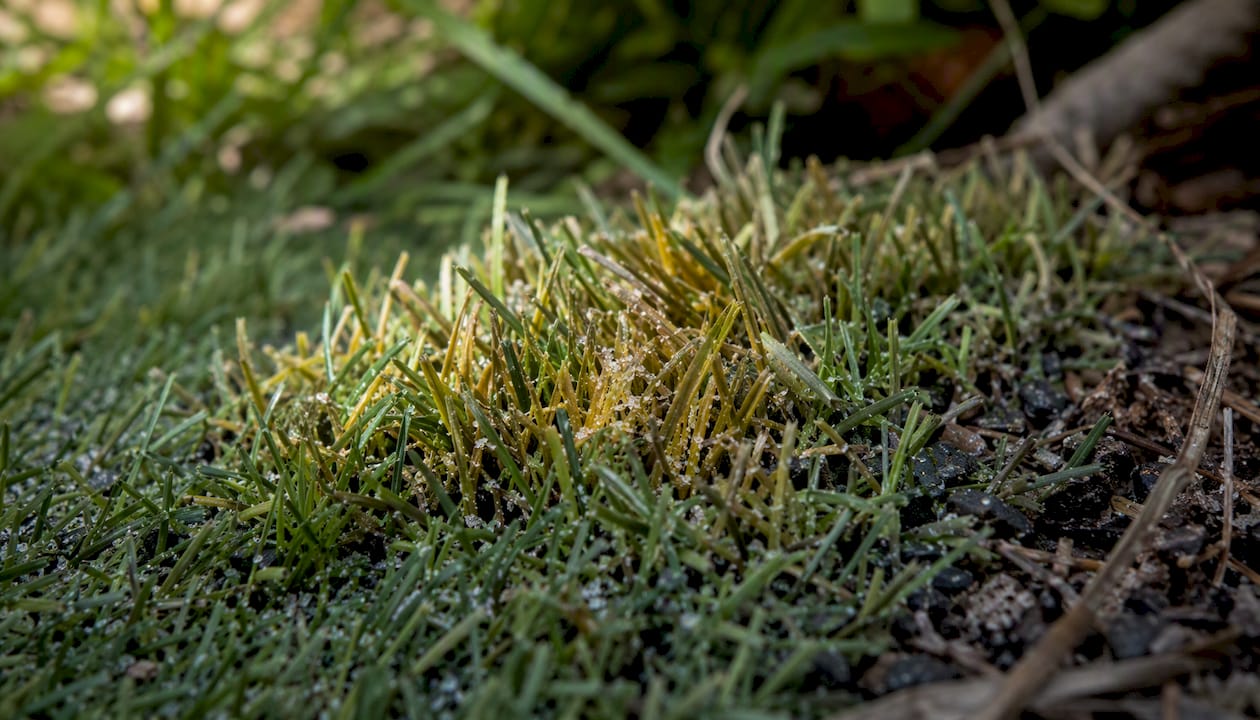
When a dog urinates on synthetic turf, urea begins converting to ammonia almost immediately. Over time, that ammonia forms crystalline deposits that lodge in the turf pile, the infill layer, and the backing material. Bacteria colonise those deposits and keep producing odour as long as organic material remains. A surface rinse moves liquid around but rarely reaches the backing, which is why the smell returns within hours on a warm day.
Acids and detergents work differently from enzymes. Vinegar, for instance, temporarily lowers the pH around the odour source, which suppresses the smell briefly. Once the acidity dissipates, the uric acid crystals are still there and bacteria resume their work. Enzymes, by contrast, digest the organic compounds themselves, removing the fuel bacteria need to produce odour in the first place.
Key points on where odour hides:
- Turf pile: fibres trap urine droplets and dry into a concentrated residue
- Infill (sand, crumb rubber, or cork): porous materials absorb and hold urine salts
- Backing and sub-base: the deepest reservoir, rarely reached by a garden hose alone
When should you treat: fresh spots versus set-in smells?
Timing changes everything about how much effort the job takes.
Fresh urine (within 24 hours)
- Rinse the spot generously with plain water to dilute and mobilise surface salts.
- Apply your enzyme cleaner at the standard dilution rate.
- Allow the recommended dwell time, then leave to air-dry. No further rinsing needed with a no-rinse formula.
Set-in or recurring odour
- Rinse first with a heavy volume of water to rehydrate dried crystals.
- Apply enzyme cleaner at a higher concentration, saturating the area so the solution reaches the backing.
- Agitate with a soft broom to work the cleaner into the infill.
- Allow an extended dwell time (at least 20–30 minutes, longer for older deposits).
- Repeat the treatment after 48 hours if the smell persists.
Maintenance cadence to prevent recurrence:
- Single-pet household: a quick rinse of potty zones every day or two; a full enzyme treatment roughly once a month
- Multi-pet household: rinse every day; enzyme treatment every two weeks or more frequently in summer
- Hot, dry weather: urine dries and concentrates faster, so treat more often and apply in the evening when enzyme activity is not compromised by heat
- Cool, wet weather: rain helps dilute surface salts, but the backing still needs periodic enzyme treatment; monthly is a reasonable baseline
Routine quick rinses plus periodic enzyme deep-cleans are the most cost-effective routine for most single-pet households.
How to apply an enzyme cleaner to artificial grass
What you need
A garden hose, a soft-bristle broom or turf rake, your concentrated enzyme cleaner, and a watering can or pump sprayer for the application.
Step-by-step
- Clear the area. Remove any surface debris. Brush the turf fibres upright with your broom so the cleaner can penetrate evenly.
- Pre-rinse. Soak the affected zone with plain water. This rehydrates dried urine salts and makes them accessible to the enzymes.
- Mix the concentrate. Follow the product’s dilution instructions. For Turftails concentrate, the coverage guidance gives you up to 100m² per bottle when mixed correctly — so for a typical 4–6m² potty zone, a single bottle goes a long way.
- Apply generously. Pour or spray the diluted solution so it saturates the turf pile and reaches the infill. Do not mist; the solution needs to reach the backing.
- Agitate. Work the cleaner into the turf with a soft broom, pushing it down toward the backing where ammonia crystals concentrate. Misting alone often fails because it never penetrates deep enough.
- Dwell time. Leave the cleaner to work for at least 15–20 minutes. For older odours, 30 minutes or more gives better results. Enzyme cleaners begin working immediately and continue to break down material after the surface looks dry.
- Rinse or leave. With a no-rinse formula like Turftails, you can leave the area to air-dry. If you choose to rinse, do so lightly — a heavy rinse washes away enzymes that are still working.
- Keep pets off until the surface is dry, especially if you have applied a concentrated solution.
Pro Tip: Apply in the early evening rather than midday. High temperatures accelerate enzyme degradation, so treating during cooler hours gives the formula more time to work before it dries out.
Cleaners and habits that damage turf or make odours worse
Some of the most popular DIY fixes actively make the problem harder to solve.
- Bleach: strips colour from turf fibres, degrades the backing material, and kills the beneficial microbes that help break down organic waste naturally. It also leaves a chemical residue that irritates paws.
- Undiluted ammonia: counterproductive for obvious reasons — you are adding more of the compound you are trying to remove.
- Strong solvents: dissolve the adhesives that bond the turf backing and can cause fibres to loosen or shed.
- Baking soda: absorbs surface moisture temporarily but the powder settles into drainage holes and infill, reducing drainage over time and trapping rather than removing odour compounds.
- Powdered deodorisers: the same drainage problem as baking soda, with the added issue that many contain fragrances that attract dogs back to the same spot.
Vinegar is not a cleaner for artificial grass odour — it is a temporary suppressant. Once the acidity evaporates, the uric acid crystals remain intact and bacteria resume producing ammonia. Vinegar does not penetrate the backing or dissolve uric acid crystals, so the smell reliably returns.
Avoid keeping pets on a freshly treated area before it has dried, and never layer multiple cleaning products on top of each other — the chemical interactions can be unpredictable and may damage the turf surface.
How to deal with stubborn or recurring odours
If the smell returns within a day or two of treatment, the issue is almost always one of the following.
Diagnostic checks:
- Drainage blocked? Lift a corner of the turf if possible and check whether the sub-base is waterlogged.
- Is the infill saturated? Sand and crumb rubber hold urine salts for months; no surface treatment will fully resolve it.
- Is the dog returning to the same spot? Repeated use in one zone builds up deposits faster than any maintenance schedule can clear.
- Are you applying enough solution? A light spray rarely reaches the backing.
Deeper fixes:
- Perform a heavy-saturation enzyme treatment: drench the zone until water pools on the surface, then cover with a tarpaulin for 24–48 hours to extend dwell time and prevent evaporation.
- Power-broom the infill to loosen compacted material and redistribute the enzyme solution.
- Top up or replace infill in the worst-affected zones. Non-porous infill options (such as coated sand or cork) are easier to clean than standard crumb rubber.
- If sub-base contamination is suspected, professional base flushing may be necessary.
When to call a professional: if repeated enzyme treatments over several weeks produce no lasting improvement, the sub-base is likely saturated. A professional service can flush the base and assess whether infill replacement is needed.
Are enzyme cleaners safe for pets, children, and the environment?
The enzymes themselves are proteins — they break down organic waste and then become inert once the organic material is gone.
Practical safety guidance:
- Pets: keep dogs off the treated area until it is fully dry. Once dry, the surface is safe.
- Children: the same rule applies. Dry surface equals safe surface.
- Storage: keep concentrate out of reach of children, in a cool, dry place away from direct sunlight, which degrades enzyme activity.
- Dilution: always follow the product’s dilution ratio. Using concentrate undiluted does not improve results and wastes product.
- Rinse water: the diluted solution that drains through the turf is safe for soil and will not harm surrounding plants when used at the recommended concentration.
When reading labels, look for: no harsh chemicals, no artificial perfumes, biodegradable formula, and pet-safe certification. Turftails meets all of these.
Why Turftails is the recommended enzyme cleaner
Turftails was formulated specifically for dog urine on artificial grass, which matters more than it might seem. General-purpose enzyme cleaners are often designed for hard floors or carpets and may not penetrate turf infill effectively.
| Feature | Turftails |
|---|---|
| Formula type | Enzyme-powered concentrate |
| Coverage per bottle | Up to 100m² |
| Harsh chemicals | None |
| Artificial perfumes | None |
| Rinse required | No |
| Surfaces covered | Artificial grass, patios, decking, concrete, kennels, fabrics |
| Pet and child safe | Yes (once dry) |
One concentrated bottle covers up to 100m². For a typical potty zone of 4–6m², that is enough for multiple treatments across several months, making it genuinely cost-effective compared with ready-to-use sprays that run out quickly.
Turftails also works on patios, decking, concrete, and kennels, so one product handles the whole outdoor space rather than requiring separate solutions for different surfaces.
The enzyme routine Turftails recommends — spot treatment for frequent potty zones, correct dilution, and trusting the formula to keep working after the surface dries — is straightforward enough to stick to.
An honest take on keeping turf fresh
The single habit that makes the biggest difference is not the monthly deep-clean. It is the daily two-minute rinse of the potty zone. Most persistent odour problems come from urine being allowed to dry and concentrate repeatedly in the same spot before any treatment is applied. By the time the smell is noticeable to guests, the crystals are already embedded in the backing.
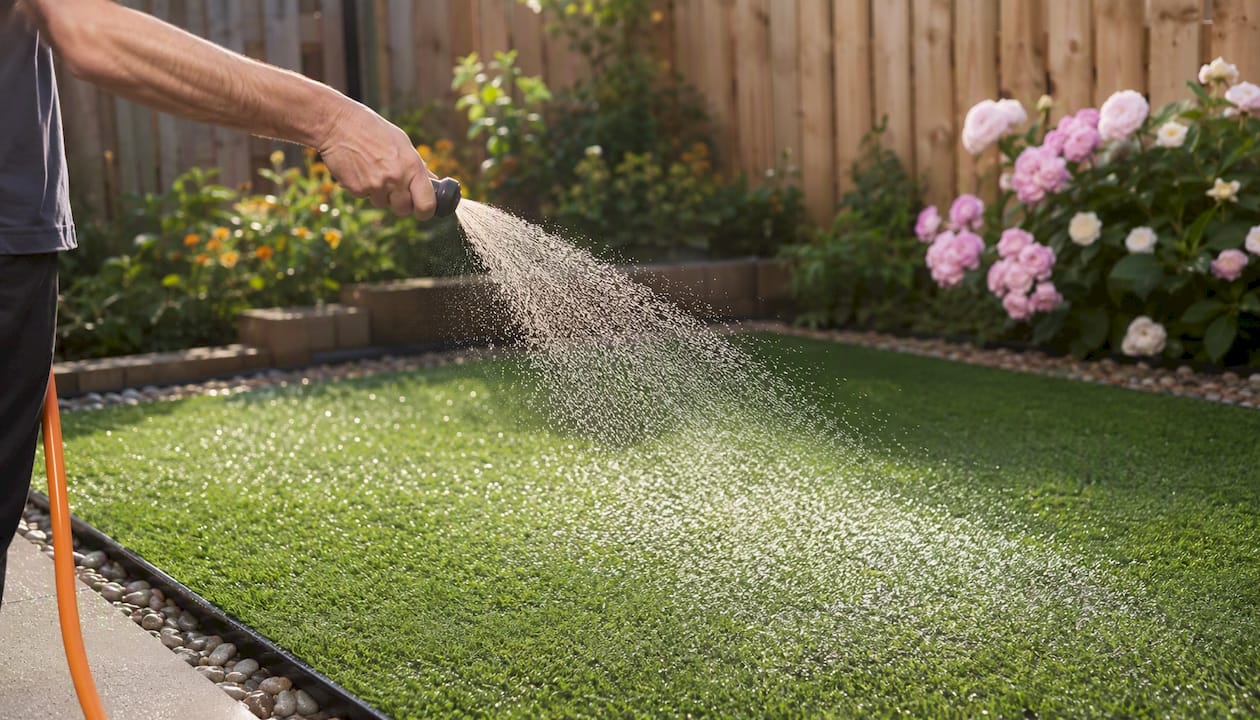
Enzyme cleaners are not magic — they need contact time and enough solution to reach the source. But used consistently, they genuinely remove the odour rather than just postponing it. One practical habit worth adopting: keep a diluted bottle of Turftails in a pump sprayer near the back door. A quick spray after the dog goes out, every time, takes ten seconds and prevents the build-up that makes deep-cleaning necessary.
Get Turftails delivered to your door
Turftails is available directly from Turftails with a one-time purchase or a subscription that keeps a bottle arriving before you run out. The concentrate covers up to 100m² per bottle, so most households need only one or two bottles a year.
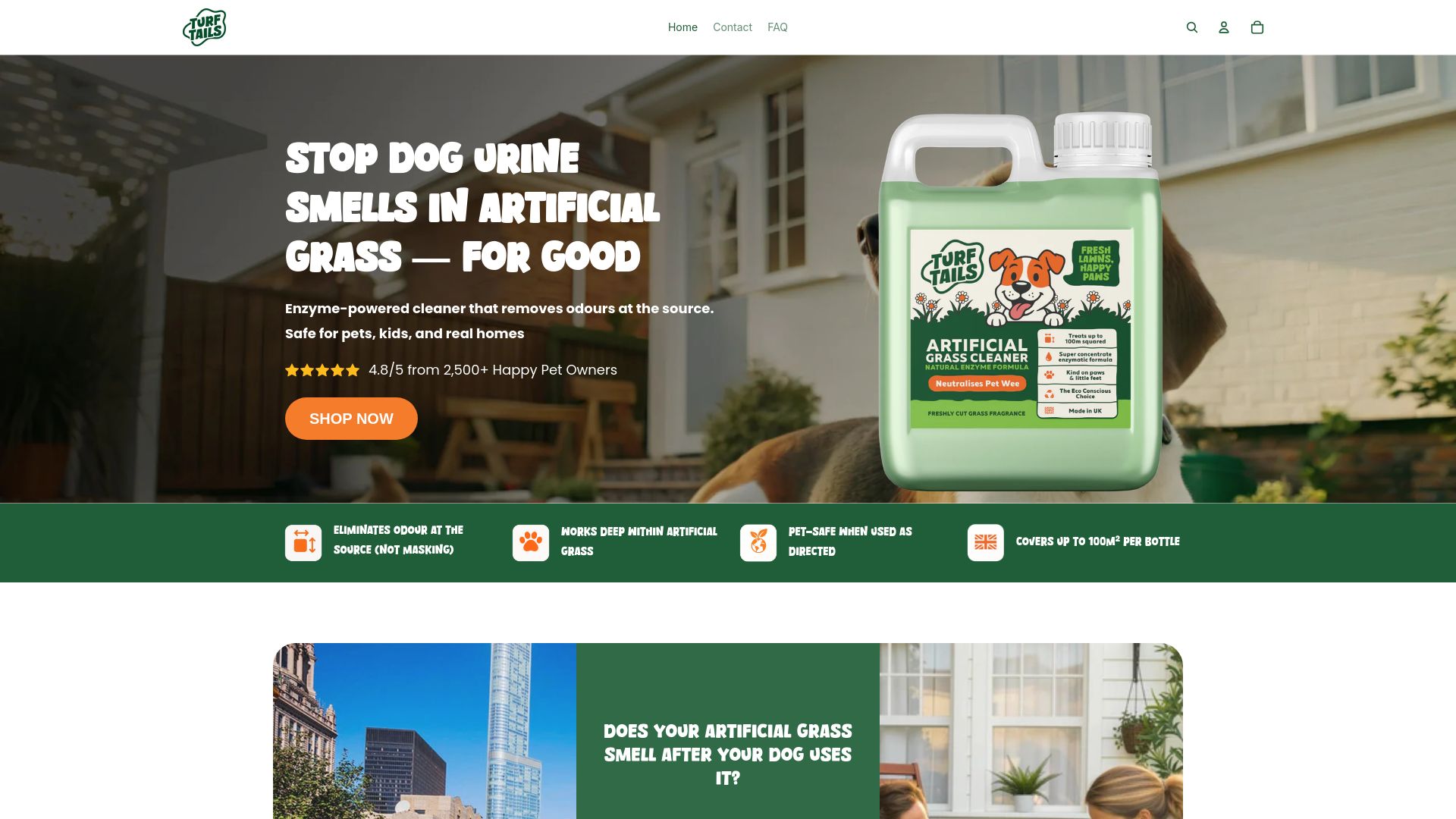
Shipping covers the United Kingdom. If you have questions about which format suits your garden size or how to set up a subscription, the Turftails customer support team is reachable via the website. Order once, see the difference, and subscribe when you are ready.
Useful sources
- Turftails enzyme cleaner — product page and purchase options
- Best artificial grass cleaner for dog owners: enzyme routine
- How enzyme cleaners work on artificial grass
- How long does enzyme cleaner take to work?
- Pressure washing artificial grass: what dog owners need to know
- Pet-safe patio cleaner for artificial grass and dogs
FAQ
Does dog urine permanently damage artificial grass?
No. Urine does not degrade synthetic fibres, but the ammonia crystals it leaves behind will cause persistent odour if not treated with an enzyme cleaner. Regular treatment prevents long-term build-up.
How often should I use an enzyme cleaner on artificial grass?
For a single-dog household, a monthly enzyme treatment combined with frequent plain-water rinses is a practical baseline. Multi-pet households or high-use zones benefit from treating every two weeks.
Can I use Turftails on surfaces other than artificial grass?
Yes. Turftails works on patios, decking, concrete, kennels, and fabrics, so one bottle covers the full outdoor area where your dog spends time.
How long before my dog can go back on the treated turf?
Once the treated surface is fully dry, it is safe for pets and children. With a no-rinse formula like Turftails, that typically means waiting until the area has air-dried naturally.
Why does the smell come back after I use vinegar?
Vinegar temporarily suppresses odour by lowering the pH around the uric acid deposits, but it does not dissolve or remove them. Once the acidity evaporates, bacteria resume breaking down the remaining crystals and the smell returns.