

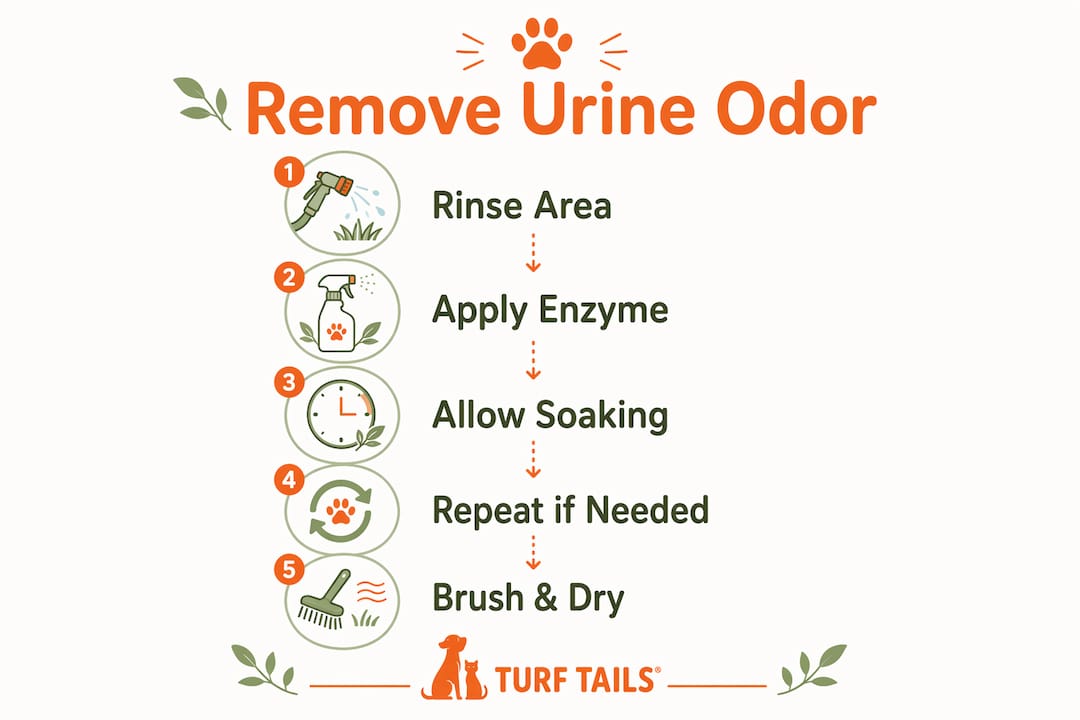
A garden that smells of dog urine can be sorted today. Rinse the affected area, treat it with an enzyme cleaner, and allow to work. That is the whole fix for a fresh incident. For ongoing control, Turftails enzyme cleaner is the recommended pet-safe option: it covers up to 100m² per bottle, requires no rinsing, and contains no harsh chemicals.
Quick action plan (under 30 minutes):
-
Hose down the soiled area thoroughly to flush urine through the backing
-
Apply an enzyme cleaner such as Turftails directly to the wet surface
-
Allow it to dry and let the enzyme works
Pro Tip: Apply your enzyme cleaner in the late afternoon or evening. UV light and midday heat degrade biological agents before they can work, so evening application gives the enzymes the best possible dwell time.
Table of Contents
-
How do you remove fresh dog urine odour from artificial grass?
-
What cleaning methods make the smell worse or damage your turf?
-
How do you choose an enzyme cleaner for artificial grass in the UK?
How do you remove fresh dog urine odour from artificial grass?
Work through this in order. Skipping steps is where most people go wrong.
-
Remove any solid waste first. Pick it up immediately with a bag or scoop. The longer it sits, the deeper it presses into the fibres.
-
Apply your enzyme cleaner. Spray evenly across the area or whole turf. For a concentrated product, follow the dilution guide on the label. Turftails is 1 part Turf tails to 10 parts water or 1 part Turf Tails to 5 parts water for stronger odours
-
Allow to dry. Do not rush this step — the enzymes need contact time to break down uric acid compounds.
-
Final rinse (if required). Turftails does not. Check your label.
For patches that have been building up over weeks, two or three treatments on consecutive evenings will usually clear them.
Safety notes: Never apply enzyme cleaners when frost is forecast — frozen backing prevents drainage and the product will not reach the sub-base. Keep pets and children off the treated area until it is dry. If you have a garden pond nearby, rinse the edges of the treated zone away from it.
Pro Tip: If the smell spikes on warm afternoons, that is the sun heating trapped uric acid crystals and driving off ammonia gas. An evening enzyme treatment targets those crystals directly.
Why does artificial grass develop a dog urine smell?
A quick rinse often fails because the problem is not on the surface. Uric acid crystals are not water-soluble, so plain water moves them around without breaking them down. They settle into the infill and backing, where bacteria feed on them and produce ammonia. That ammonia off-gasses when the turf heats up, which is why the smell is often worst on sunny afternoons.
The main culprits:
-
Uric acid crystals that survive rinsing and accumulate in the infill over time
-
Bacteria thriving in the warm, moist environment between fibres and backing
-
Poor drainage trapping urine in the sub-base rather than allowing it to disperse
-
Silica sand infill retaining moisture and odour more than specialist pet infills do
-
UK climate factors — cool, damp weather slows evaporation, while afternoon heat accelerates ammonia off-gassing
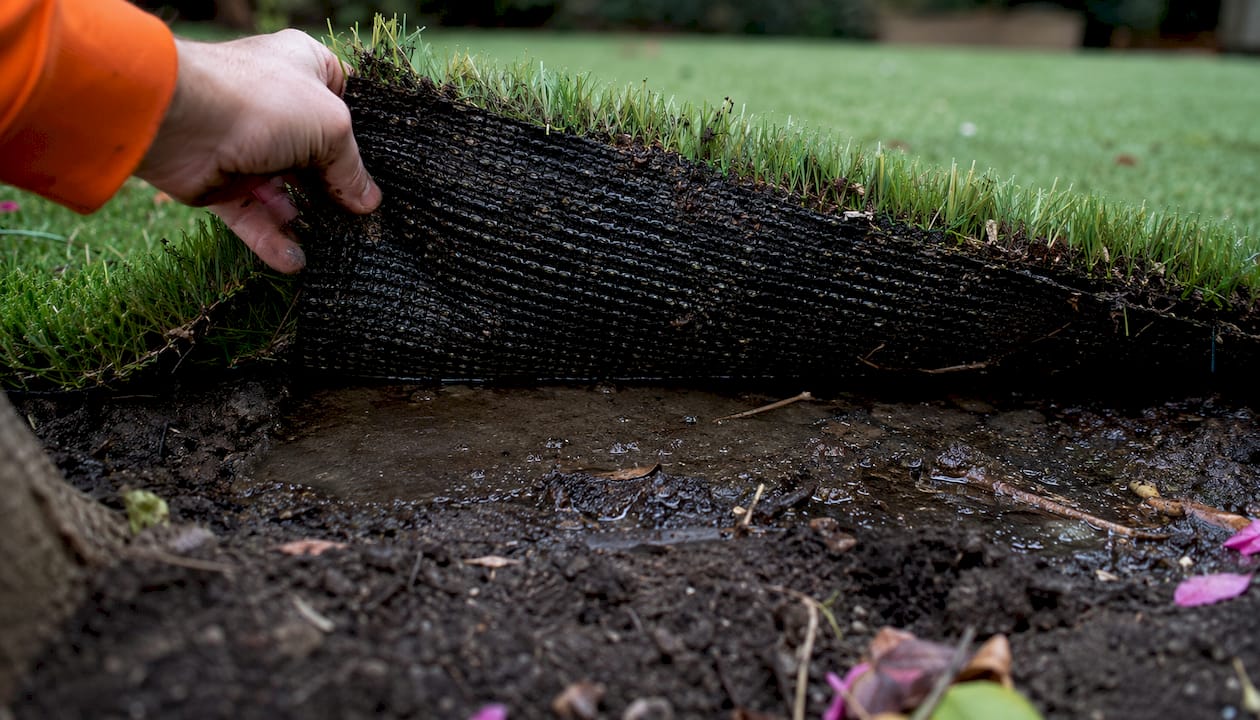
Drainage failure is the root cause in over 80% of persistent artificial grass odour cases. When urine cannot flow through the backing into the sub-base and away, it pools and concentrates. No amount of surface cleaning fixes a structural drainage problem.
What cleaning methods make the smell worse or damage your turf?
Some popular home remedies cause more harm than good. Here is what to avoid and what to use instead.
-
Bleach. It will not break down uric acid, it degrades polyurethane backing over time, and it can harm pets and children. Use an enzyme cleaner instead.
-
High-PSI power washing. High-pressure jets damage seams and backing and can void your installer’s warranty. If you use a pressure washer at all, keep it on the lowest setting and avoid seams entirely.
-
Heavy soap or washing-up liquid. Soap leaves a sticky residue that traps dirt and odour-causing particles in the fibres. Rinse with plain water instead.
-
Excessive white vinegar. A diluted vinegar rinse can neutralise ammonia temporarily, but repeated use lowers the pH of the infill and may damage backing materials over time. It also does nothing to break down uric acid crystals.
-
Baking soda left on the surface. It absorbs odour briefly but clumps in the infill, blocks drainage, and is difficult to remove fully. If you use it, rinse thoroughly within 30 minutes.
Pro Tip: The rule of thumb is simple: if it would bleach your clothes or strip paint, keep it off your turf. Enzyme cleaners are the only category that actually addresses the chemistry of dog urine rather than masking or diluting it.
How to prevent dog urine smells from returning
Consistency matters more than any single deep clean. A realistic schedule for a single-dog household looks like this:
Daily:
-
Remove solid waste immediately
-
Quick hose rinse of the main toilet spot
Weekly:
-
Thorough rinse of all high-use areas
-
Brush fibres upright to maintain airflow
Monthly:
-
Full enzyme treatment across the whole lawn
-
Check for pooling water after rinsing (a sign of drainage issues)
Annually:
-
Inspect infill depth and top up if needed
-
Check backing integrity at seams and edges
For multi-dog households, increase enzyme treatment to fortnightly during summer and weekly during hot spells. The higher the urine load, the faster crystals accumulate.
| Task | Frequency | Time needed |
|---|---|---|
| Solid waste removal | Daily | 2–3 minutes |
| Spot rinse (toilet areas) | Daily to twice weekly | 5 minutes |
| Full lawn rinse | Weekly | 10–15 minutes |
| Enzyme treatment | Monthly (fortnightly in summer) | 15–20 minutes |
| Infill inspection and top-up | Annually | 30–60 minutes |
UK seasonal note: During the wet months from October through to March, natural rainfall helps flush the surface, but cool temperatures slow bacterial activity and evaporation. Odour can build silently over winter and hit hard when the first warm days arrive in April or May. A pre-spring enzyme treatment in late March catches this before it becomes noticeable.
How do infill and drainage affect dog urine odour?
The material packed between your turf fibres has a bigger effect on odour than most owners realise.
Silica sand is the most common and cheapest infill, but it retains moisture and provides no antimicrobial protection. In a pet area, it becomes a reservoir for uric acid and bacteria.
Zeolite is a natural mineral that acts as a molecular sieve, trapping ammonia ions before they off-gas. Zeolite and antimicrobial acrylic-coated sands are the recommended choices for pet areas because they actively suppress odour rather than just holding the pile upright.
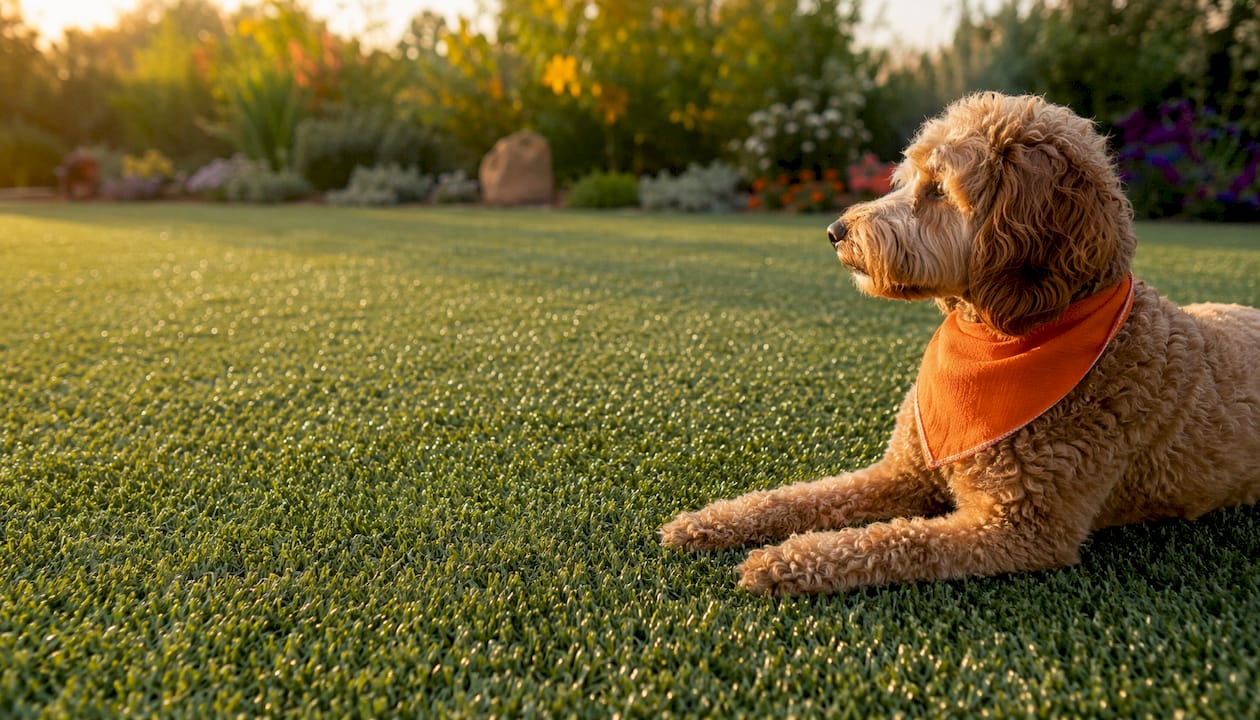
Antimicrobial acrylic-coated sand inhibits bacterial growth at the surface level, which reduces the rate at which uric acid is converted to ammonia.
For backing, look for full flow-through or permeable backing when choosing new turf. A backing with drainage holes every few centimetres allows urine to pass straight through rather than pooling on the surface.
Installer checklist for a pet-friendly installation:
-
Minimum 100mm excavation depth for the sub-base
-
MOT Type 1 crushed stone compacted as the base layer
-
Sharp sand levelling layer on top
-
Permeable weed membrane (not impermeable landscape fabric)
-
Drainage tiles or channels if the garden has a natural slope that runs toward the house
Pro Tip: Ask your installer to demonstrate drainage before they lay the turf. Pour a bucket of water on the prepared sub-base and watch how quickly it disappears. If it pools for more than 30 seconds, the base needs more work.
What should you do when cleaning keeps failing?
If the smell returns within a day or two of cleaning, work through this checklist before calling anyone.
-
Does water pool after rinsing? If yes, the problem is structural. Surface cleaning will only ever give temporary relief.
-
Does the smell return after rain? Rain reactivates uric acid crystals in the sub-base. This points to deep contamination, not a surface issue.
-
Is the smell localised or widespread? A single spot suggests one heavy-use area with compacted infill. Widespread smell usually means the drainage system has failed across the whole installation.
-
Has the infill always been plain silica sand? If so, replacing it with zeolite or antimicrobial infill is often the single most effective upgrade.
Decision flow:
-
Try a deep enzyme soak (heavy saturation, leave overnight) on the problem area.
-
If the smell returns within 48 hours, lift a small section of turf and inspect the sub-base. Wet, dark, or compacted stone indicates urine has reached the base.
-
If the base is contaminated, call an installer. Spot rebase work typically costs less than full relaying and can resolve localised problems.
If water does not flow through the backing into the sub-base, the odour source is in the base and requires excavation or base repair. No enzyme product, however good, can fix a structural drainage failure from the surface alone.
Pro Tip: Heavy saturation with a microbe-based cleaner, followed by covering the area with a dark tarp for 24–48 hours, can incubate active bacteria and help digest deep-set uric acid crystals. It is worth trying before committing to excavation.
How do you choose an enzyme cleaner for artificial grass in the UK?
Not all enzyme cleaners are equal. Use this checklist when buying:
-
Pet-safe and child-safe — no phenols, no quaternary ammonium compounds at concentrations harmful to animals
-
Non-corrosive to backing — safe for polyurethane and latex-backed turf
-
Contains uric-acid-targeting enzymes or live microbes — products that use live bacteria actually consume uric acid crystals rather than just breaking them into smaller pieces
-
Clear dilution and dwell guidance — vague instructions usually mean a weaker formulation
-
No sticky residues — residue traps dirt and makes the problem worse over time
-
Suitable for UK water temperatures — some biological products need water above 10°C to activate; check the label if you are treating in winter
Coverage calculation: A product covering 100m² at a 1:20 dilution produces approximately 5 litres of working solution per 100m². Turftails covers a significant area per bottle, which makes it cost-effective for most UK back gardens.
When not to apply: Avoid treating when frost is forecast within 12 hours, when heavy rain is expected within two hours of application, or when temperatures are below 5°C. Protect pond edges and planted borders by rinsing the perimeter with plain water after treatment.
Why Turftails works: the product in practice
Turftails is built specifically for the problem addressed in this article. It is not a general-purpose cleaner with a pet-friendly label added on.
What it does:
-
Breaks down urine compounds at the molecular level using enzyme technology
-
Contains no harsh chemicals or artificial perfumes
-
Requires no rinsing after application
-
Is safe for pets and children once dry
-
Works on artificial grass, patios, decking, concrete, kennels, and fabrics
How to use it:
Apply Turftails directly to the wet or dry surface. No dilution is required for standard use. Spray evenly across the affected area and allow it to dwell. There is no need to rinse afterwards, which makes it particularly practical for larger lawns or for owners who want a quick routine rather than a multi-step process.
| Feature | Detail |
|---|---|
| Coverage per bottle | Up to 100m² |
| Rinsing required | No |
| Safe for pets and children | Yes |
| Harsh chemicals | None |
| Surfaces covered | Artificial grass, patios, decking, concrete, kennels, fabrics |
| Formula type | Enzyme-based, eco-friendly |
The coverage claim of 100m² per bottle means most UK back gardens are covered by a single purchase.
DIY spot treatment for different patch sizes
The approach changes depending on how large the soiled area is.
Small patches (under 0.5m²): These are the easiest to treat. Rinse with a hand-held spray bottle of water, apply enzyme cleaner directly, and leave to dwell. A single treatment usually clears a fresh small patch completely.
Medium patches (0.5m²–3m²): Use a garden hose on a wide-spray setting to flush the area first. Apply enzyme cleaner with a pump sprayer for even coverage. For patches that have been building up, treat on two consecutive evenings rather than doubling the dose in one go. Two lighter treatments allow the enzymes to work progressively through the infill layers.
Large or widespread areas (over 3m²): This is where a concentrated product with high coverage matters. Apply enzyme cleaner systematically in overlapping passes. Work from the edges inward so you are not walking through the treated zone. Leave overnight if possible. A second treatment three days later consolidates the result.
For any size patch, brushing the fibres upright after the area dries improves airflow and reduces the chance of moisture being trapped at the base of the pile.
Can you train your dog to urinate less on artificial grass?
Yes, and it makes a genuine difference to how often you need to clean. Dogs are creatures of habit, and most can be redirected to a designated toilet area with consistent training.
Practical steps:
-
Choose a corner of the garden and place a small amount of your dog’s urine there initially to mark it as the toilet zone.
-
Walk your dog to that spot every time you let them out. Use a consistent cue word.
-
Reward immediately when they use the designated area. Timing matters: the reward needs to come within two seconds of the behaviour.
-
If your dog starts to squat elsewhere, calmly redirect them to the spot without punishment.
Most dogs establish a preference within two to four weeks. For multi-dog households, each dog may develop a slightly different preferred spot, so designating two or three areas is more realistic than trying to confine all dogs to one corner.
A designated toilet area also makes your cleaning routine far more efficient. Instead of treating the whole lawn, you focus enzyme treatments on one or two zones, which reduces product use and keeps the rest of the turf in better condition.
Does your dog’s diet and hydration affect urine smell?
It does, more than most owners expect. Concentrated urine smells significantly stronger than dilute urine, and the main driver of concentration is hydration.
A dog that drinks enough water produces paler, more dilute urine with lower ammonia levels. The practical implication: make sure fresh water is always available, particularly in summer. Dogs that eat dry kibble exclusively tend to drink less than those on wet food, so if your turf smell is getting worse in warmer months, checking your dog’s water intake is a sensible first step.
Diet also plays a role. High-protein diets produce urine with more nitrogen compounds, which bacteria convert to ammonia more readily. This does not mean switching your dog to a low-protein diet, but it does mean that working dogs or large breeds on high-protein feeds will generally produce stronger-smelling urine and need more frequent turf maintenance.
Some owners add a small amount of apple cider vinegar to their dog’s water, believing it reduces urine odour. The evidence for this is anecdotal. What is well established is that adequate hydration is the single most effective dietary lever for reducing urine concentration.
Seasonal maintenance for UK gardens beyond rain and frost
UK weather creates specific challenges that a generic maintenance guide does not cover.
Spring (March–May): This is the highest-risk period for odour. Winter’s accumulated uric acid crystals warm up rapidly as temperatures rise, and the smell can appear to come from nowhere. A thorough enzyme treatment in late March, before the first warm spell, prevents this. Brush the pile thoroughly after winter to restore airflow.
Summer (June–August): Afternoon heat drives ammonia off-gassing from any crystals that survived spring treatment. Increase enzyme treatment frequency to fortnightly. Water your dog more and rinse the turf in the early morning before the day heats up, which keeps the surface cooler and reduces off-gassing during peak hours.
Autumn (September–November): Falling leaves trap moisture against the turf surface and create ideal conditions for bacterial growth. Clear leaves regularly and do a full enzyme treatment in October before the cold sets in. This prevents a build-up that would otherwise sit through winter.
Winter (December–February): Bacterial activity slows in cold weather, which means enzyme cleaners are less effective below 5°C. Focus on physical removal of waste and plain water rinsing on days above freezing. Save enzyme treatments for days when temperatures are above 8°C and no frost is forecast overnight.
Key takeaways
Dog urine smell on artificial grass is almost always fixable with an enzyme cleaner and consistent rinsing, but persistent odour usually points to a drainage or infill problem that needs structural attention.
| Point | Details |
|---|---|
| Rinse immediately | Flush fresh urine through the backing with a hose before it can crystallise in the infill. |
| Use enzyme cleaners | Only enzyme or microbe-based products break down uric acid crystals; water and soap do not. |
| Match infill to pet use | Zeolite or antimicrobial-coated infill suppresses odour far more effectively than plain silica sand. |
| Turftails for ongoing control | Turftails enzyme cleaner covers up to 100m² per bottle, needs no rinsing, and is safe for pets and children. |
What installers know that most guides skip
The most common mistake I see discussed among UK turf owners is treating a structural problem with a surface solution. People buy cleaner after cleaner, apply it diligently, and the smell comes back within a week. The issue is almost never the product. It is that urine has reached the crushed-stone base, and no spray applied from above can fully saturate and neutralise what is sitting 150mm underground.
The installer diagnostic is simple and anyone can do it: pour a full bucket of water onto the suspect area and watch it for 60 seconds. If the water pools or drains slowly, the sub-base is compacted, the backing is impermeable, or the weed membrane is blocking flow. That is the conversation to have with your installer, not a request for more cleaning advice.
The other thing worth saying plainly: the cheapest artificial grass installations almost always use impermeable backing and silica sand infill because they are cheaper to source and lay. If your turf was installed at the lower end of the market and you have a dog, you are likely fighting a losing battle with surface cleaning alone. Upgrading the infill to zeolite is a relatively affordable fix that can be done without relaying the whole lawn, and it makes a substantial difference.
Turftails: the cleaner built for this exact problem
If you have read this far, you know that the right enzyme cleaner is not optional — it is the difference between a garden that smells fresh and one that defeats every cleaning attempt.
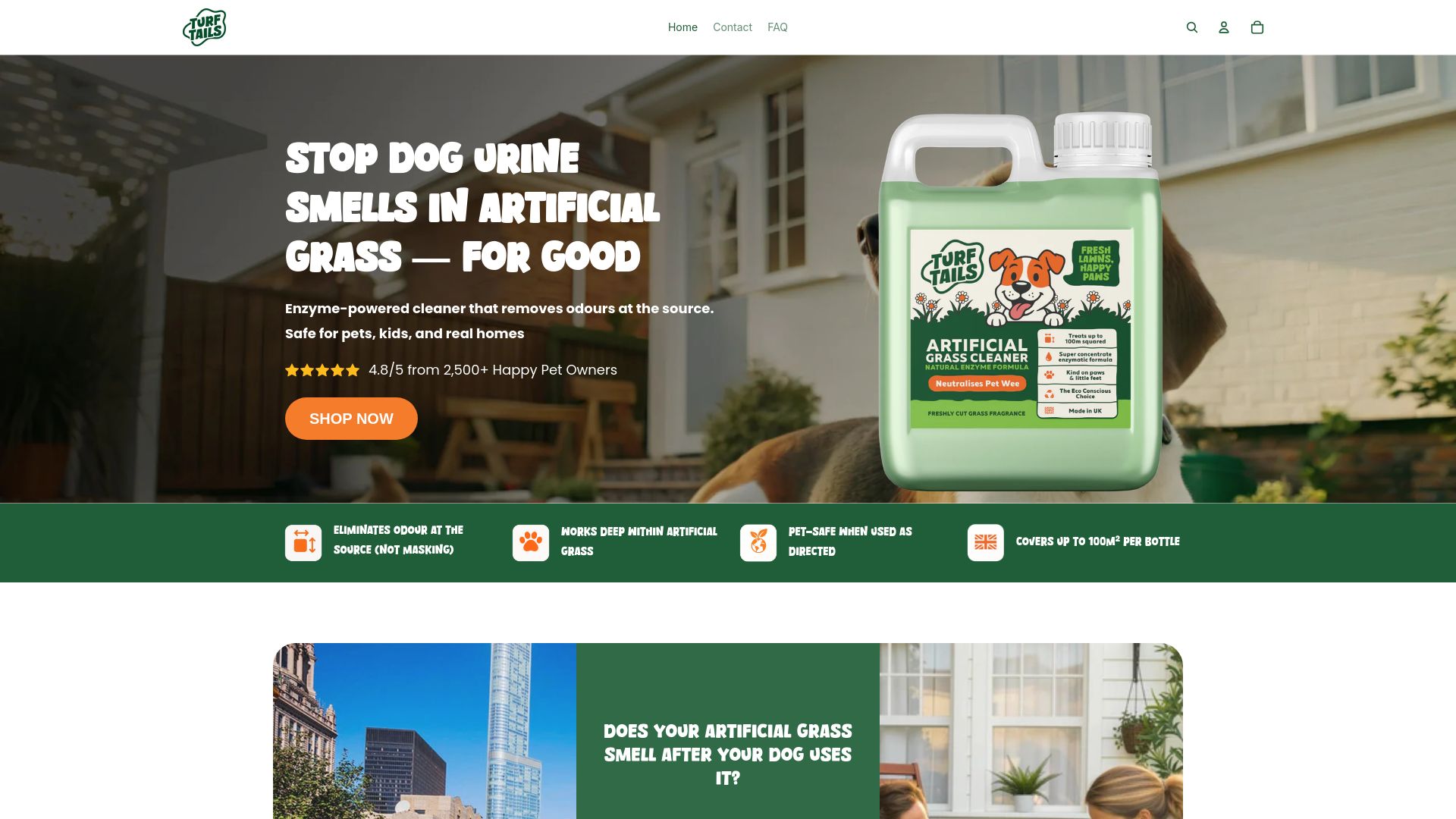
Turftails is formulated specifically for artificial grass and dog urine. One bottle covers up to 100m², works on artificial grass, patios, decking, concrete, kennels, and fabrics, and requires no rinsing after application. There are no harsh chemicals, no artificial perfumes, and it is safe for pets and children once dry. You can order as a one-time purchase or set up a subscription so you never run out before the next treatment is due.
Visit the Turftails product page to check coverage for your lawn size and place your order.