

For dog urine odour on artificial grass, Turf Tails is the recommended enzyme-based cleaner available in the UK. It breaks down urine compounds at the molecular level, requires no rinsing, and covers a large area per bottle.
- Enzymes beat surfactants. All-purpose “green” cleaners like Simple Green rely on surfactants that lift and mask residues. Enzyme cleaners digest the urine proteins and urea that cause odour at the source.
- Safe for pets and children. Turf Tails contains no harsh chemicals or artificial perfumes, making it suitable for households where dogs and children share the same turf.
- One bottle, big coverage. It suits most UK garden lawns without constant restocking.
- UK availability. Order directly from the Turf Tails website; check the product page for sizes and subscription options.
Table of Contents
- Which enzyme-based alternatives work best for artificial grass?
- Why do enzyme cleaners outperform “green” all-purpose cleaners on urine odour?
- How to choose the right enzyme cleaner for artificial grass
- How to apply an enzyme cleaner to artificial grass
- Persistent odour? How to troubleshoot and when to call a professional
- How to spot greenwashing and which safety claims actually matter
- Key takeaways
- The case for getting the formula right
- Turf Tails: formulated for the problem, not just the category
Which enzyme-based alternatives work best for artificial grass?
The table below covers the main options available to UK buyers. Turf Tails leads as the recommended product; the remaining entries are product categories or widely available brands worth knowing.
| Product | Best for | Formulation | Pet & child safe | Artificial grass | Rinse required | Coverage | Scent | UK availability |
|---|---|---|---|---|---|---|---|---|
| Turf Tails | Regular maintenance and dedicated turf care | Enzyme concentrate | Yes | Yes | No | large coverage | Fragrance-free | Direct online |
| Ready-to-use enzyme spray | Light spot treatment and frequent small-area cleaning | Ready-to-use | Usually yes | Yes | Varies | Low (spot only) | Often fragrance | Supermarkets, Amazon UK |
| Enzyme concentrate (heavy odour) | Large areas or longstanding odour problems | Concentrate | Check label | Yes | Varies | High when diluted | Varies | Online, trade suppliers |
| Bio-enzymatic granules / infill treatment | Infill-saturated odour where liquids struggle to penetrate | Granular / powder | Check label | Yes | No | Varies | Minimal | Specialist turf retailers |
| Urine-Off | General pet urine on multiple surfaces | Ready-to-use | Yes | Yes | Minimal | Moderate | Low | Amazon UK, pet retailers |
| Nature’s Miracle | Broad pet stain and odour removal | Ready-to-use | Yes | Yes | Minimal | Moderate | Light | Amazon UK, Pets at Home |
| Rocco & Roxie Professional Strength | Heavy staining and strong odour on multiple surfaces | Ready-to-use | Yes | Yes | Minimal | Moderate | Light | Amazon UK, pet retailers |
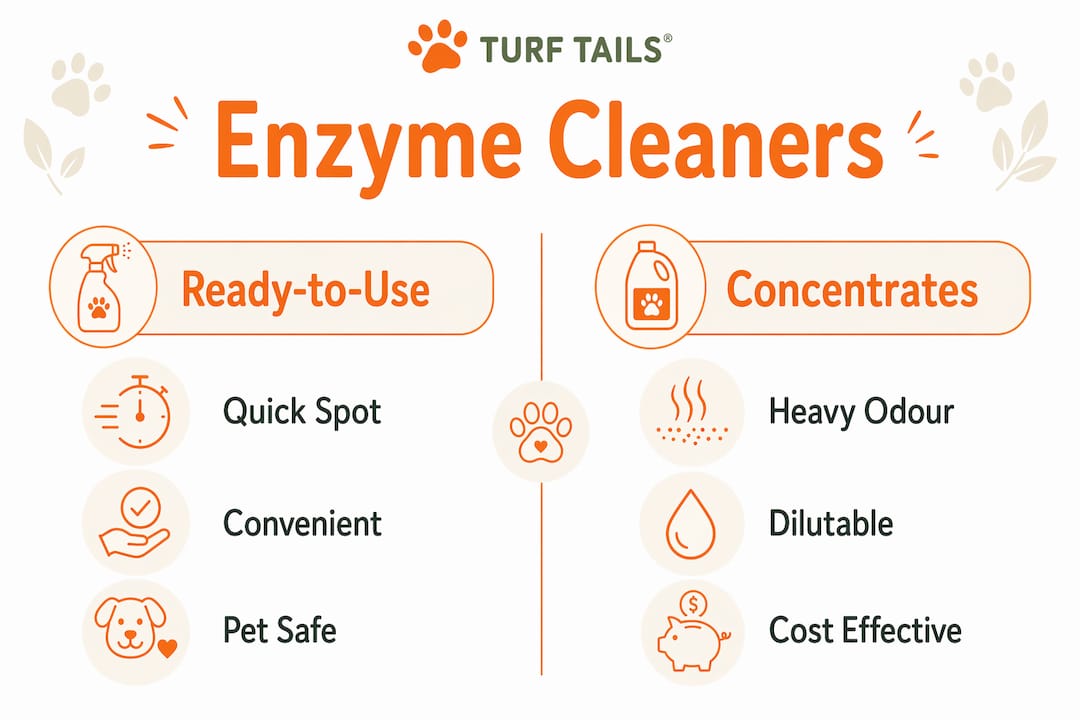
Turf Tails is the only option in this list formulated specifically for artificial grass. Its concentrated enzyme formula means you apply it diluted across a large area rather than burning through a ready-to-use bottle on a single hot spot.
Ready-to-use enzyme sprays (including Urine-Off, Nature’s Miracle, and Rocco & Roxie) are convenient for quick spot treatments and work well on hard floors, carpets, and patios. On artificial grass, though, they tend to cover a smaller area per bottle and may not penetrate the infill layer where urine accumulates over time.
Enzyme concentrates for heavy odour offer better value per square metre when diluted correctly. Worth considering for larger lawns or older, deeply embedded smells, but check that the label explicitly states suitability for artificial turf and lists the enzyme types.
Bio-enzymatic granules target infill saturation directly. They are a useful complement to liquid treatments but often require professional application for consistent results.
Pro Tip: Check UK retailers and the Turf Tails product page for current sizes and subscription options before buying a ready-to-use spray in bulk.
Why do enzyme cleaners outperform “green” all-purpose cleaners on urine odour?
All-purpose “green” cleaners are surfactant-focused. Surfactants break surface tension and lift dirt into water, which works brilliantly on grease and general grime. Dog urine is a different problem entirely.
Urine contains urea, uric acid, proteins, and ammonia precursors. When urea breaks down, it releases ammonia — that sharp, eye-watering smell. Surfactants can dilute and shift the surface residue, but they do not digest the underlying compounds. The smell returns as soon as the turf dries.
Enzyme cleaners work differently:
- Proteases break down the protein fraction of urine.
- Ureases target urea directly, stopping ammonia formation at the source.
- The enzyme action sequence: enzymes bind to urine molecules, catalyse their breakdown into smaller, odourless compounds, and those compounds either evaporate or rinse away harmlessly.
- Dwell time is critical. Enzymes need time to complete this reaction. Rinsing or wiping too soon removes the enzymes before they finish working.
On artificial grass, urine migrates into the infill and backing. Surface cleaning alone rarely reaches it. A properly formulated enzyme cleaner for artificial surfaces must penetrate the infill layer and be left long enough to act on trapped residues.
Homemade alternatives — vinegar, bicarbonate of soda — are useful for general cleaning but do not replicate enzyme action. They neutralise surface pH temporarily without digesting the biological compounds that cause persistent odour.
92% of homeowners express interest in sustainable cleaning solutions, yet most general “eco” products on shelves are surfactant-based, not enzyme-based. The gap between “green” and “bio-enzymatic” is where persistent pet odour lives.
How to choose the right enzyme cleaner for artificial grass
Choose a product labelled explicitly as bio-enzymatic that lists its enzyme types and states a dwell time. “Natural” and “eco” alone tell you nothing about whether the formula will actually digest urine.
Checklist before you buy:
- Lists specific enzyme types (protease, urease, or both)
- States a recommended dwell time on the label
- Full ingredient list published — no vague “fragrance” entry hiding actives
- Explicit pet and child safety statement
- Confirmed suitable for artificial turf (not just carpet or hard floors)
- Coverage per bottle stated clearly
- Environmental certification where available (e.g. EWG Verified®, EPA Safer Choice equivalent)
Red flags:
- “Eco” or “natural” with no certification and no ingredient list
- “Fragrance” listed without disclosure of what it contains
- No usage instructions specific to artificial grass
- No dwell time guidance at all
Commercial green cleaning products span many surface types; a floor cleaner and a turf cleaner are not interchangeable. Before purchasing, confirm UK retailer availability, check whether the brand offers a returns policy, and look for subscription options if you treat regularly.
How to apply an enzyme cleaner to artificial grass
The single most important rule: observe the dwell time and do not rinse the enzymes off too soon.
- Remove solids. Pick up any waste and dispose of it before applying cleaner.
- Pre-rinse if heavily soiled. A brief rinse with plain water removes excess surface residue so the enzyme formula can reach the infill.
- Dilute if concentrated. Follow the product’s dilution ratio precisely — too dilute reduces enzyme concentration; too strong wastes product.
- Apply evenly. Use a garden sprayer or watering can on a low-pressure setting. Cover the affected area thoroughly, including the surrounding turf where urine may have spread.
- Allow full dwell time. Do not rush this step.
- Light agitation (if specified). Some products benefit from a gentle brush-in to help the formula reach the infill. Check the label.
- Rinse or leave. Turf Tails requires no rinsing. For other products, follow the label — rinse only once the stated dwell time has elapsed.
| Odour severity | Typical dwell time | Repeat interval |
|---|---|---|
| Light / recent | — | Weekly as needed |
| Moderate | — | Every 3–5 days |
| Heavy / longstanding | — | Daily for 3–5 days, then reassess |
Pro Tip: Apply in the evening when the turf is cooler. Heat accelerates evaporation and can dry the enzyme formula before it finishes acting.
Persistent odour? How to troubleshoot and when to call a professional
Repeat enzyme treatments and a thorough deep-clean before considering infill replacement. If the smell persists after multiple correct applications, escalate.
Diagnostic checklist:
- Is the smell concentrated in one hot spot or spread across the whole lawn? A hot spot usually means a single high-use area; diffuse odour suggests infill saturation throughout.
- Does the smell return within hours of treatment? That points to deep infill contamination the liquid is not reaching.
- Is there visible staining or discolouration? Older deposits are harder to shift and may need multiple treatments.
- Does water pool rather than drain? Poor drainage traps urine and limits enzyme penetration — a professional turf assessment may be needed.
Escalation steps:
- Repeat treatment correctly — confirm dilution ratio, dwell time, and coverage before assuming the product has failed.
- Professional deep-clean. Specialist turf cleaners use pressure-assisted enzyme application to force the formula into the infill. Costs vary; get quotes from local turf maintenance companies.
- Infill replacement. If the infill is saturated beyond recovery, replacement is the only lasting fix. Costs and timescales vary depending on turf size and infill type; a specialist installer can advise.
How to spot greenwashing and which safety claims actually matter
Look for verified ecolabels and a full ingredient list. “Safer” does not mean “specialised,” and a product that is safe for general household use may still be unsuitable around animals or on artificial turf.
Verification checklist:
- EPA Safer Choice or EWG Verified® — the EPA’s Safer Choice label and EWG’s verification programme both require ingredient transparency and safety screening. These are the most credible third-party signals available to UK buyers.
- Full ingredient list — if a brand will not publish its full formula, that is a reason to look elsewhere.
- Explicit pet-safety statement — “non-toxic” is not the same as “safe for animals to walk on after application.”
- Published dwell time — a product without usage instructions for artificial turf has not been tested on it.
- Veterinary or laboratory endorsement — where available, these add meaningful credibility.
“Ecolabels and ‘Safer’ branding indicate ingredient safety and biodegradability but do not guarantee performance on specialised biological waste like dog urine. Look for explicit ‘bio-enzymatic’ labelling.” — EPA guidance on greener cleaning products
Community experiences with degreasers confirm that some formulas cause skin irritation. Wear gloves when applying any enzyme cleaner, store products out of reach of children, and keep pets off the treated turf until the recommended residence time has elapsed.
Key takeaways
Enzyme-based cleaners formulated specifically for artificial grass outperform all-purpose “green” products because they digest urine compounds rather than masking them.
| Point | Details |
|---|---|
| Enzymes vs surfactants | All-purpose green cleaners mask odour; enzyme cleaners digest urine proteins and urea at the source. |
| Dwell time is non-negotiable | Rinsing or wiping too soon removes enzymes before they finish working — always observe the stated dwell time. |
| Check the label carefully | Look for named enzyme types (protease, urease), a full ingredient list, and explicit artificial grass suitability. |
| Escalate persistent odour | If smell returns after multiple correct treatments, consider professional deep-cleaning or infill replacement. |
| Turf Tails for UK gardens | Turf Tails covers a large area, requires no rinsing, and is formulated specifically for artificial grass pet odour. |
The case for getting the formula right
Most pet owners I speak with have already tried a general “eco” cleaner before they find an enzyme product. The frustration is understandable: the label says “natural,” the smell disappears for a day, and then the turf bakes in the sun and the odour comes back stronger than before. That is not a cleaning failure — it is a formulation mismatch.
What strikes me about the artificial grass problem specifically is how the structure of the surface works against you. Infill traps urine in a way that carpet and hard floors simply do not. A surfactant can shift what is sitting on the fibres; it cannot reach what has settled into the crumb rubber or sand beneath. Enzyme cleaners are not a premium upgrade — for this surface and this problem, they are the correct tool.
The greenwashing issue compounds this. A product can carry an ecolabel, list plant-derived surfactants, and still do nothing useful for dog urine odour. “Safer” and “bio-enzymatic” are different claims. The former tells you about ingredient toxicity; the latter tells you whether the product will actually work. Both matter, but only one solves the smell.
Turf Tails: formulated for the problem, not just the category
Every enzyme cleaner on this list will outperform a surfactant-based “green” spray on dog urine. But most of them were designed for carpets, hard floors, or general pet surfaces — artificial grass was an afterthought, if it featured at all.
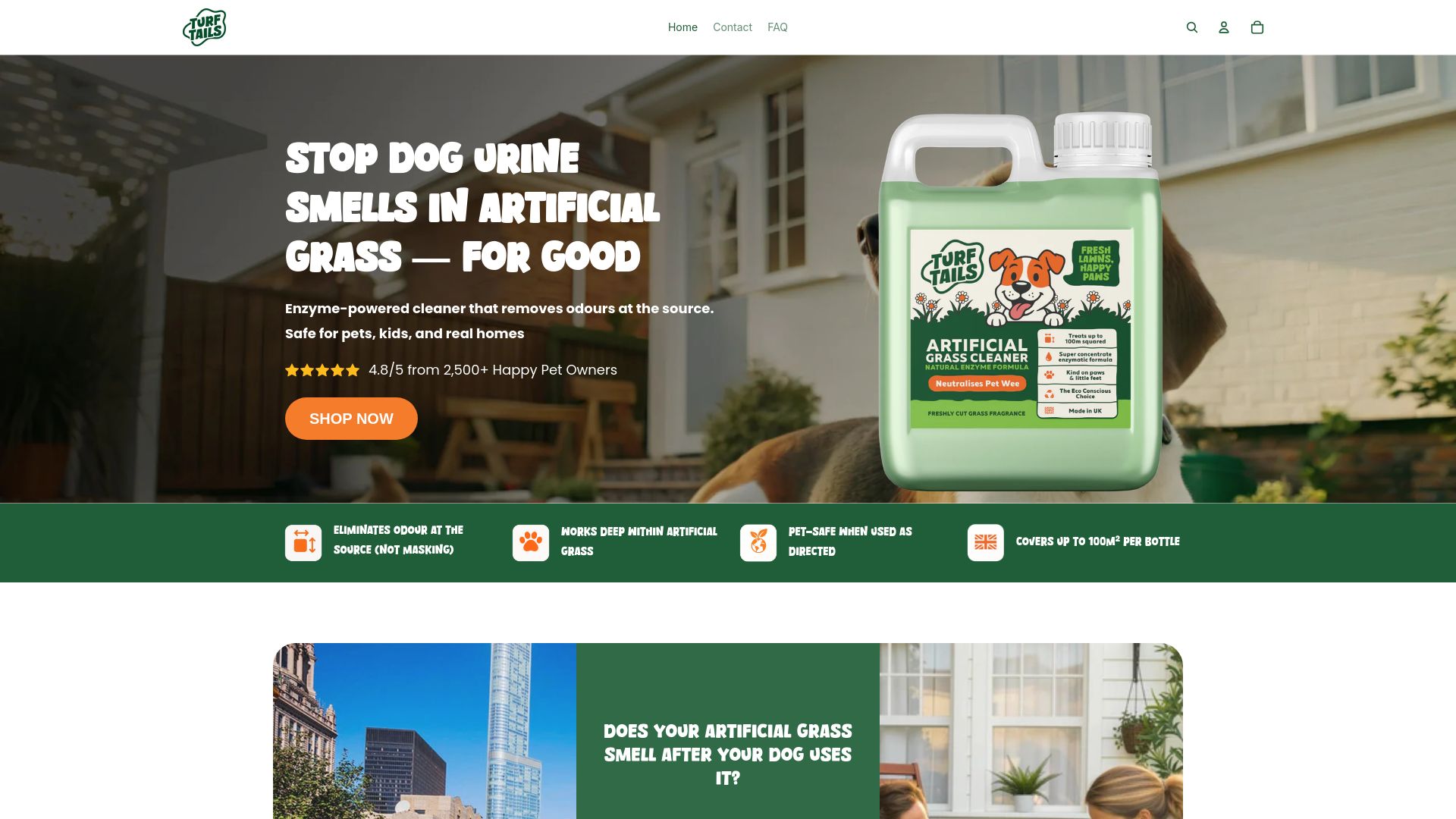
Turf Tails was built specifically for artificial grass. The concentrated enzyme formula penetrates infill, requires no rinsing, and covers a large area per bottle — so a single order treats a full-sized garden lawn multiple times. No harsh chemicals, no artificial perfumes, and safe for pets and children to return to once applied.
Check sizes, usage instructions, and subscription options on the Turf Tails product page and order directly from turftails.co.uk.
Useful sources and further reading
- EPA: Identifying greener cleaning products — guidance on Safer Choice, DfE labels, and greenwashing.
- EWG’s Guide to Healthy Cleaning — independent ingredient ratings and EWG Verified® product database.
- Service Autopilot: eco-friendly commercial cleaning products — industry overview of green cleaning categories and formulation differences.
- UAEX: Clean and green homemade cleaners — context on DIY cleaning recipes and their limitations for biological waste.
- Turf Tails artificial grass cleaner page — product coverage claims, usage instructions, and purchase options.
- Artificial Grass Installers: turf installation and maintenance — professional guidance on drainage, infill, and when to seek specialist help.
Always consult product labels and manufacturer instructions for product-specific dilution ratios, dwell times, and safety guidance.