

For most UK pet owners, the short answer is no. Pressure washing artificial grass to remove dog urine odour usually makes the problem worse, not better. High-pressure jets push urine salts and bacteria deeper into the infill and drainage base, where they become far harder to shift. The exception is a no-infill installation laid on a solid concrete base, where a low-pressure rinse (staying under 1,500 psi with a wide fan tip, lance held at least 30 cm from the surface) is sometimes acceptable. For everything else, a garden hose plus a pet-safe enzyme cleaner like Turftails is the faster, safer route.
When a low-pressure rinse is acceptable:
- No infill present (no silica sand, rubber crumb, or Envirofill)
- Turf laid directly on a hard base such as concrete
- No visible seams, joins, or repair patches nearby
- Odour is surface-level, not persistent after previous cleaning
Immediate steps after a fresh urine event:
- Remove any solids straight away
- Blot excess liquid with an old towel if the area is heavily saturated
- Rinse gently with a garden hose to dilute and disperse
- Apply an enzyme cleaner and allow it to dwell before the next use
Pro Tip: An enzyme cleaner breaks down the uric acid crystals that cause odour at a molecular level. Water alone, even under pressure, cannot do that.
Table of Contents
- Why pressure washing can damage your artificial grass
- How to spot-clean dog urine safely, step by step
- When does your turf need a deeper clean?
- How to choose a pet-safe cleaning product for artificial turf
- A practical maintenance schedule for UK pet owners
- Troubleshooting persistent odours and drainage problems
- Key takeaways
- The case for doing less, not more
- Turftails: the no-rinse enzyme cleaner built for dog owners
- Useful sources and further reading
Why pressure washing can damage your artificial grass
High pressure is the enemy of synthetic turf longevity, and the damage is not always visible straight away. A pressure washer can displace infill granules, flatten the pile, and lift seams, all of which shorten the life of your lawn. Manufacturers routinely warn that warranties may be voided by jet-washing damage.
The microbiology makes things worse. Urine salts and bacteria settle into the infill layer beneath the fibres, not just on the surface. Blasting the surface with a pressure washer does not reach that layer cleanly. Instead, it can force contaminated debris deeper into the drainage base, where it dries out and re-releases odour every time the turf warms up.
“A pressure washer can make the lawn look cleaner on the surface, but it does not always deal with the real problem. If odours, bacteria or compacted debris are sitting deeper in the pile or base, brushing and the right cleaning product usually matter more than pressure.” — Asgoodasgrass
Situations where pressure washing is particularly risky:
- Turf with sand or rubber infill
- Installations on a softer build-up over soil or sand
- Lawns with visible seams, edge details, or repair patches
- Lighter domestic-grade products
- Any area used regularly as a pet toilet
Safe parameters if you do use a jet washer on a hard-base, no-infill lawn:
- Wide fan tip (25–40°), never a turbo or pinpoint nozzle
- Pressure kept below 1,500 psi
- Lance angled low, not directed straight down
- Lance held at least 30 cm from the surface at all times
- Test a discreet patch first
How to spot-clean dog urine safely, step by step
Spot cleaning is where most of the real work happens, and it takes less time than you might expect.
What you need:
- Garden hose with a gentle spray setting
- Soft-bristle synthetic brush (never metal)
- Enzyme cleaner such as Turftails
- Disposable gloves
For a single fresh urine spot:
- Remove any solids immediately.
- Rinse the area with a gentle hose spray to dilute the urine.
- Apply your enzyme cleaner directly to the affected area.
- Allow it to dwell for the time stated on the product (typically 5–10 minutes).
- Work the cleaner gently into the pile with a soft brush.
- Rinse if the product instructions require it. Turftails requires no rinsing.
- Leave to air dry before pets return.
For a high-use pet toilet zone:
- Clear any debris and rinse the whole zone with a hose.
- Apply enzyme cleaner generously across the entire area, not just visible wet patches.
- Allow a longer dwell time (10–15 minutes) to reach the infill layer.
- Brush the pile against the grain to lift fibres and work the product in.
- Rinse if required, then allow to dry fully.
Pro Tip: For spots your dog returns to repeatedly, apply enzyme cleaner twice in the same session. The first application breaks down the surface layer; the second reaches the residue in the infill.
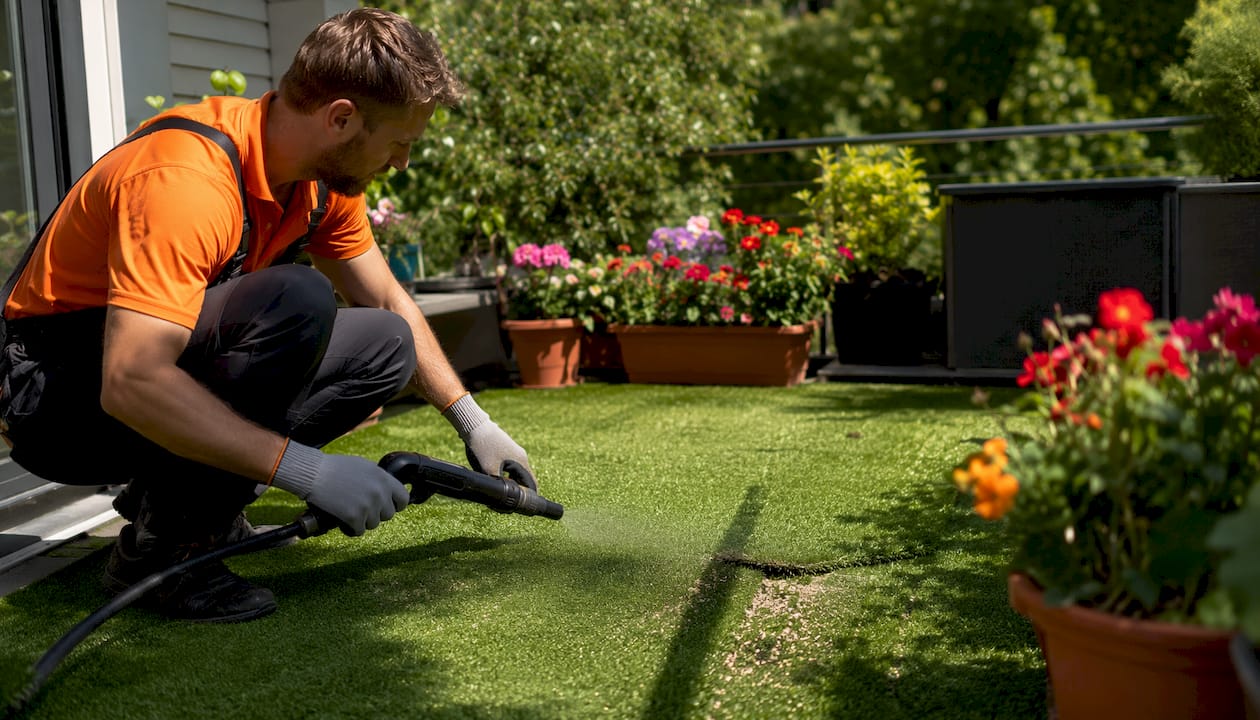
Turf-care guides consistently recommend a garden hose and a stiff synthetic-bristle broom as the core tools for everyday pet use. Metal brushes and rotating patio heads are off the list entirely.
When does your turf need a deeper clean?
Spot cleaning handles most situations, but some signs tell you the problem has gone beyond the surface.
Signs you need a deeper intervention:
- Persistent odour after repeated spot cleaning
- Smell that intensifies after rain or warm weather
- Visible infill compaction or flat, matted pile
- Water pooling on the surface rather than draining through
- Odour concentrated in one corner or zone despite regular treatment
When those signs appear, the cause is usually infill colonisation or a drainage problem rather than surface contamination. A non-pressure deep clean combines enzyme saturation, mechanical brushing, and suction or extraction to remove contaminants without displacing infill or lifting seams.
Questions to ask any professional cleaner:
- Do you use enzyme treatments, or just water and pressure?
- How do you protect seams and infill during the clean?
- What happens if drainage is the root cause?
- Do you offer any guarantee on odour removal?
If drainage has genuinely failed or seams have lifted repeatedly, cleaning alone will not fix it. At that point, partial or full replacement is the honest answer, and repeated pressure washing will have accelerated that outcome.
How to choose a pet-safe cleaning product for artificial turf
Not every cleaner marketed for artificial grass is safe for pets or effective on urine odour. The product attributes that actually matter are straightforward.
What to look for:
- Enzyme-based formula (breaks down uric acid, not just masks it)
- Certified pet- and child-safe ingredients
- Biodegradable, no harsh bleaches or ammonia
- No artificial perfumes that simply cover the smell
- Clear coverage guidance (e.g. up to 100 m² per bottle)
- Stated dwell time and rinsing requirements
Red flags to avoid:
- Bleach or ammonia (discolours fibres and breaks down backing)
- Solvent-based cleaners or strong degreasers
- Products with no stated safety data for pets
- Rotating patio cleaner heads or aggressive scrubber attachments
Enzyme cleaners break down odour-causing molecules at source rather than masking them. For pet urine on artificial grass, that distinction is what separates a product that works from one that just smells nice for a day.
Turftails ticks every box on that list. It is concentrated, covers a generous area suitable for most residential lawns, requires no rinsing, and contains no harsh chemicals or artificial perfumes. For a busy household with dogs, that means less time cleaning and no worry about pets going back onto the grass too soon.
A practical maintenance schedule for UK pet owners
Consistent, light-touch maintenance prevents the build-up that leads to expensive deep cleans. Here is a realistic timetable.
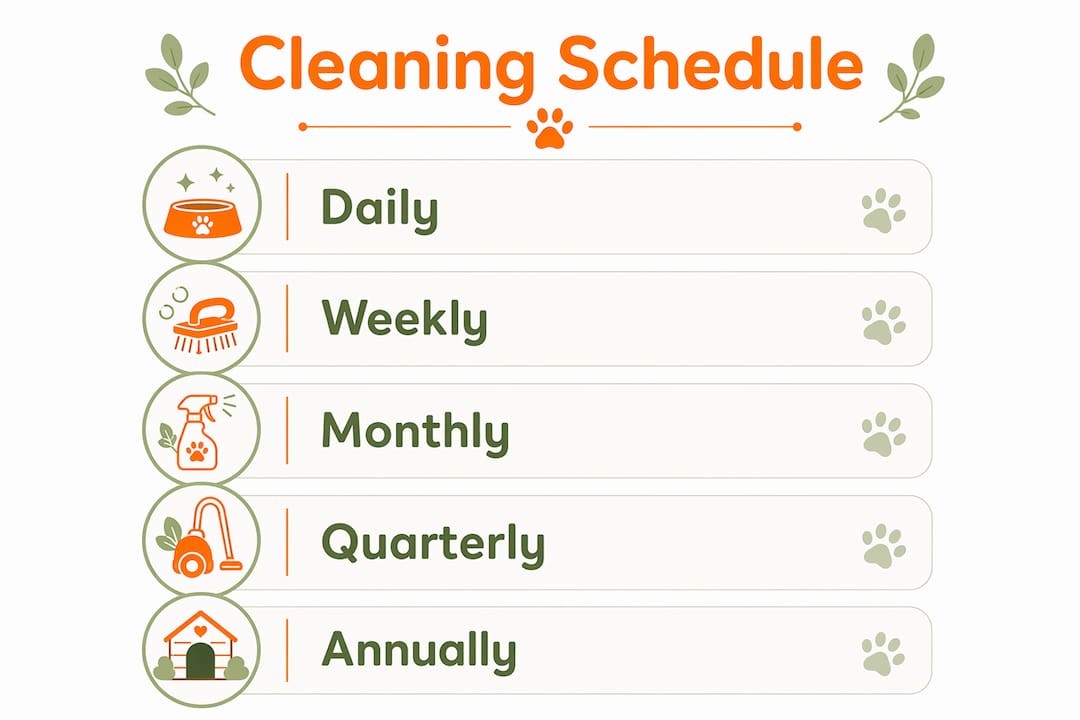
| Task | Frequency | Time needed |
|---|---|---|
| Pick up solids, quick hose rinse of pet zones | Daily / after use | 2–5 minutes |
| Brush high-traffic areas, hose rinse, inspect seams | Weekly | 15–30 minutes |
| Enzyme treatment of pet zones | Monthly | 20–30 minutes |
| Infill check, redistribution, drainage test | Every 6 months | 30 minutes |
| Professional inspection or mechanical grooming | Annual | Varies by provider |
Weekly rinsing reduces bacteria and dust build-up; monthly enzyme treatments keep the turf sanitary and safe for pets and children. Annual mechanical grooming with a power broom can decompact infill and restore pile, reducing odour traps before they become a problem.
For heavy pet use, the cost of a monthly enzyme treatment is modest compared to the cost of professional remediation or early replacement.
Troubleshooting persistent odours and drainage problems
If odour keeps returning despite regular cleaning, work through this checklist before calling a professional.
Diagnostic checklist:
- Does the smell appear after rain? (Suggests infill colonisation.)
- Is it worse when the turf is dry and warm? (Concentrated urine salts in the base.)
- Is water pooling on the surface? (Drainage blockage.)
- Is the pile flat or infill visibly displaced? (Compaction reducing drainage.)
Steps to try first:
- Apply enzyme cleaner generously and allow a longer dwell time than usual (15–20 minutes).
- Brush the pile firmly against the grain to redistribute infill and lift fibres.
- Pour a bucket of water slowly onto the problem area and watch whether it drains within 30 seconds. If it does not, drainage is compromised.
- If drainage is the issue, redistribute infill manually with a stiff brush and retest.
- If the problem persists, consult a professional who uses suction or extraction methods rather than pressure.
Pro Tip: If the smell returns within a week of enzyme treatment, the bacteria have colonised the infill layer, not just the surface. At that point, infill replacement or a professional extraction clean is more cost-effective than repeated surface applications.
When seams have lifted, the base is chronically waterlogged, or odour has persisted for more than a season despite proper treatment, replacement of the affected section is often the most practical outcome. Repeated pressure washing accelerates all three of those failure modes.
Key takeaways
Avoiding pressure washing and using an enzyme cleaner on a consistent weekly and monthly schedule is the most reliable way to keep artificial grass odour-free and structurally sound.
| Point | Details |
|---|---|
| Avoid high-pressure washing | Pressure displaces infill, lifts seams, and pushes urine deeper into the base. |
| Low-pressure only on hard-base, no-infill turf | Stay below 1,500 psi, use a wide fan tip, and keep the lance at least 30 cm away. |
| Enzyme cleaners outperform water alone | They break down uric acid at the molecular level; water cannot do this regardless of pressure. |
| Weekly and monthly routine prevents deep problems | A 15-minute weekly rinse and brush plus monthly enzyme treatment stops odour build-up before it starts. |
| Turftails for routine use | Covers up to 100 m², requires no rinsing, and is safe for pets and children to return to immediately. |
The case for doing less, not more
The instinct to reach for the most powerful tool available is understandable. A jet washer feels decisive. But with artificial grass and pet urine, force is almost always the wrong answer. The smell is not on the surface. It is in the infill, in the base, in the microscopic crystalline residue that uric acid leaves behind when it dries. Water pressure cannot dissolve that. Enzymes can.
What turf-care specialists agree on, and what the evidence consistently supports, is that gentle, regular maintenance preserves both the appearance and the structure of synthetic turf far better than periodic aggressive cleaning. A lawn that is brushed weekly, rinsed lightly, and treated monthly with a proper enzyme product will outlast one that is jet-washed quarterly and neglected in between.
The other thing worth saying plainly: warranties matter. Manufacturers and installers are explicit that pressure damage is not covered. One overzealous cleaning session can void the protection on a lawn that cost several thousand pounds to install.
Turftails: the no-rinse enzyme cleaner built for dog owners
If you have got dogs and artificial grass, the cleaning routine described in this article works best with a product that is actually designed for it. Turftails is an enzyme-based cleaner that breaks down dog urine at the molecular level, targeting the uric acid crystals that cause persistent odour rather than masking them with fragrance.
One bottle covers up to 100 m², the formula is concentrated, and it requires no rinsing after application. That means pets can return to the garden straight away. No harsh chemicals, no artificial perfumes, and safe for children too. It works on artificial grass, patios, decking, concrete, kennels, and fabrics, so one bottle handles more than just the lawn.
Available as a one-off purchase or on subscription for households that want to stay on top of their monthly routine without reordering. Order Turftails and see the difference a proper enzyme cleaner makes.
Useful sources and further reading
The following sources informed the guidance in this article, particularly the PSI safety parameters, enzyme effectiveness, and maintenance frequency recommendations.
- Can you pressure wash artificial grass? — Asgoodasgrass — PSI guidance, infill risk, and warranty warnings
- Is artificial turf pressure washing safe? — IntegraTurf — Safe technique parameters (fan tip, distance, pressure range)
- How to deep clean your artificial turf — Purchase Green — Maintenance frequency, enzyme treatment, and deep-clean methods
- Artificial turf maintenance: DIY tips — RealTurf — Tool guidance, brushing technique, and mechanical grooming
- Artificial lawn maintenance guide — Sod Green — Infill redistribution and drainage maintenance
- Maintenance: Synthetic Turf — Safe Healthy Playing Fields — Broader maintenance standards including infill depth and grooming schedules
- Turftails enzyme cleaner — product page — Coverage specs, usage instructions, and purchase options