

Turftails is the cleaner to reach for if you have artificial grass and a dog: it’s an enzyme-powered formula that breaks down urine compounds at the molecular level rather than masking them with fragrance. One concentrated bottle covers up to 100 m², contains no harsh chemicals or artificial perfumes, and is safe for pets and children. No rinsing required.
Table of Contents
- How do enzyme cleaners actually remove dog urine odour?
- Is it safe for your pets and children?
- How to apply it: artificial grass, patios, decking and kennels
- Coverage, cost and how often to reapply
- What to check on labels and where to buy in the UK
- What users report after switching to Turftails
- Key takeaways
- Why the “pet safe” label deserves more scrutiny
- Turftails: the enzyme cleaner built for artificial grass
- Useful sources
How do enzyme cleaners actually remove dog urine odour?
Standard detergents lift surface grime. Bleach kills bacteria. Fragrances cover smells. None of them solve the real problem: uric acid crystals that bind to surfaces and reactivate every time moisture hits them. That’s why a patio can smell fine after a scrub and then reek the moment it rains.
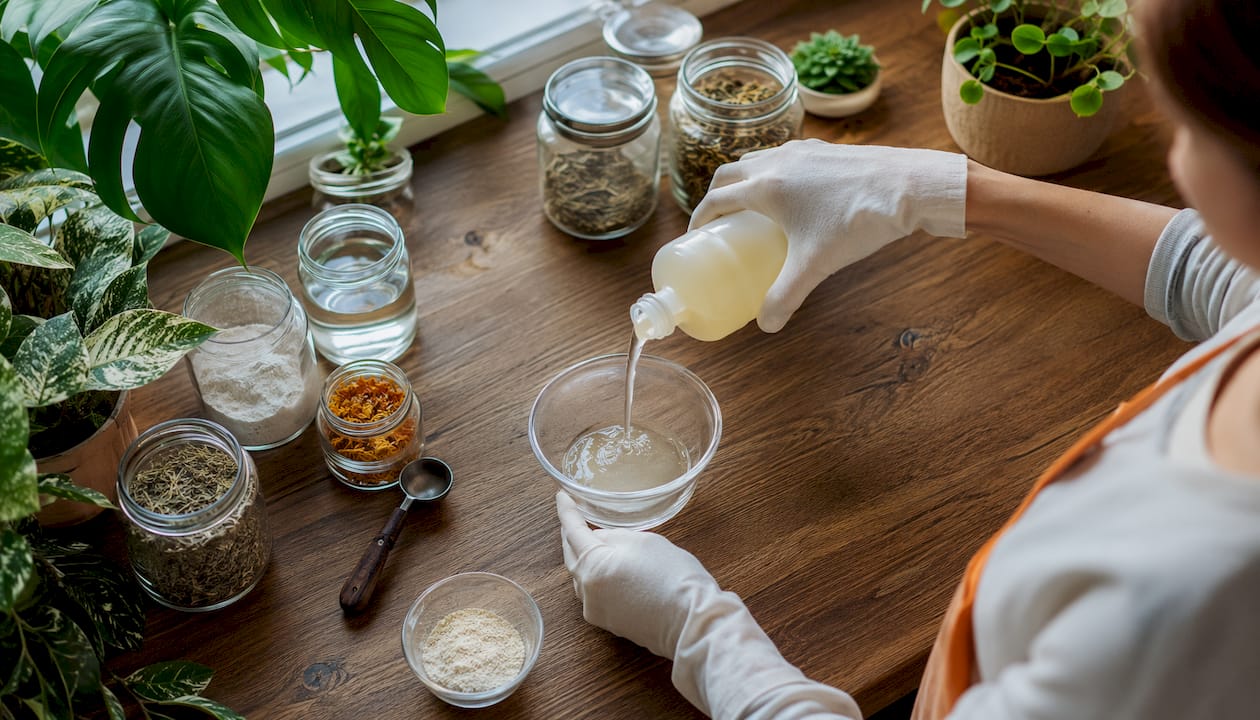
Enzyme cleaners work differently. The active enzymes — proteases, ureases and lipases — break urea, uric acid and other urine compounds into odourless, water-soluble molecules that simply evaporate or rinse away. The odour source is gone, not hidden.
Uric acid is the stubborn one. It’s insoluble in water, which is why hosing down artificial grass rarely works long-term. Enzymes are one of the few things that actually degrade it. They also leave no caustic residue, which matters on artificial turf where fibres can degrade under repeated bleach exposure.
Pro Tip: Dilution and contact time are everything. Too much water and you reduce enzyme concentration; too little dwell time and the reaction doesn’t complete. Follow the product’s dilution guide precisely, and give the treated area at least 10–15 minutes before foot traffic.
Is it safe for your pets and children?
The short answer: look for “enzyme-based,” “no harsh chemicals,” “no artificial perfumes,” and an explicit pet-and-child safety claim on the label. Those four things together tell you what you need to know.
Ingredients to avoid include bleach, ammonia, quaternary ammonium compounds (QACs), strong acids, and petroleum solvents. QACs in particular are common in disinfectant sprays and can irritate paws and airways. Products carrying EU Ecolabel certification are independently verified as low-hazard, which is a useful shortcut when you’re scanning labels quickly.
Some patio cleaners marketed as biodegradable and plant-friendly avoid biocides entirely, which reduces risk to pets and garden wildlife. Others, like Pro-Kleen’s Simply Spray, are labelled safe for children and pets once the treated surface is completely dry.
Turftails is enzyme-powered, eco-friendly, and free from harsh chemicals or artificial perfumes. It requires no rinsing, which removes one of the main risk windows: residue left on the surface after incomplete rinsing. Keep pets off a freshly treated area until it’s dry, and store any concentrated solution out of reach of animals and children.
Caution: Never apply a concentrated enzyme solution directly without diluting as instructed. Very young animals or puppies should be kept away from treated areas until fully dry.
How to apply it: artificial grass, patios, decking and kennels
Artificial grass
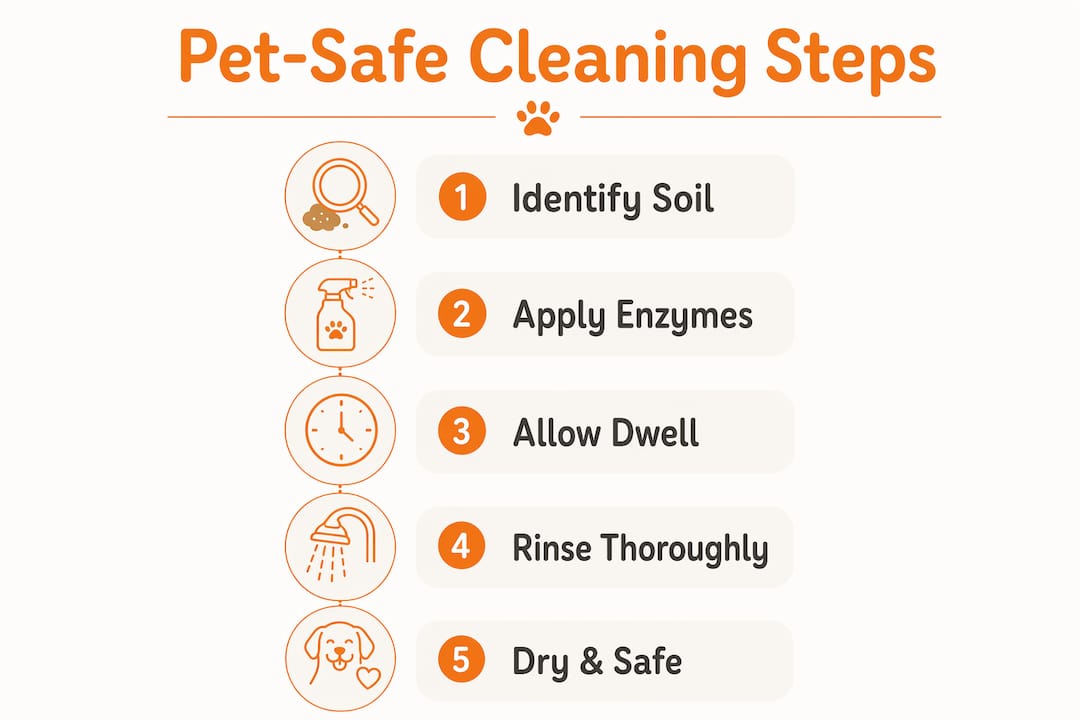
- Remove any solid waste and blot excess liquid with an absorbent cloth.
- Dilute the Turftails concentrate as directed on the label.
- Apply generously to the affected area, working the solution into the grass fibres so it reaches the backing layer where uric acid accumulates.
- Leave for a minimum of 10–15 minutes (longer for older or heavy staining).
- Allow to air dry. No rinsing needed.
Patios, decking and concrete
- Sweep away loose debris.
- Apply the diluted solution evenly across the surface, starting from one edge.
- For ingrained staining, agitate gently with a stiff brush after applying.
- Leave to dwell for 15–30 minutes.
- Rinse with clean water or leave to dry depending on the surface and product instructions.
Kennels and fabrics
- Remove bedding and rinse the kennel floor.
- Apply diluted solution, saturating the surface.
- Allow full dwell time, then wipe down or hose off.
Pro Tip: For outdoor spaces used by families and pets, a regular maintenance routine keeps odours from building up. Practical guides on maintaining outdoor spaces for families offer useful ideas on scheduling seasonal cleans alongside spot treatments.
| Incident type | Recommended frequency |
|---|---|
| Single urination event | Treat immediately; one application usually sufficient |
| Weekly maintenance | Apply once per week during heavy-use periods |
| Chronic/daily use | Treat every 2–3 days; reassess after two weeks |
Coverage, cost and how often to reapply
Turftails covers up to 100 m² per concentrated bottle. That’s a meaningful amount: a typical UK back garden with artificial grass is moderate in size, so one bottle handles multiple full treatments of the whole area.
| Patio/turf size | Bottles needed (single treatment) | Estimated treatments per bottle |
|---|---|---|
| Up to 100 m² (typical small or medium) | 1 | Up to 5 (with lighter use or spot treatments); 2–3 for full treatments |
| Larger or heavily used areas | 1+ | 1 or fewer (if applying more heavily or more frequently) |
For a rough cost-per-treatment calculation: divide the bottle price by the number of treatments your area allows. For a 30 m² garden, one bottle gives you multiple full treatments, so the per-treatment cost is a third of the bottle price.
Frequency depends on your dog’s habits. A single dog using a 30 m² lawn once or twice daily will need weekly maintenance applications during summer and fortnightly in winter. Multiple dogs or a small area shifts that to every few days.
- Single incident: treat immediately and once is usually enough.
- Regular maintenance: weekly during peak use (spring and summer).
- Heavy use: every 2–3 days; consider a subscription to avoid running out.
What to check on labels and where to buy in the UK
Before buying any pet-safe patio or artificial grass cleaner, run through this checklist:
- Active ingredient: enzyme-based (not just fragrance or surfactant).
- No bleach, no ammonia, no QACs: check the ingredients or safety data sheet.
- Biodegradable formula: look for explicit biodegradability claims or EU Ecolabel accreditation.
- Surface compatibility: confirm it’s listed as safe for artificial grass, not just hard surfaces.
- Dilution instructions: a concentrate with clear ratios gives you better value and flexibility.
- Pet and child safety statement: should be explicit, not implied.
- Storage guidance: concentrated solutions need cool, dry storage away from animals.
For UK buyers, Turftails is available directly via turftails.co.uk/collections/frontpage, with both one-time purchase and subscription options. Subscription ordering suits regular dog owners who treat weekly: it removes the risk of running out mid-summer.
Before you buy: a concentrated formula almost always offers better value than a ready-to-use spray for artificial grass owners. You control the dilution, reduce plastic waste per treatment, and get more coverage per pound spent.
Pro Tip: If you have a large garden or multiple dogs, buy the largest available bottle size and calculate your cost per treatment before committing. A subscription also typically reduces per-bottle cost.
What users report after switching to Turftails
Users of Turftails report noticeable odour reduction and less frequent cleaning after switching from standard patio cleaners or fragrance-based sprays. The most common feedback pattern is that the smell returns after rain with conventional products but doesn’t with an enzyme treatment.
Typical timelines from the Turftails product page suggest noticeable improvement within 24–72 hours of the first application, with persistent odour from older staining often clearing after two or three treatments.
Pro Tip: The simplest way to judge effectiveness is a smell test 24 hours after application, ideally after light rain or a garden hose rinse. If odour returns, the uric acid hasn’t fully broken down — apply again and extend the dwell time.
Key takeaways
An enzyme cleaner that targets uric acid is the only reliable way to eliminate dog urine odour from artificial grass; Turftails meets every core criterion for UK pet owners.
| Point | Details |
|---|---|
| Enzyme action beats masking | Only enzymes degrade uric acid crystals; fragrances and detergents leave the odour source intact. |
| Safety checklist | Avoid bleach, ammonia and QACs; look for biodegradable, no-harsh-chemicals, and explicit pet-safe labelling. |
| Coverage per bottle | Turftails covers a large area per concentrated bottle, giving 2–5 treatments for a typical UK garden. |
| Application timing | Treat immediately after incidents; weekly maintenance during heavy-use periods keeps odour from building. |
| Turftails recommendation | Enzyme-powered, no rinsing required, safe for pets and children, and available with a subscription for regular dog owners. |
Why the “pet safe” label deserves more scrutiny
Most products that call themselves pet safe are referring to a single condition: once dry. That’s a reasonable baseline, but it sidesteps the bigger question, which is what happens during application, what residue remains in the substrate, and whether the formula actually removes the odour source or just suppresses it temporarily.
Artificial grass is a particular case. The backing layer traps uric acid in a way that hard surfaces don’t, and most general patio cleaners aren’t formulated to penetrate it. A product that works brilliantly on concrete can leave artificial turf smelling fine for a week and then release odour again as soon as the weather warms. The enzyme mechanism isn’t a marketing claim — it’s the only chemistry that degrades uric acid rather than diluting or masking it.
What I’d push back on is the idea that any non-toxic cleaner will do the job. Biodegradable and plant-friendly are worthwhile qualities, but they say nothing about odour elimination. Turftails was built specifically for this problem: artificial grass, dog urine, and the need for a formula that’s genuinely safe without sacrificing effectiveness. That specificity matters when you’re choosing between a general outdoor cleaner and something designed for the exact surface and the exact problem you have.
Turftails: the enzyme cleaner built for artificial grass
If you’ve been through multiple “pet-friendly” sprays that smell fine on day one and reek by day three, the issue isn’t your cleaning routine. It’s the product. Turftails is an enzyme-based artificial grass cleaner that breaks down dog urine at the source, covers a large area per concentrated bottle, and requires no rinsing.
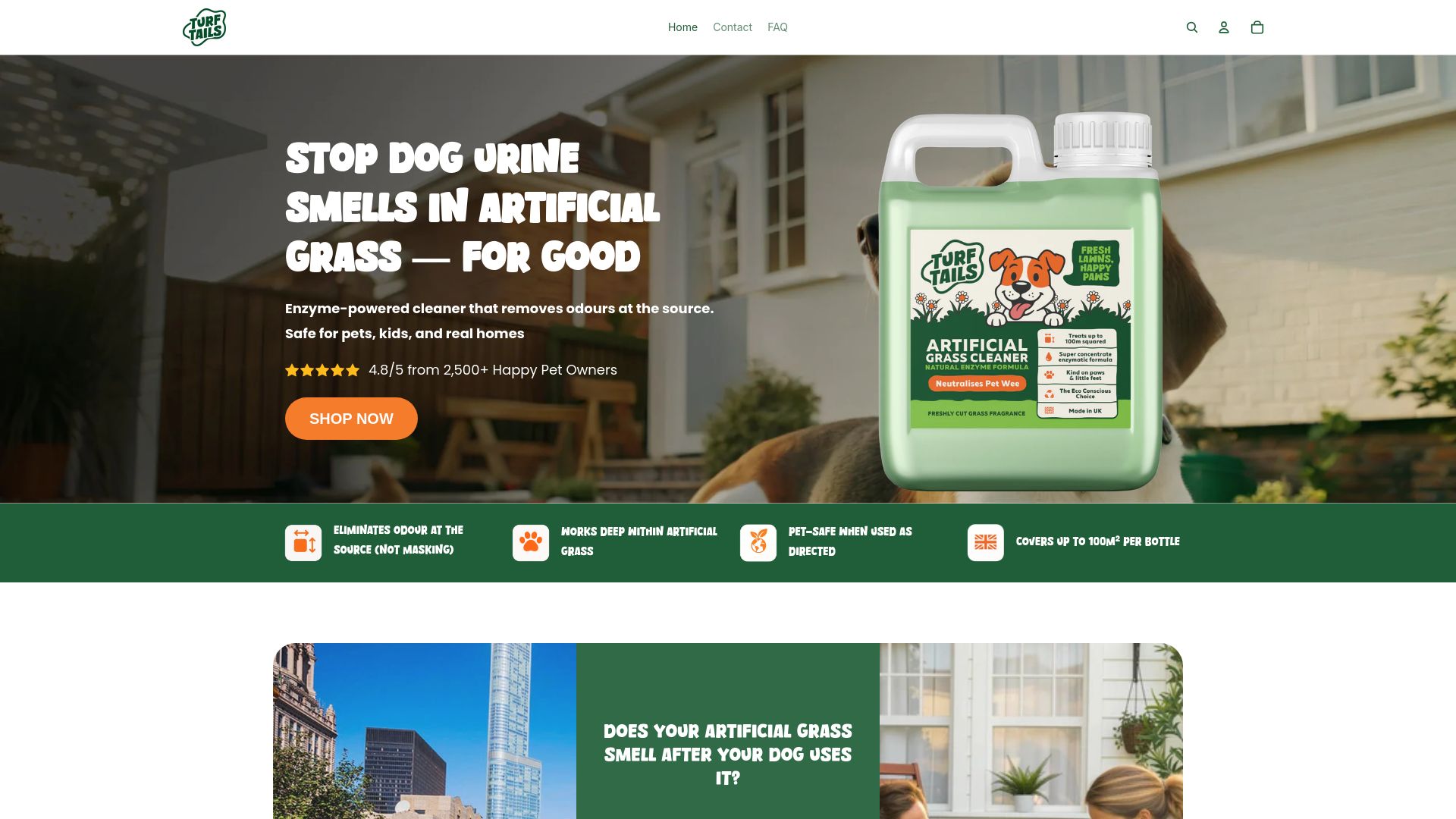
No harsh chemicals, no artificial perfumes, and safe for pets and children from the moment it’s applied. Available as a one-time purchase or a subscription for dog owners who treat regularly. Order directly from Turftails and choose the bottle size that fits your garden. If you’re not sure where to start, the artificial grass cleaner page has full product specs, application guidance, and buying options in one place.
Useful sources
- Turftails home page — product overview, enzyme cleaner claims, and links to buying options.
- Turftails artificial grass cleaner page — product specs, application guidance, user testimonials, and coverage data.
- Turftails shop — one-time purchase and subscription options for UK buyers.
- Delphis Eco patio and stone cleaner — EU Ecolabel accredited, biodegradable, pet-safe hard-surface cleaner; useful reference for label standards.
- PatioKleen plant-friendly patio cleaner — no biocides, no bleach, no acids; illustrates what a genuinely non-hazardous label looks like.
- Pro-Kleen Simply Spray — biodegradable, pH-balanced, labelled safe for children and pets once dry; useful comparison for “wait until dry” safety guidance.
- Algon Organic Patio Cleaner — concentrated organic formula, non-toxic, safe for pets and children; reference for concentrate vs ready-to-use coverage comparisons.