

Enzyme cleaners genuinely remove dog urine odours from artificial grass — not by masking the smell, but by breaking down the organic compounds that cause it at a molecular level. The American Cleaning Institute confirms that enzymes target specific organic molecules, and Turftails’ turf-focused formula applies exactly this principle to the compounds trapped in artificial turf.
Quick takeaways:
- Use a pet-safe enzyme formula designed for artificial grass, not a general-purpose spray
- Saturate the affected area fully — surface-level dampening is not enough
- Keep the area moist throughout the dwell time (15–30 minutes for fresh urine, several hours for set-in odours)
- Repeat treatments if the smell persists after initial application
Fresh urine responds fastest. Set-in odours, where uric acid has crystallised into the infill, need longer dwell times and sometimes more than one treatment.
Table of Contents
- How enzyme cleaners work: the plain-English version
- Why dog urine odours linger in artificial grass
- What enzyme cleaners will and will not do
- How to apply an enzyme cleaner on artificial grass
- How to choose an enzyme cleaner for artificial grass in the UK
- When enzyme treatment is not enough
- Turftails: a turf-focused enzyme cleaner
- Key takeaways
- A note on getting this right
- Turftails enzyme cleaner: the straightforward option for artificial grass
- Useful sources
How enzyme cleaners work: the plain-English version
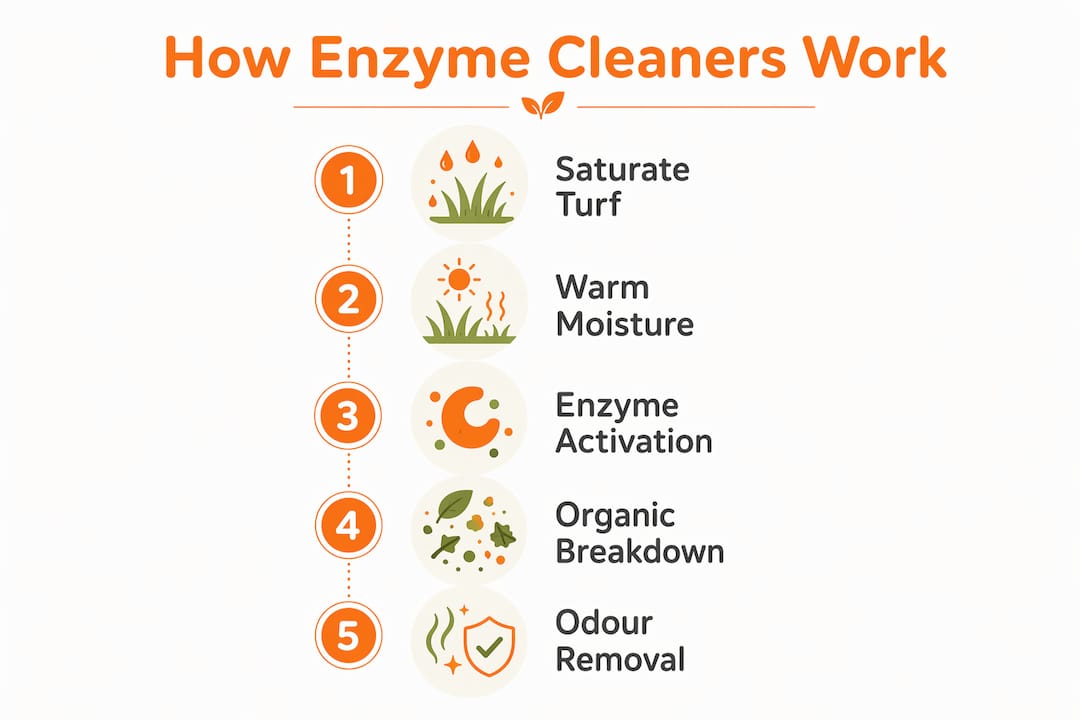
Enzymes are biological catalysts — proteins that speed up chemical reactions without being consumed in the process. In a cleaning context, they break long chains of organic molecules into smaller, water-soluble fragments that can be rinsed or evaporated away. That is the fundamental difference between an enzyme cleaner and an air freshener: one removes the source, the other masks it with fragrance.
The key to understanding enzyme cleaners is specificity. Each enzyme type targets one class of molecule:
- Protease breaks down proteins (the main component of urine solids and body odours)
- Lipase targets fats and oils
- Amylase tackles starches and carbohydrates
- Urease (included in some pet-specific formulas) targets urea directly
Dog urine is a complex mix, which is why quality enzyme cleaners use blends rather than a single enzyme. As Jatin Sharma, marketing manager at BASF, noted in a Wirecutter interview: effective cleaning is always a balance between time, chemistry, and temperature — enzymes are one powerful piece of that equation.
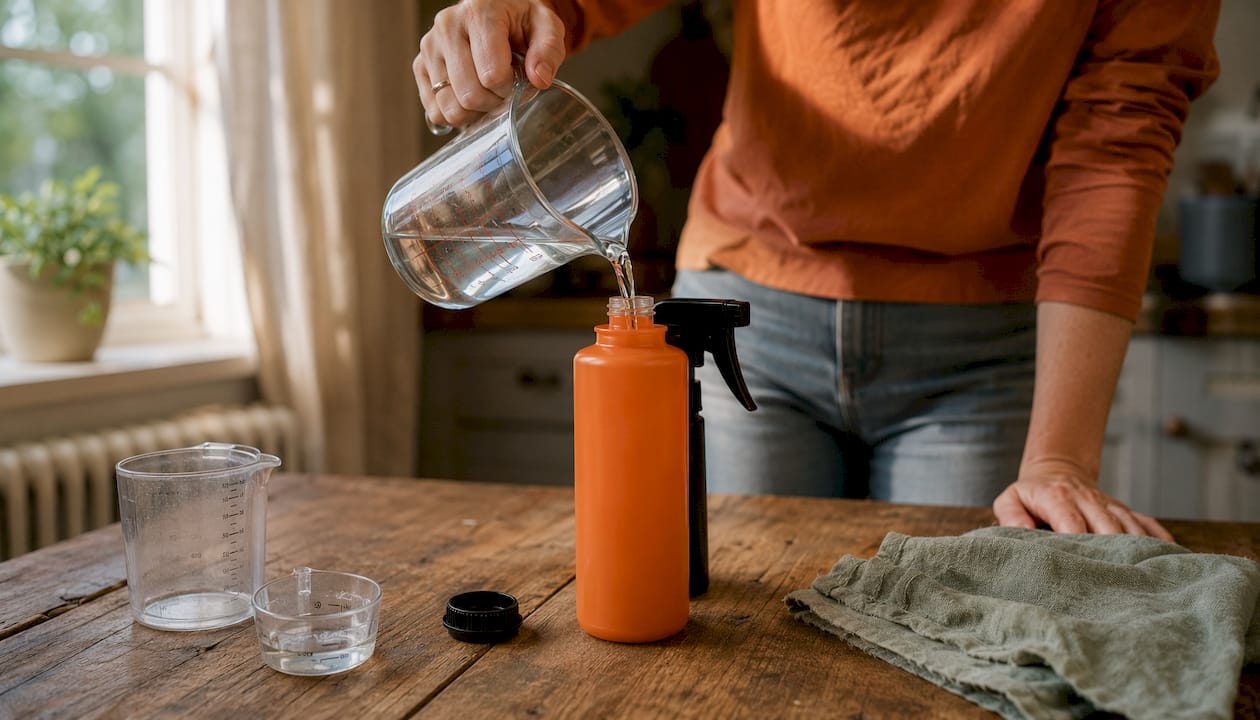
Moisture and warmth are not optional extras. Enzymes halt their activity when they dry out, and very hot water can denature them entirely. Warm (not boiling) water and a moist surface are what keep them working through the full dwell time.
Why dog urine odours linger in artificial grass
Artificial turf is not fabric. It cannot be machine-washed, and its layered construction — fibres, infill (usually crumb rubber or sand), and a perforated backing — creates pockets where urine residues accumulate over time.
Dog urine contains proteins, urea, and uric acid. The proteins and urea break down relatively quickly, but uric acid crystallises as it dries. Those crystals bond to infill particles and backing fibres, and they are largely insoluble in plain water. Every time the area gets damp again — rain, morning dew, a dog sitting on it — the crystals partially dissolve and release that familiar ammonia-like smell.
Common mistakes that make the problem worse:
- Applying cleaner to a dry surface and not saturating deeply enough to reach the infill
- Letting the treated area dry before enzymes have finished working
- Using very hot water, which deactivates enzymes before they can act
- Treating only the visible surface rather than the full depth of the contaminated zone
- Expecting a single application to resolve months of accumulated residue
What enzyme cleaners will and will not do
Enzyme cleaners remove the organic source of odour — they do not disinfect. That distinction matters if you are dealing with faecal contamination or suspected pathogens, where a separate pet-safe disinfectant step is needed after enzyme treatment.
Where they excel:
- Fresh urine: fast-acting, often resolved in a single 15–30 minute treatment
- Protein-based stains and odours on turf fibres and accessible infill
- Regular maintenance cleaning to prevent odour build-up
Where they have limits:
- Established uric acid crystals deep in infill may need multiple treatments or extended dwell times
- They will not kill bacteria or viruses on their own
- Heavily saturated areas with years of accumulation may need professional attention
Pro Tip: If the smell returns after the turf dries, the uric acid crystals have not been fully broken down. Repeat the treatment with a longer dwell time — cover the area with a damp cloth to keep it moist for several hours rather than a shorter period.
How to apply an enzyme cleaner on artificial grass
Saturate, wait, and keep it moist — that is the core principle. Here is the full procedure:
- Remove solids first. Pick up any waste and hose the area lightly to remove loose debris before applying the cleaner.
- Do a test patch. Apply a small amount to an inconspicuous area and leave for 10 minutes to check for any colour or fibre reaction — particularly relevant for older or non-standard turf.
- Dilute if using a concentrate. Follow the product label precisely. Turftails’ concentrated formula covers up to 100m² per bottle — measure carefully to avoid under-diluting.
- Saturate the affected area. Apply enough product to penetrate the infill, not just wet the surface fibres. For a dog’s regular spot, that means a generous, even spray across the whole zone.
- Keep it moist. For fresh urine, a short dwell time of several minutes is usually sufficient. For set-in stains, aim for two to eight hours — lay a damp cloth or light cover over the area to prevent drying.
- Rinse or blot as directed. Some formulas (including Turftails) are no-rinse; others recommend a light hose-down after the dwell time. Check your product label.
- Keep pets off the area while wet. Once the surface is dry, it is safe for pets and children.
Safety notes when using concentrates:
- Wear gloves when mixing
- Store out of reach of children and pets
- Check the product’s Safety Data Sheet (SDS) before first use
Pro Tip: Use lukewarm water — not hot — when diluting a concentrate. Hot water can deactivate enzymes before they reach the turf.
How to choose an enzyme cleaner for artificial grass in the UK
Not every enzyme cleaner on the market is suitable for turf. Many are formulated for carpet or upholstery and may contain surfactants or fragrances that leave residue on synthetic fibres or harm infill materials.
Look for these on the label or product page:
- Multi-enzyme blend (protease at minimum; urease or lipase a bonus for pet urine)
- Explicitly turf-safe — the product page should state compatibility with artificial grass and infill
- Pet-safe and child-safe certification or statement
- Eco-friendly / biodegradable — enzymes are biodegradable at low concentrations, but check the full formula
- Fragrance-free or naturally scented — artificial perfumes mask rather than remove odour
- SDS available — any reputable concentrate will have a Safety Data Sheet you can request or download
- Stated coverage per bottle — calculate your turf area before buying; a 100m² bottle covers most standard UK gardens in one purchase
Be cautious with DIY enzyme mixtures such as homemade citrus enzyme solutions. Enzyme concentration and specificity vary enormously in home preparations, and contamination risk is real. For turf, a tested, labelled product is the safer choice.
When enzyme treatment is not enough
If the odour persists after two or three complete treatments — each with correct saturation and full dwell time — it is time to escalate.
- Extend the dwell time. Cover the area and leave the enzyme cleaner working for eight hours or overnight before rinsing
- Deep rinse. If your product permits, follow with a thorough hose-down to flush loosened residue through the drainage layer
- Professional turf decontamination. Specialists can use extraction equipment to pull contaminated infill and flush the backing more thoroughly than a surface spray allows
- Infill replacement. In severe cases — years of heavy use with no treatment — partial or full infill replacement may be the only lasting solution
One firm rule: never mix bleach or chemical disinfectants with enzyme cleaners. Bleach denatures enzymes immediately, rendering the treatment useless — and the combination can produce hazardous fumes. If disinfection is needed, apply the enzyme cleaner first, allow it to complete its work, then apply a pet-safe disinfectant separately.
Turftails: a turf-focused enzyme cleaner
Turftails is formulated specifically for artificial grass — not repurposed from a carpet or laundry product. It breaks down urine compounds at the molecular level using an enzyme blend targeted at the organic residues dog urine leaves behind in turf.
Key features relevant to turf owners:
- Enzyme blend targeting proteins and urine compounds
- Pet-safe and child-safe — no harsh chemicals or artificial perfumes
- Eco-friendly formula with low environmental impact
- Concentrated formula covering up to 100m² per bottle
- No-rinse application — saturate, wait, done
- Works on artificial grass, patios, decking, concrete, kennels, and fabrics
Turftails users consistently report a noticeable reduction in odour after switching from air fresheners and general-purpose sprays. Always check the product page and SDS for full directions before first use.
Key takeaways
Enzyme cleaners remove dog urine odours by breaking down organic compounds at the molecular level — they work on artificial grass when applied correctly, with full saturation and adequate dwell time.
| Point | Details |
|---|---|
| Saturation is non-negotiable | Apply enough product to reach the infill, not just the surface fibres |
| Dwell time determines results | Fresh urine needs 15–30 minutes; set-in odours need several hours or overnight |
| Enzymes are not disinfectants | Use a separate pet-safe disinfectant after enzyme treatment if sanitation is needed |
| Escalate after 2–3 treatments | Persistent odour after correct applications may need professional extraction or infill replacement |
| Turftails for turf | Turftails’ concentrated, no-rinse formula covers up to 100m² and is formulated specifically for artificial grass |
A note on getting this right
The most common reason enzyme treatments disappoint is not the product — it is the application. Owners spray lightly, the area dries in ten minutes, and the uric acid crystals are barely touched. The chemistry works; the method does not.
Artificial grass rewards patience. A thorough, moist, unhurried treatment will outperform three hasty ones every time. If you are dealing with a long-standing problem, set realistic expectations: the first treatment loosens the residue, the second or third clears it. That is not a product failure; it is how the biology works.
For complex situations — large areas, very old contamination, or turf with unusual infill — contact Turftails directly for guidance before assuming the product is not working. The SDS and product instructions are your first reference; the support team is your second.
Turftails enzyme cleaner: the straightforward option for artificial grass
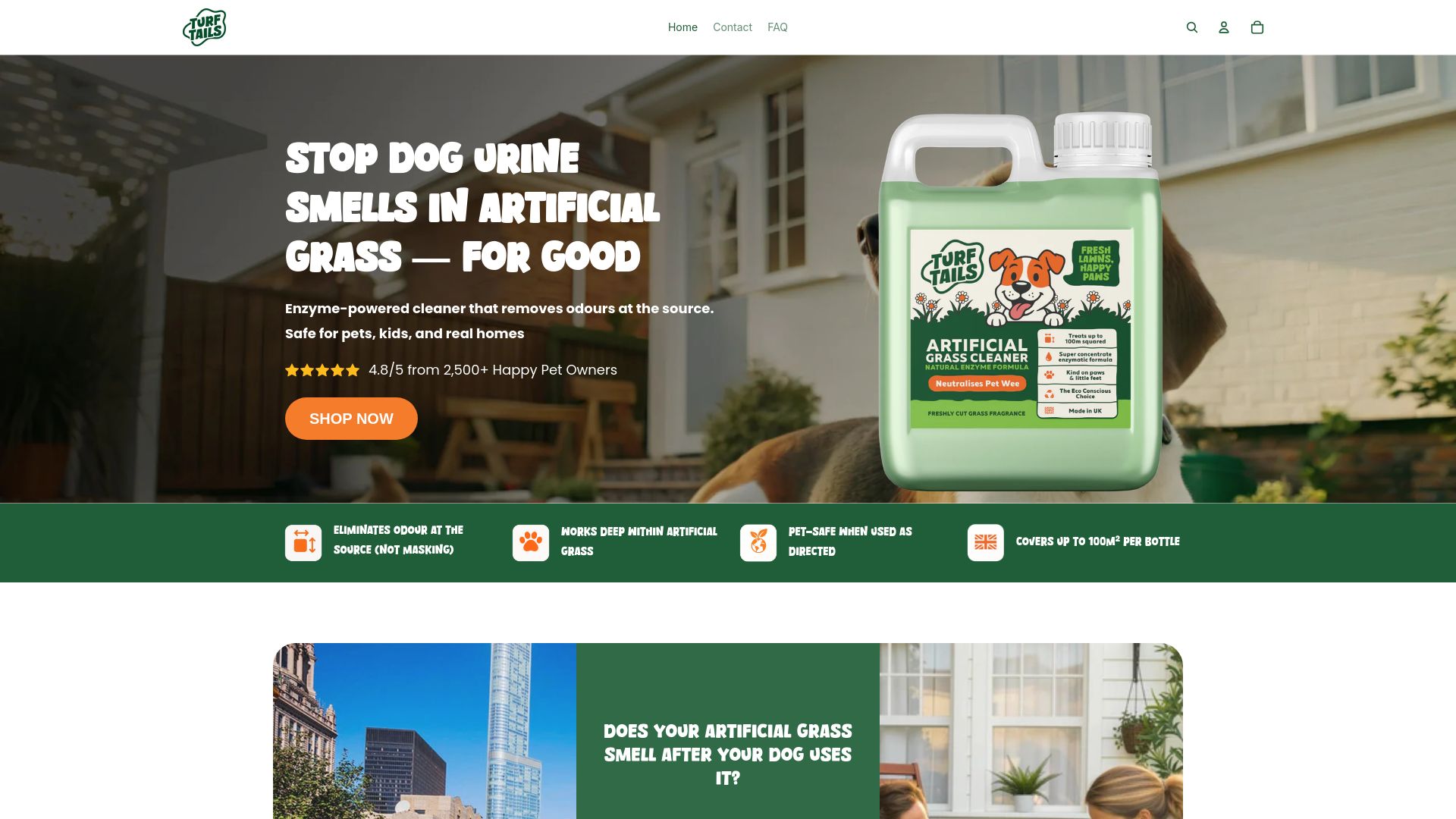
Turftails cuts through the confusion: one concentrated, pet-safe bottle covers up to 100m² of artificial grass and requires no rinsing. Where air fresheners only cover the smell, Turftails removes what is causing it.
Key reasons turf owners choose it:
- Concentrated formula — one bottle covers a full-sized garden
- No harsh chemicals, no artificial perfumes, no rinsing required
- Safe for pets and children once the surface is dry
- Works on artificial grass, patios, decking, kennels, and fabrics
Available as a one-off purchase or on subscription so you never run out mid-summer. Read the SDS and label instructions before first use. Order Turftails and treat the problem today.
Useful sources
- American Cleaning Institute — The role of enzymes in detergent products: enzyme specificity, biodegradability, and blends
- EnzymeCleaners.com — What is an enzyme cleaner?: dwell time, moisture requirements, and mechanism
- Better Homes & Gardens — What is an enzyme cleaner?: disinfection limitations and temperature guidance
- The Spruce — What is an enzyme cleaner?: household application steps and escalation guidance
- Homes & Gardens — What is an enzyme cleaner?: DIY enzyme cautions
- Turftails product page: concentrated formula details, coverage claims, and usage instructions
This article provides general information about enzyme cleaning products and artificial grass maintenance. It is not a substitute for professional advice. Always read the product label and Safety Data Sheet before use, and consult a professional for large-scale or persistent contamination.