

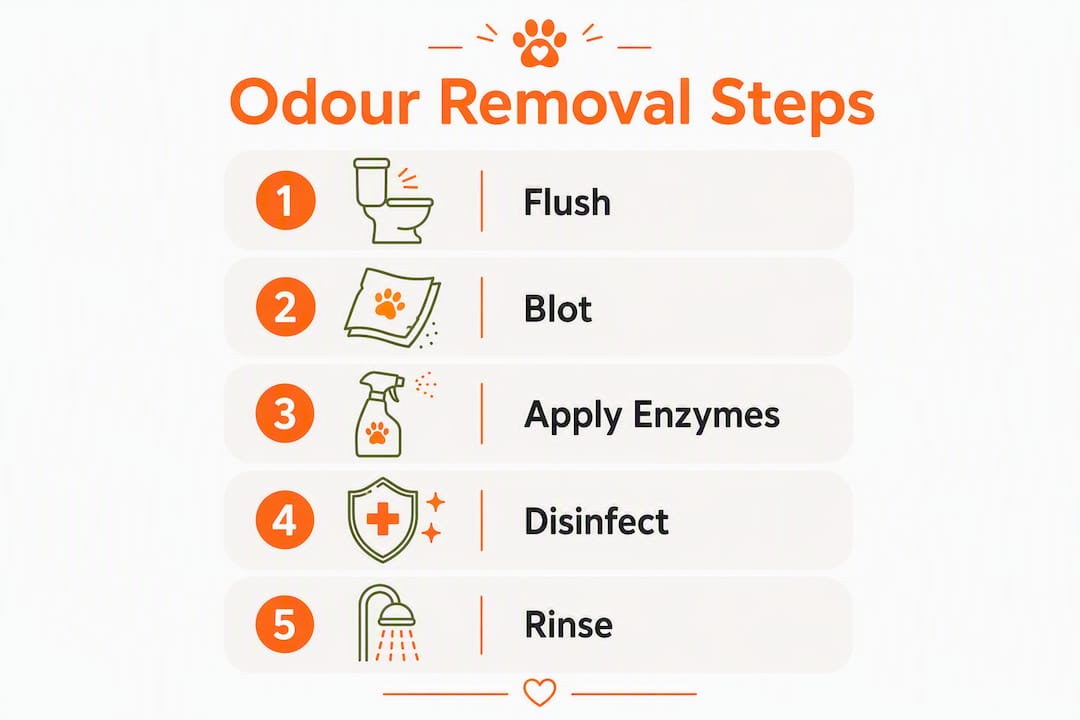
The fastest way to remove urine smell from artificial grass is to flush fresh urine through the backing immediately, then apply an enzyme-based cleaner at dusk and allow it to dwell. That sequence tackles the actual culprit: uric acid crystals that cling to synthetic fibres and release ammonia gas whenever heat or moisture reactivates them.
Act now — immediate steps for a fresh incident:
- Remove any solid waste first.
- Hose the area with a directed stream (not a fine mist) to push urine through the backing rather than spreading it.
- Blot any pooled liquid on the surface with an old towel.
- Apply an enzyme or microbe-based cleaner once the surface cools towards evening.
- Allow the product to dwell for the time stated on the label before rinsing or leaving overnight.
Air fresheners and scented sprays do nothing here. Uric acid is poorly soluble and forms microscopic crystals that sit in the fibres, infill, and backing long after the liquid has drained. Only a product that breaks down or consumes those crystals will actually deodorise synthetic grass.
Table of Contents
- Why does artificial grass hold urine odour so stubbornly?
- How to remove urine smell from artificial grass right now
- The three-stage method that permanently removes odour
- Why does the smell come back after DIY attempts?
- A practical maintenance schedule to prevent odour returning
- What professionals know that most guides miss
- Key takeaways
- The routine that actually works, from someone who has seen both sides
- Turftails: the enzyme cleaner built for UK pet gardens
- Useful sources and further reading
Why does artificial grass hold urine odour so stubbornly?
Natural lawns have one thing synthetic turf does not: a living soil layer packed with microbes that digest organic waste. On real grass, urine breaks down relatively quickly. On artificial turf, there is no biological safety net.
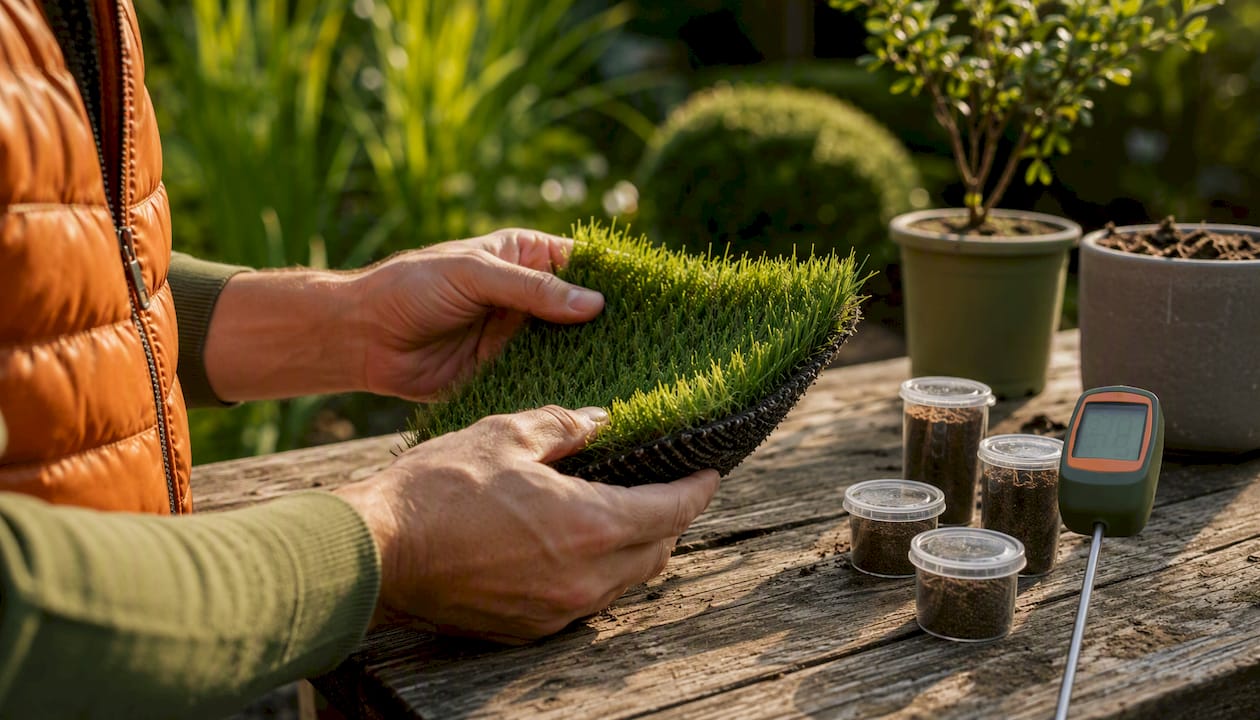
Uric acid crystallises as urine dries. Those crystals are microscopic, poorly soluble, and bond to the fibres, thatch layer, and backing material. Every time rain or a garden hose re-wets them, they release a fresh burst of ammonia. That is why a lawn can smell fine on a cool morning and unbearable by mid-afternoon on a warm day.
The physical structure of artificial turf makes things worse:
- Infill material (crumb rubber, sand, or silica) traps residues between granules where water cannot easily flush them.
- Backing layers can absorb and hold liquid if drainage holes are too small or partially blocked.
- Biofilm builds up over time as bacteria colonise the warm, damp environment, adding a secondary layer of odour on top of the uric acid.
Poor drainage compounds every one of these problems. If urine cannot evacuate through the backing into a permeable base, it pools and concentrates, and no amount of surface cleaning will fix that.
How to remove urine smell from artificial grass right now
Step-by-step for fresh or mild odour
- Remove solids with a bag or scoop before doing anything else.
- Hose with a directed stream aimed at the affected patch. The goal is to push liquid down through the backing, not spread it sideways. Use a jet setting rather than a shower head.
- Blot standing water on the surface if drainage is slow.
- Apply your enzyme cleaner once the surface temperature drops, ideally at dusk. Biological products lose activity in direct sun and heat above roughly 40°C.
- Allow dwell time as directed. Most products need 15–30 minutes minimum; overnight is better for anything more than a fresh incident.
- Rinse lightly only if the product label requires it. Many enzyme cleaners work best left in place.
Home remedies: what works, what damages, and what to skip
| Remedy | Effect | Caution |
|---|---|---|
| White vinegar diluted 1:1 | Neutralises ammonia temporarily | Acidic; repeated use can degrade some backings |
| Bicarbonate of soda | Absorbs surface odour briefly | Does not break down uric acid crystals |
| Hydrogen peroxide (3%) | Mild oxidising action on residues | Can bleach or discolour turf fibres |
| Bleach | Masks smell very briefly | Damages synthetic fibres and backing; avoid entirely |
| Enzyme/microbe cleaner | Breaks down or consumes uric acid | None for pet-safe formulas; check label |
Household remedies are fine for a one-off emergency, but they do not solve the underlying crystal problem. Vinegar and bicarbonate of soda mask odour for a day or two; the smell returns with the next warm afternoon.
When to stop DIY and call a professional: if the odour is concentrated in a low spot, persists after two or three enzyme treatments, or intensifies after rinsing rather than improving, the residue has likely reached the sub-base. That requires extraction equipment or base remediation, not another bottle of cleaner.
Pro Tip: Never use a fine mist setting when hosing artificial grass after a urine incident. A mist distributes liquid sideways across a wider area rather than flushing it downward, spreading the problem rather than containing it.
The three-stage method that permanently removes odour
Rinsing alone can re-activate dormant uric acid crystals and push them deeper into the infill and backing. The approach that actually works is a staged sequence:
-
Stage one: enzyme or microbe cleaner. Apply a product containing live bacteria or active enzymes. Live bacteria are particularly effective because they consume uric acid crystals entirely rather than just breaking the molecules into smaller compounds. Enzyme-only products can leave partial breakdown products that still off-gas. Apply at dusk or dawn, when UV and heat are low, and keep the area damp during dwell time to maintain biological activity.
-
Stage two: antimicrobial treatment. Once the enzyme stage has had time to work (typically 24 hours for a deep treatment), apply a pet-safe antimicrobial to reduce the biofilm and bacterial colonies that contribute secondary odour. This step is often skipped in DIY routines, which is why smell returns within a few weeks.
-
Stage three: rinse or safe oxidiser. A light rinse flushes breakdown products through the backing. For stubborn cases, a dilute hydrogen peroxide solution acts as a mild oxidiser to neutralise any remaining compounds. Avoid bleach entirely.
Applying enzyme cleaners correctly
- Dilute as directed. Concentrated formulas need mixing; applying neat product wastes coverage and can overwhelm the biological action.
- Apply in cool conditions. Morning or evening application preserves enzyme and microbial activity. Midday summer sun can kill live bacteria before they have time to work.
- Keep the area damp. If conditions are dry and warm, lightly mist the treated area after application to extend the active window.
- For deep-set odour: saturate the area heavily, then lay a tarp over it for 24–48 hours. This traps moisture and incubates the microbes long enough to consume uric acid crystals in the sub-base.
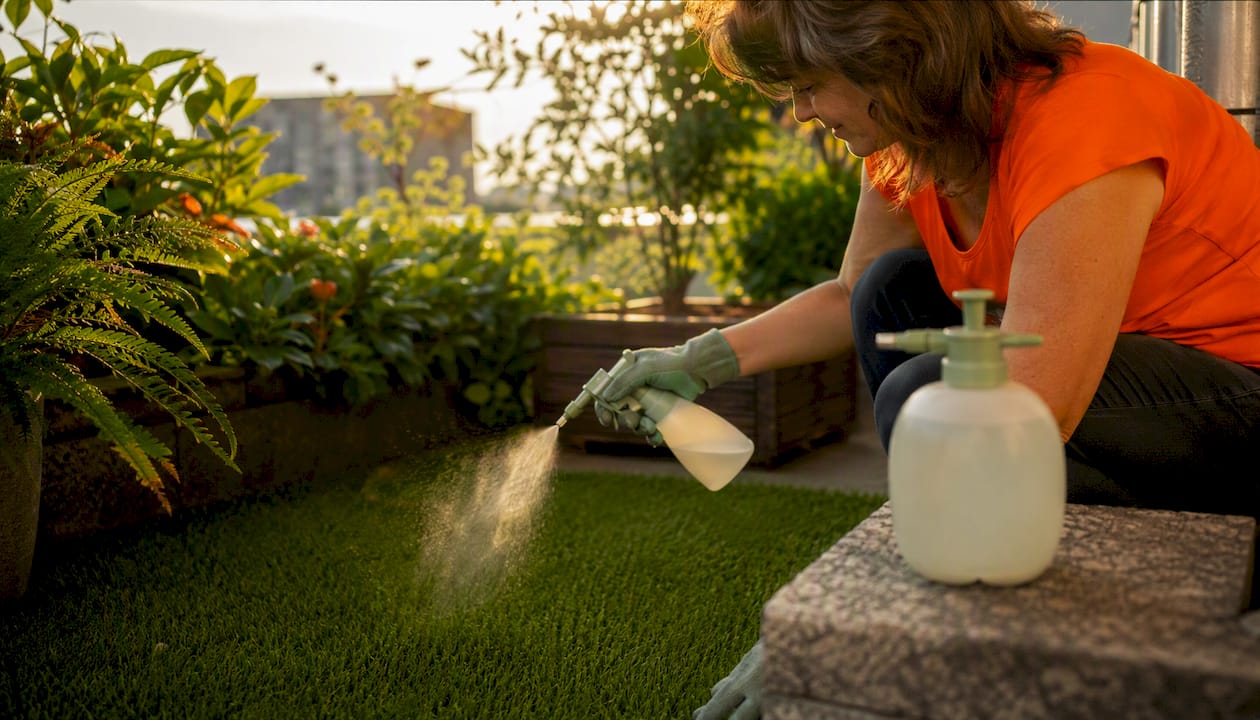
Turftails is formulated as a concentrated enzyme cleaner designed for exactly this routine. One bottle treats up to 100 m², covers a typical UK back garden in a single application, and contains no harsh chemicals or artificial perfumes. It is safe for pets and children once applied, and requires no rinsing. For a full breakdown of how the biology works, the enzyme cleaner science guide on the Turftails site is worth reading before your first application.
Pro Tip: If you are treating a large area, divide it into 4 m² sections and work methodically. Overlapping coverage at the edges prevents untreated strips that become odour hotspots.
Why does the smell come back after DIY attempts?
The most common reason is that rinsing re-wets dormant crystals and redistributes them into the infill and backing rather than removing them. The surface smells better for a day, then the heat returns and so does the ammonia.
Signs that the residue has moved beyond the surface layer:
- Odour is strongest on warm afternoons, not immediately after the dog uses the area.
- Smell intensifies after hosing rather than improving.
- The odour is concentrated in one low spot or corner, suggesting pooling.
- Multiple surface treatments have produced only temporary relief.
These patterns point to residue in the sub-base, not the fibres. At that stage, the question is whether the base is still structurally sound or whether drainage has failed.
Questions to ask a professional installer:
- Is the drainage gradient correct (typically 1:80 or better for pet areas)?
- Are the backing perforations clear, or have they been blocked by compacted infill or debris?
- Has the stone base compacted to the point where it holds water rather than draining it?
Realistic timelines: infill replacement is a half-day job for a professional on a standard garden. Sub-base remediation, which involves lifting the turf, re-grading, and relaying, is a one-to-two day project. Neither is cheap, but persistent odour that resists treatment almost always traces back to drainage or sub-base failure rather than the wrong cleaning product.
Pro Tip: Before calling a professional, pour a bucket of water onto the problem area and watch how quickly it drains. If water pools for more than 30 seconds, drainage is compromised and surface treatment alone will not solve the smell.
A practical maintenance schedule to prevent odour returning
Consistent cleaning scaled to how much your dog uses the turf is the single most effective prevention measure. Uric acid crystals accumulate gradually; catching them early is far easier than treating a deep-set problem.
| Frequency | Task |
|---|---|
| Daily | Visual check; remove solids immediately |
| Weekly | Directed hose-down of pet zones; check drainage is clear |
| Monthly | Apply enzyme cleaner to high-use areas; brush fibres upright |
| Annually | Deep enzyme treatment of full area; top up or replace infill if compacted |
Prevention tactics that actually reduce the problem
- Designate a toilet zone. Train your dog to use one corner of the garden. Concentrate your cleaning effort there and consider a gravel or bark chip area adjacent to the turf as an alternative.
- Choose the right infill. Zeolite infill absorbs ammonia actively and can be recharged by rinsing. Pet-friendly silica sand is easier to keep clean than crumb rubber, which traps residues between granules. Infill choice and permeable backing make a measurable difference to long-term odour control.
- Check your drainage slope. Artificial turf for pet areas should drain at a minimum gradient. Flat installations pool urine rather than evacuating it.
- Pick permeable backing. If you are installing new turf or replacing existing, specify a backing with adequate perforation density for a pet area.
Pro Tip: After heavy rain, check whether water drains from your turf within a minute or two. Rain effectively tests your drainage in real conditions and gives you early warning of a blockage before odour builds up.
What professionals know that most guides miss
Landscape professionals who install and maintain pet turf regularly point to one root cause that DIY guides consistently underplay: poor base compaction or failed drainage is the reason odour resists treatment, not the choice of cleaning product.
“If urine cannot evacuate through the backing into a permeable base, odour will persist regardless of treatment frequency. Good installation and drainage design is the first line of defence against persistent pet odour on artificial turf.”
— Industry installer guidance, Fake Grass Essex
A few operational details that improve outcomes significantly:
- Apply enzyme products during the coolest part of the day. Biological activity drops sharply above 35–40°C, and a product applied at noon in July may do very little before the heat destroys the active cultures.
- Avoid applying to bone-dry turf in summer without pre-wetting. A quick light hose before the enzyme application helps the product penetrate the infill rather than sitting on the surface.
- For long-standing odour that has not responded to standard treatments, the tarp method described in the three-stage section above is the most reliable escalation before calling a professional.
The best artificial grass cleaner guide on the Turftails site covers product selection in more detail, including how to match cleaner type to infill material.
Pro Tip: Pre-wet the turf lightly before applying any enzyme cleaner in warm weather. Dry infill acts as a barrier; moisture helps the product reach the crystals where they actually sit.
Key takeaways
Enzyme-based cleaning combined with a three-stage routine (enzymes, antimicrobial, rinse) is the only method that permanently removes uric acid odour from artificial grass rather than masking it temporarily.
| Point | Details |
|---|---|
| Act immediately on fresh incidents | Flush with a directed hose, blot, then apply enzyme cleaner at dusk for best results. |
| Three-stage routine removes odour at source | Enzyme or microbe cleaner, followed by antimicrobial treatment, then a light rinse or oxidiser. |
| Rinsing alone can make things worse | Water re-wets uric acid crystals and pushes them deeper into infill and backing. |
| Maintenance prevents recurrence | Weekly rinse of pet zones, monthly enzyme treatment, and annual deep clean keep crystals from accumulating. |
| Turftails covers up to 100 m² per bottle | Safe for pets and children, no harsh chemicals, and no rinsing required after application. |
The routine that actually works, from someone who has seen both sides
There is a tendency in guides like this one to present enzyme cleaning as a near-magical fix, and it is genuinely effective when used correctly. But the part most articles gloss over is expectation-setting: deep-set odour that has been baking into a compacted base for months will not vanish after one application. It takes two or three treatments, spaced a few days apart, with proper dwell time each time.
The other thing worth saying plainly: if you have tried a good enzyme product twice and the smell returns within a week, the problem is almost certainly drainage, not the cleaner. No product, however well formulated, can compensate for urine that is pooling in the sub-base rather than evacuating. That is an installation problem, and it needs an installer.
For straightforward cases — a healthy, well-drained lawn that has accumulated odour over a season — the three-stage routine described here works reliably. Start with a thorough enzyme treatment at dusk, allow overnight dwell, follow up with an antimicrobial, and build the monthly maintenance habit. Most pet owners who do this consistently find the problem stays manageable without heroic effort.
If you have questions about a specific case, the Turftails support team is worth contacting directly. Complex situations (old turf, unknown infill, suspected drainage issues) benefit from a conversation rather than a generic guide.
Turftails: the enzyme cleaner built for UK pet gardens
If you have read this far, you know that most of the products on supermarket shelves either mask odour with fragrance or use chemistry that risks damaging your turf. Turftails takes a different approach: a concentrated enzyme formula that breaks down uric acid at the molecular level, leaving nothing to reactivate on the next warm afternoon.
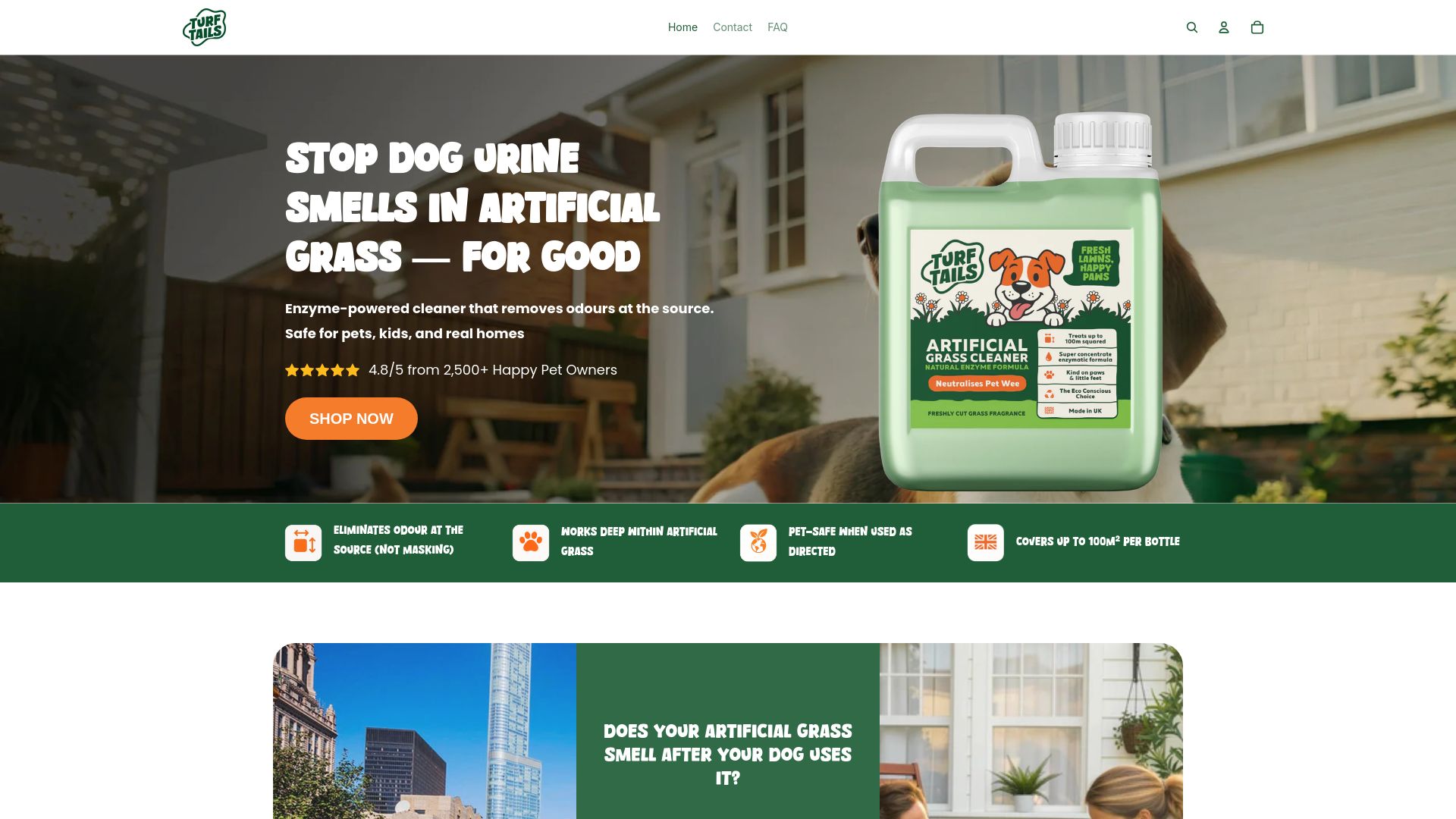
One bottle covers up to 100 m², making it practical for a full UK back garden in a single treatment. There are no harsh chemicals, no artificial perfumes, and no rinsing required after application. It is safe for dogs and children to return to the area once the product has been applied, and it works on artificial grass, patios, decking, concrete, kennels, and outdoor fabrics.
Turftails fits directly into the three-stage routine described in this guide: apply it as your enzyme stage, follow with an antimicrobial if needed, and use it monthly to keep uric acid crystals from building up. A subscription option means you never run out mid-season.
Order Turftails and treat your lawn this week before the warmer months make the problem harder to shift.
Useful sources and further reading
The following sources informed this guide and are worth reading if you want to go deeper on any particular aspect of artificial grass odour control.
- Simple Green: how to clean artificial grass (dog urine) — practical cleaning frequency guidance scaled to pet use.
- Taylor Made Landscapes: removing pet odours from synthetic turf — covers the three-stage method and the risk of rinsing redistributing crystals.
- Install-IT-Direct: remove dog urine smell from artificial grass — detail on live microbial cleaners and the tarp method for deep-set residues.
- Turftails: how enzyme cleaners work on artificial grass — product-specific science and application guidance for the Turftails formula.
- Turftails: dog urine on artificial grass — step-by-step home-care advice tailored to UK homeowners.