

If your garden smells like a public toilet every time it rains, the right fix is an enzyme-based cleaner, not a patio biocide. The best Patio Magic alternatives for dog urine on artificial grass are concentrated, multi-enzyme formulas that biologically digest uric acid and proteins at the molecular level. Turftails is the product we recommend: pet-safe, eco-friendly, no harsh chemicals, and concentrated enough to cover up to 100 m² per bottle.
Quick steps to take right now:
- Stop using bleach or ammonia-based products on your turf immediately
- Remove any solid waste, then saturate the affected area thoroughly with an enzyme cleaner
- Allow the full dwell time stated on the label before letting pets back onto the surface
- Re-treat after 48–72 hours if any odour persists
One practical note on safety: Turftails contains no harsh chemicals or artificial perfumes, is safe for pets and children once dry, and works on synthetic turf, patios, decking, concrete, kennels, and fabrics.
Table of Contents
- What do we mean by ‘Patio Magic alternatives’ here?
- Why do enzyme cleaners remove urine odour when other products fail?
- How to choose an enzyme cleaner for artificial grass
- Step-by-step: using an enzyme cleaner on artificial grass and hard surfaces
- Why home remedies usually make the problem worse
- When should you call a professional deep cleaner?
- Turftails: what it does and why we recommend it
- Why surface-only cleaning never fully solves the problem
- Comparing the alternatives: pet safety, efficacy, and environmental impact
- Key takeaways
- Why I think most people are still cleaning their turf wrong
- Turftails: the enzyme cleaner built for this exact problem
What do we mean by ‘Patio Magic alternatives’ here?
This article is not about removing moss or lichen from paving. When we use the phrase “Patio Magic alternatives,” we mean enzyme-based, pet-safe cleaners designed to break down dog urine compounds on artificial grass and the hard surfaces surrounding it.
The surfaces this covers: synthetic turf, patios, decking, concrete, kennels, and fabrics. The surfaces this does not cover: traditional patio biocides for green algae or mould on natural stone. If you arrived here looking for a moss-killer, this is the wrong article. If your artificial lawn smells of urine and you want something that actually works, read on.
The products we discuss use enzyme action (protease, amylase, lipase) and are available from UK suppliers. Turftails is the publisher-recommended option throughout.
Why do enzyme cleaners remove urine odour when other products fail?
Uric acid crystals are insoluble in water. Rinsing, scrubbing, or spraying vinegar shifts the surface smell temporarily, but the crystals remain embedded in the infill and backing. Every time humidity rises, those dormant crystals reactivate and the odour returns. This is why the garden smells worse on damp days even after you have cleaned it.
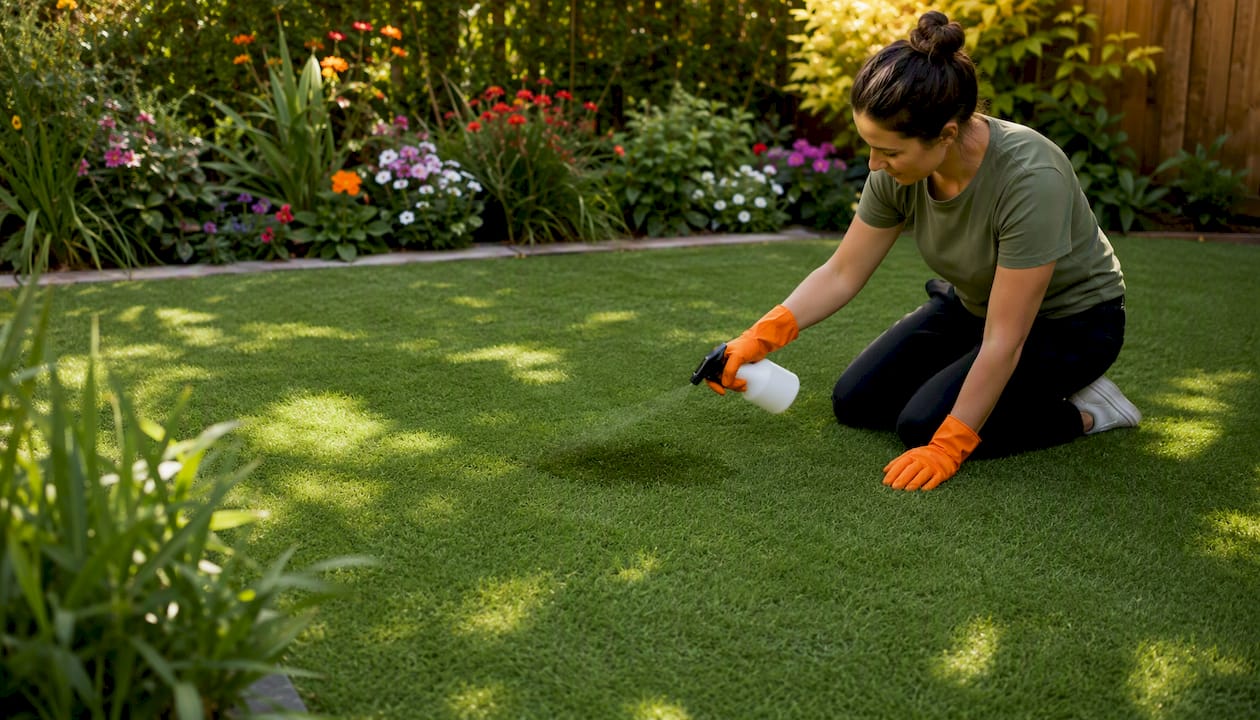
Enzyme-based cleaners work differently: protease breaks down the proteins in urine, while specific enzymes and beneficial microbes digest the uric acid crystals themselves, leaving nothing behind to re-emit ammonia. Critically, enzymatic action continues after application as long as moisture is present, so the cleaner keeps working after you walk away.
| Method | How it acts | Long-term effectiveness | Risk to synthetic turf | Pet safety |
|---|---|---|---|---|
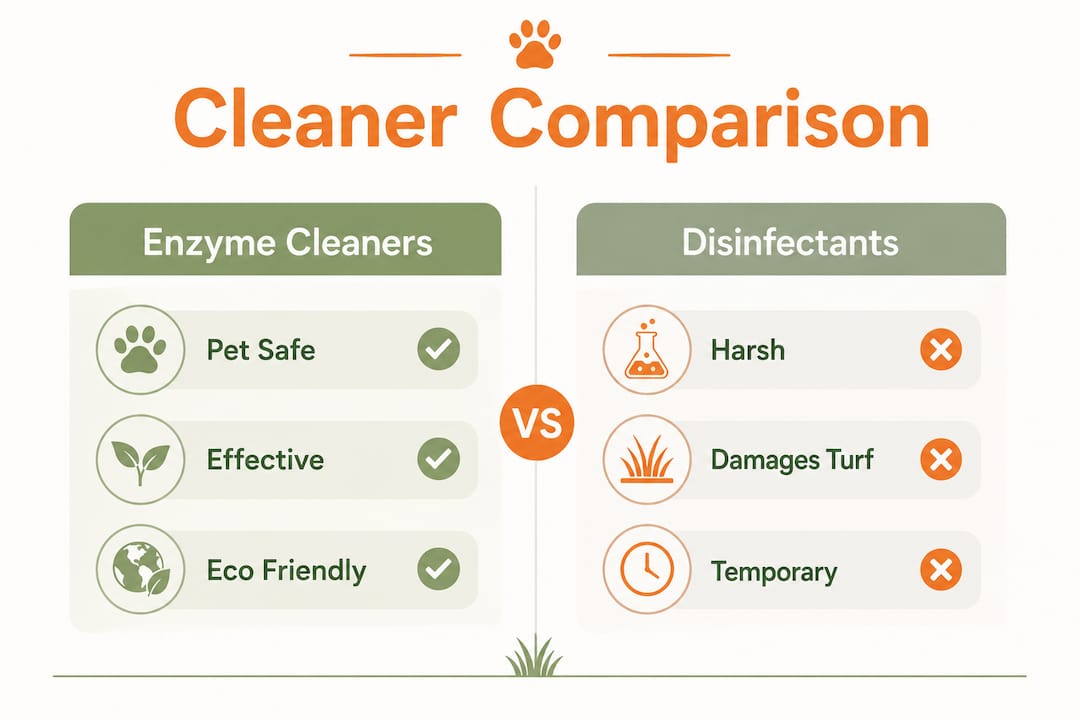
| Enzyme cleaner | Digests proteins and uric acid at molecular level | High: removes the source | Low: formulated for turf | High: no harsh chemicals |
| White vinegar | Neutralises ammonia temporarily; cannot dissolve uric acid crystals | Low: odour returns | Low to moderate | Moderate |
| Bleach/disinfectants | Kills surface bacteria; masks odour | Low: source remains | High: damages fibres and backing over time | Low: irritant to paws and airways |
Household disinfectants and fragranced deodorisers can degrade synthetic fibres and backings with repeated use while leaving the odour source completely intact.
How to choose an enzyme cleaner for artificial grass
Not all enzyme cleaners are equal. When comparing outdoor cleaning products for turf, these are the features that genuinely matter:
- Multi-enzyme formulation: look for protease, lipase, and amylase on the label. Multi-enzyme formulas target proteins, starches, and fats simultaneously, making them more effective on complex organic stains than single-enzyme products
- Concentration and coverage: a concentrated formula means lower cost per treatment; check the stated coverage per bottle (Turftails covers a substantial lawn area)
- No-rinse claim: a no-rinse formula is safer for turf infill and reduces the risk of washing the enzymes away before they finish working
- Pet and child safety: the product should be explicitly labelled safe for pets once dry, with no harsh chemicals or artificial perfumes
- Biodegradability: eco-friendly patio cleaners that biodegrade after use are safer for drainage and garden soil
- Dwell time and activation: check that the product activates with water and states a minimum dwell time; this tells you the enzymes are live and working
Pro Tip: To estimate how much concentrate you need, measure your turf area in square metres. Divide the bottle’s stated coverage by that figure to find how many treatments you get per bottle. For a moderate size lawn, one bottle provides multiple treatments, covering routine maintenance and spot re-treatments for a season.
Step-by-step: using an enzyme cleaner on artificial grass and hard surfaces
Saturate the affected area with your enzyme solution and allow the full dwell time. That single instruction covers most failures. Here is the full procedure:
- Remove any solid waste and blot up excess liquid with paper towels or an absorbent cloth
- Dilute the concentrate per the label instructions; do not guess the ratio
- Apply generously using a watering can or hose attachment to saturate to the depth the urine has soaked, not just the blade surface
- Allow the full dwell time stated on the label without disturbing the area
- Only rinse if the product instructs it; most no-rinse formulas work best left in place
- Keep pets off the treated area until the surface is dry
- Re-treat after 48–72 hours if any odour remains; persistent odours often need a follow-up application days after the initial treatment
A few things to avoid:
- Do not apply heat or steam before enzymatic neutralisation is complete; heat sets proteins and makes odour harder to remove
- Never mix vinegar or bleach with an enzyme product in the same application; acid neutralises the enzymes before they can work
- Check paws after treatment and allow full drying time before pets use the area
Why home remedies usually make the problem worse
Vinegar and bicarbonate of soda are the two most common DIY fixes, and both offer only temporary improvement. Vinegar neutralises ammonia on contact, which is why the smell drops immediately, but it cannot dissolve uric acid crystals. The odour returns within days. Bicarbonate absorbs surface moisture and can reduce the immediate smell, but again, the crystals remain.
Bleach and ammonia-based cleaners are worse. They can damage synthetic fibres and backing materials with repeated use, irritate pets’ paws and airways, and do nothing to address the uric acid source.
Do not mix: white vinegar neutralises enzyme cleaners. If you have used vinegar on the area, rinse thoroughly with clean water and wait at least 30 minutes before applying an enzyme product, or you will deactivate it on contact.
Safe interim measures when an enzyme cleaner is not immediately available:
- Rinse the area thoroughly with cold water to dilute fresh urine
- A small amount of diluted biological laundry liquid (fragrance-free) can act as an emergency pre-treatment to begin breaking down proteins
- Apply your enzyme cleaner as soon as it arrives; do not wait for the smell to “air out”
Pro Tip: Biological laundry liquid contains some of the same enzyme types as dedicated pet cleaners, but it is not formulated for turf and should only be used as a short-term measure. Rinse it out fully before applying a proper enzyme product.
When should you call a professional deep cleaner?
Call a professional if odour persists after two full enzyme treatments, or if urine has soaked through to the underlay or base aggregate. Surface-only cleaning cannot reach contamination at that depth.
What a professional can do that DIY cannot:
- Sub-surface extraction to pull contaminated liquid from the base
- Hot-water extraction with enzyme pre-treatment for deep-set contamination
- Infill replacement or base repairs where saturation has caused structural issues
Before booking, ask these questions:
- Do you use enzyme pre-treatment before extraction?
- What extraction method do you use on artificial grass?
- Do you have experience with synthetic turf specifically?
- What guarantee do you offer if odour returns?
Red flags: any provider who recommends steam cleaning or bleach without enzyme pre-treatment first. Steam without prior enzymatic neutralisation sets proteins into the fibres permanently.
Turftails: what it does and why we recommend it
Turftails is an enzyme-powered cleaner built specifically for dog urine on artificial grass and adjacent hard surfaces. It targets urine compounds at the molecular level rather than masking them with fragrance, which is the core reason it works where air fresheners and disinfectants do not.
| Specification | Detail |
|---|---|
| Formula type | Concentrated enzyme-based |
| Coverage per bottle | Up to 100 m² |
| Surfaces supported | Artificial grass, patios, decking, concrete, kennels, fabrics |
| Harsh chemicals | None |
| Artificial perfumes | None |
| Rinse required | No |
| Pet and child safety | Safe once dry |
| Eco-friendly | Yes, biodegradable |
Turftails suits two use cases equally well: routine maintenance (a few treatments per season to keep odour from building up) and deep treatment after a heavy contamination event. For routine use, the 100 m² coverage makes a single bottle go a long way on a typical UK garden lawn.
Pro Tip: For the most thorough coverage, apply Turftails with a watering can rather than a hand sprayer. It delivers a more even saturation into the infill and backing, which is where the uric acid crystals actually live.
Why surface-only cleaning never fully solves the problem
Cleaning only the grass blades is like washing the top of a sponge and expecting the inside to be clean. Urine travels through the blade surface, into the infill, through the backing, and down to the aggregate base. Bacteria colonise every layer.
Surface spraying under-doses deep contamination. Effective treatment requires enough solution to match the volume of urine that originally soaked in, which is why saturation with a watering can or hose attachment consistently outperforms a quick spray. For heavily used areas, planned saturation on a regular schedule prevents the base layer from becoming a permanent odour reservoir.
Infill type matters too. Sand or crumb rubber infill holds urine differently; rubber infill in particular can trap bacteria in its porous surface. If your turf has rubber infill and persistent odour, you may need to consider partial infill replacement alongside enzyme treatment.
Comparing the alternatives: pet safety, efficacy, and environmental impact
The three dimensions that matter most for UK dog owners choosing between outdoor cleaning products are pet safety, how thoroughly the product removes odour, and what it does to drainage and garden soil.
Enzyme cleaners score well on all three: they are formulated to be safe for pets, they address the odour source rather than masking it, and biodegradable formulas break down harmlessly after use. Bleach-based products score poorly on all three. Vinegar sits in the middle: low environmental impact, moderate pet safety, but genuinely poor long-term efficacy on uric acid.
Fragranced disinfectants are the worst option for turf specifically. They can degrade the latex or polyurethane backing over time, and the fragrance compounds that make them smell clean to humans can be irritating to dogs’ sensitive noses and paws. For anyone comparing safe patio cleaning products for a garden shared with dogs, the enzyme category is the only one that addresses all three criteria without compromise.
Key takeaways
Enzyme-based cleaners are the only Patio Magic alternatives that permanently remove dog urine odour from artificial grass by digesting uric acid crystals rather than masking them.
| Point | Details |
|---|---|
| Enzyme action is the only permanent fix | Only enzymes digest uric acid crystals; vinegar and bleach leave them behind to reactivate. |
| Saturate, don’t just spray | Apply enough solution to match the depth urine has soaked into infill and backing. |
| Re-treat within 48–72 hours | Persistent odour after the first treatment usually clears with a follow-up application. |
| Avoid bleach, vinegar, and disinfectants | These damage turf fibres, neutralise enzymes, or fail to address the odour source. |
| Turftails covers a substantial lawn area per bottle | One concentrated bottle handles a full season of routine maintenance on a typical UK lawn. |
Why I think most people are still cleaning their turf wrong
The conventional advice is to rinse artificial grass regularly and use a “pet-safe” cleaner. That is not wrong, but it misses the point by a wide margin. Most products marketed as pet-safe are simply disinfectants with a reassuring label. They kill surface bacteria, leave a clean smell for a day or two, and do nothing about the uric acid crystals sitting in the infill. The odour comes back, the owner cleans again, and the cycle continues.
The real problem is that most people treat artificial grass like a hard floor. It is not. It is a layered system with infill, backing, and a base, and urine contaminates all of it. Cleaning the surface is the equivalent of mopping the top of a mattress after a spill. The solution is not more frequent cleaning with the wrong product; it is one thorough treatment with the right one, applied with enough volume to reach the actual contamination.
Enzyme cleaners are not a premium option for fussy pet owners. They are the only category of product that actually works on uric acid. Everything else is a temporary fix.
Turftails: the enzyme cleaner built for this exact problem
Dog urine on artificial grass is a specific problem that needs a specific solution. Turftails is a concentrated, enzyme-powered cleaner formulated for exactly this: breaking down urine compounds at the molecular level on synthetic turf and the hard surfaces around it, with no harsh chemicals, no artificial perfumes, and no rinsing required.
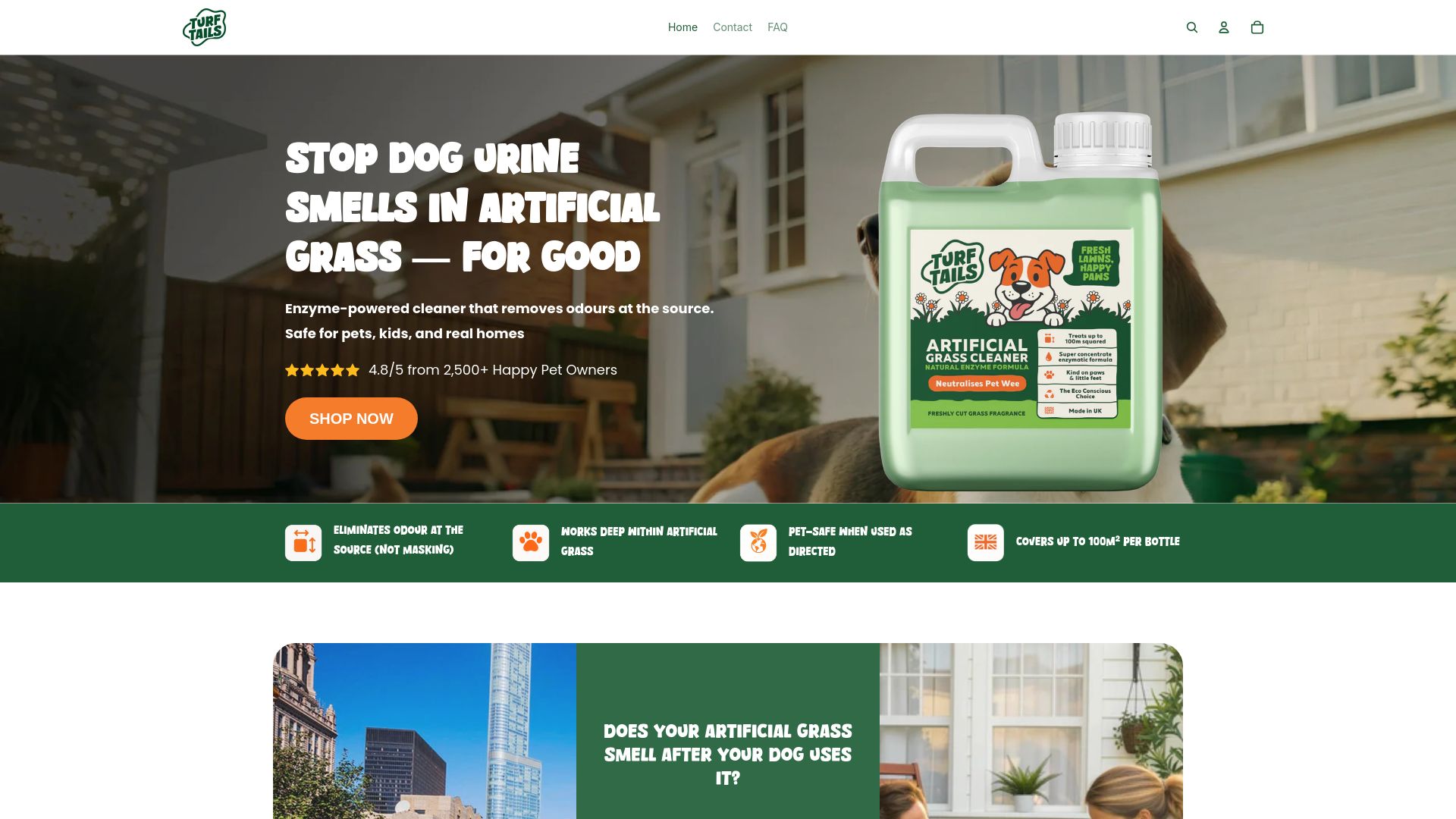
One bottle covers up to 100 m², making it practical for routine seasonal maintenance as well as targeted deep treatments after heavy use. It is safe for pets and children once dry, biodegradable, and works on artificial grass, patios, decking, concrete, kennels, and fabrics. If your garden smells of urine despite regular cleaning, this is the product that addresses the source rather than the symptom.
Order Turftails directly from the website, with one-time purchase and subscription options available.