

Saturate the affected area with an enzyme cleaner, leave it wet for an extended period, then extract or follow with an oxidiser if any odour remains. That two-step sequence addresses the actual problem: uric acid crystals that form as urine dries and re-emit smell every time humidity rises. Surface sprays and air fresheners do not reach them. If the smell is unusually sharp, sour, or accompanied by increased urination or lethargy, book a vet appointment before you clean — sudden changes in urine odour can signal a urinary tract infection, kidney disease, or diabetes. For outdoor or artificial turf situations, Turftails offers an enzyme-based cleaner designed specifically for that surface.
Key takeaways
Enzyme cleaners with extended wet contact are the most reliable method for eliminating old dog urine smell from carpets, hard floors, and outdoor surfaces.
| Point | Details |
|---|---|
| Find every spot first | Use a UV/black-light torch in a darkened room to map all dried urine before treating. |
| Enzymes need time | Allow 12–48 hours dwell time for set-in or pad-level stains; cover with plastic film to prevent drying. |
| Never use heat first | Steam or heat before enzyme treatment can permanently bond urine proteins to fibres. |
| Escalate methodically | Repeat enzyme passes, then extraction, then professional pad replacement as a last resort. |
| Turftails for outdoor surfaces | Turftails’ enzyme cleaner is formulated for artificial grass, patios, and decking — covers up to 100m² per bottle. |
See a vet promptly if your dog’s urine smell changes suddenly, or if urination is accompanied by discomfort, blood, or lethargy.
Table of Contents
- Why does old dog urine smell keep coming back?
- How do you find old or hidden urine spots?
- Step-by-step: removing old dog urine smell from carpet
- Cleaning hard floors, rugs, and soft furnishings
- When should you call a professional carpet cleaner?
- How to stop repeat marking and when to see a vet
- Why enzymes first, then oxidisers, gives the best result
- Are enzyme cleaners safe for homes with pets and children?
- How to neutralise urine odours in HVAC systems and infrequently cleaned soft furnishings
- DIY homemade enzymatic cleaner alternatives
- What actually works, and what wastes your time
- Turftails: the enzyme solution for artificial grass and outdoor surfaces
- Sources
Why does old dog urine smell keep coming back?
The short answer: you are fighting chemistry, not just dirt.
- Uric acid crystals form as urine dries and bond to carpet fibres, grout, and wood grain. They are not water-soluble, so mopping or rinsing simply redistributes them. When the air warms up or humidity rises, they re-activate and release volatile compounds — which is why a room can smell fine in winter and unbearable in summer.
- Bacterial breakdown converts urea into ammonia and other volatile organic compounds. That sharp, eye-watering smell is largely ammonia produced by bacteria feeding on organic residue.
- Pheromones in dog urine act as a chemical signal to the dog itself and to other dogs. PetMD explains that enzymatic cleaners destroy these pheromone proteins, which is why removing the chemical signal matters as much as removing the smell — without it, dogs are likely to mark the same spot again.
Baking soda and white vinegar are popular home remedies, but stain-care specialists at James are clear that neither removes uric acid crystals. They can mask surface ammonia temporarily, but the crystals remain in the pad or subfloor and the smell returns. Knowing this saves you weeks of frustrating repeat attempts.
How do you find old or hidden urine spots?
You cannot treat what you cannot find. Dried urine is often invisible in normal light, especially on dark carpets or patterned rugs.
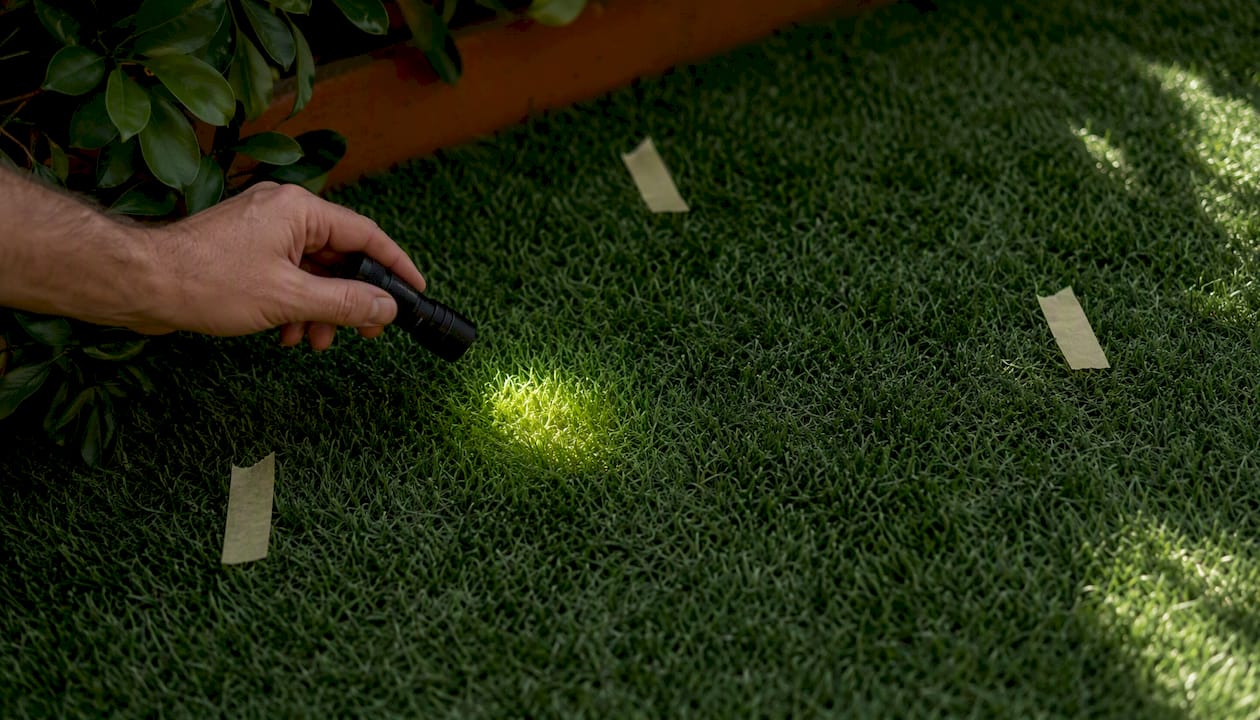
The UV/black-light method is the most reliable approach. Turn off all lights and close the curtains, then sweep a UV torch (widely available for under £15 online) slowly across the floor. Dried urine fluoresces as a pale yellow-green glow. Mark each patch with a piece of masking tape before you turn the lights back on — it is surprisingly easy to lose track of where the spots were.
Pro Tip: Buy a UV torch with at least 395nm wavelength. Cheaper models at 365nm are less effective on urine specifically and may miss faint older stains.
Beyond the floor, check carpet seams, the edges where carpet meets skirting boards, behind radiators, under sofa cushions, and the base of furniture legs. Dogs often mark vertical surfaces too, so run the torch up walls and door frames at nose height. If you suspect the carpet pad is saturated, press a dry white cloth firmly into the carpet and check for yellow transfer — or probe gently with a thin screwdriver to feel whether the pad feels damp or stiff. Stiff, crunchy pad is a sign of heavy crystalline build-up.
Step-by-step: removing old dog urine smell from carpet
Before you start
Never apply heat or steam to a urine stain before enzyme treatment. Professional cleaning guides warn that heat drives urine proteins deeper into fibres and can cause irreversible bonding, making the smell permanent. Start cold.
For a fresh stain, blot firmly with a dry cloth to absorb as much liquid as possible. Press down hard and hold rather than rubbing, which spreads the stain. For a set-in stain, skip the blotting and go straight to the enzyme step.
The enzyme treatment
- Rehydrate the stain. Pour a small amount of cold water onto the area to loosen the dried crystals before applying the enzyme cleaner. This gives the enzymes something to work with.
- Apply enzyme cleaner generously. Pour rather than spray for set-in stains — you need the cleaner to penetrate to the same depth the urine reached. For a stain that soaked through to the pad, use enough to saturate the pad too.
- Cover with plastic film. Lay cling film or a plastic bag over the treated area and tape the edges down. This slows evaporation and keeps the enzymes active for longer.
- Allow extended dwell time. Fresh stains need a minimum of 2 hours. Old or pad-level stains need 12–48 hours of wet contact. Check the area is still damp at the halfway point and add more cleaner if it has dried out.
- Extract or blot dry. Use a wet vacuum (wet vac) to extract the liquid. If you do not have one, blot repeatedly with dry towels and then run fans and a dehumidifier to dry the area fully. Incomplete drying allows mould to develop.
- Recheck with UV light. Once the carpet is fully dry, run the torch over the treated area. Residual glow means the crystals are still present — repeat the enzyme pass before moving to an oxidiser.
For pad-level contamination, a syringe or turkey baster lets you inject enzyme cleaner directly through the carpet backing into the pad. Two or three passes are normal for old stains.
| Stage | Recommended dwell time | Recheck method |
|---|---|---|
| Fresh surface stain | a few hours | UV torch after drying |
| Set-in surface stain | longer dwell time | UV torch after drying |
| Pad-level contamination | extended wet contact (repeat if needed) | UV torch + press test |
| Post-oxidiser treatment | short dwell time | Smell test + UV torch |
Pro Tip: For dwell-time guidance specific to enzyme products, Turftails’ enzyme dwell-time guide covers the variables clearly — useful even for indoor carpet situations.
DIY enzyme cleaner costs vary by product. A professional wet-extraction session typically costs more and depends on contamination and company.
Cleaning hard floors, rugs, and soft furnishings
Different surfaces need different approaches, and the spot-test rule applies everywhere: apply a small amount of any cleaner to a hidden area and wait 10 minutes before treating the full stain.
- Tiled and sealed stone floors: wipe away surface residue, apply enzyme cleaner and leave for 20–30 minutes, then wipe clean. If odour persists, follow with a diluted oxidiser solution (hydrogen peroxide at 3% is widely available). Rinse thoroughly afterwards. Consumer Reports notes that oxidising cleaners can work faster than enzymes on some compounds but must be spot-tested first.
- Wooden and laminate floors: use minimal moisture. Apply enzyme cleaner with a damp cloth rather than pouring, and dry immediately. Standing liquid can warp wood or lift laminate. Avoid oxidisers on unsealed wood — they can bleach the grain.
- Rugs: treat the same way as carpet, but lift the rug to treat the underside and the floor beneath it. Air-dry flat rather than hanging, which can distort the shape. If the rug’s filling or backing is saturated, professional cleaning is usually more cost-effective than repeated home attempts.
- Upholstery: blot, apply enzyme cleaner, cover with plastic film, and allow 4–8 hours dwell time. Extract with a wet vac or blot dry. For cushions with foam filling, the foam may need to be removed and treated separately.
- Machine-washable items (bedding, blankets, dog beds): pre-soak in cold water with an enzyme laundry additive for at least an hour, then wash at the warmest temperature the care label allows. Do not tumble-dry until the smell is completely gone — heat sets any remaining odour. For washable items with set-in stains, adding an oxygen bleach booster alongside the enzyme additive improves results on fabrics that can tolerate it.
- Dry-clean-only fabrics: blot, apply a small amount of enzyme cleaner to the stained area only, allow to air-dry, then take to a professional dry cleaner and tell them the stain is urine-based so they can choose the right solvent.
For pet-safe cleaning on patios and hard outdoor surfaces, the same enzyme-first principle applies.
When should you call a professional carpet cleaner?
Home treatment works well for surface and light pad contamination. There are clear signs it is time to bring in a professional.
- The smell returns within a week of two full enzyme treatments.
- Multiple spots are saturated across a room, or the contamination covers a large area.
- You can see or smell mould, or the subfloor feels soft or damp when you press through the carpet.
- The pad has a dark, stiff, crystalline crust visible at the edges.
When you call a professional, ask specifically for bio-enzymatic or enzyme extraction treatment and confirm they use truck-mounted extraction equipment, which generates far more suction than portable units. Standard steam-only cleaning is not suitable for urine odour and can make the problem worse. Look for IICRC-certified technicians who specialise in pet odour remediation.
In the UK, single-room enzyme extraction typically costs £80–£150. Full pad replacement, which involves lifting the carpet, removing the old pad, treating the subfloor, and relaying new pad, runs considerably higher and varies by room size and contractor. Pad replacement is the only permanent fix when the subfloor itself is contaminated.
How to stop repeat marking and when to see a vet
Cleaning the stain is only half the job. If the pheromone signal remains, the dog will return to the same spot.
- Remove the chemical signal completely. Enzyme cleaners are the only products that destroy pheromone proteins rather than masking them. Incomplete treatment leaves enough signal to trigger re-marking.
- Redirect outdoor elimination. Create a consistent outdoor toilet area with a specific surface your dog associates with going. Reward every correct outdoor elimination with a treat immediately afterwards — timing matters more than the size of the reward.
- Establish a consistent schedule. Older dogs often lose bladder control gradually. More frequent outdoor trips (every 2–3 hours for senior dogs) reduce accidents significantly.
- In multi-dog households, treat every spot thoroughly before allowing the other dogs back into the area. One dog’s pheromone signal can trigger marking from others. For large dogs or homes with multiple dogs, a monthly deep-clean routine using enzyme products keeps background odour low.
Vet referral cues: book an appointment promptly if you notice a sudden, strong change in urine smell (particularly a very sweet or very sour odour), if your dog is urinating more frequently or straining, if there is blood in the urine, or if your dog seems uncomfortable or lethargic. These can indicate a urinary tract infection, kidney disease, liver problems, or diabetes — all of which need diagnosis and treatment, not just cleaning.
Why enzymes first, then oxidisers, gives the best result
The sequence matters because the two chemistries do different jobs.
Enzyme cleaners contain biological catalysts (proteases, lipases, and urease-specific enzymes) that digest the organic compounds in urine at a molecular level. They break down uric acid crystals, proteins, and the pheromone molecules that trigger re-marking. The limitation is time: enzymes need extended wet contact to work through crystallised residue, particularly in carpet pad.
Oxidising cleaners, such as accelerated hydrogen peroxide or oxygen bleach, act faster on some volatile compounds and can neutralise residual odour after the enzyme stage. However, Consumer Reports advises that oxidisers should be spot-tested before use because they can bleach or damage certain surfaces and fabrics. Starting with enzymes minimises this risk and avoids interfering with the oxidiser’s action later.
The practical sequence: rehydrate the crystals with cold water, apply enzymes with a long dwell time, extract, then apply an oxidiser only if residual odour remains after the area is fully dry. Never mix enzyme cleaners and oxidisers in the same application — the oxidiser will deactivate the enzymes before they finish working. And never use heat at any stage until the odour is completely gone.
Are enzyme cleaners safe for homes with pets and children?
Enzyme-based cleaners formulated for pet use are generally among the safest options available for households with children and animals. The active ingredients are biological proteins rather than synthetic chemicals, and most reputable formulations are free from bleach, artificial perfumes, and harsh solvents.
When choosing a product, look for formulations that are explicitly labelled non-toxic, fragrance-free (or naturally fragranced), and safe for use around pets and children once dry. Avoid products that list quaternary ammonium compounds (quats) as active ingredients — these are effective disinfectants but can irritate respiratory tracts and paws at higher concentrations.
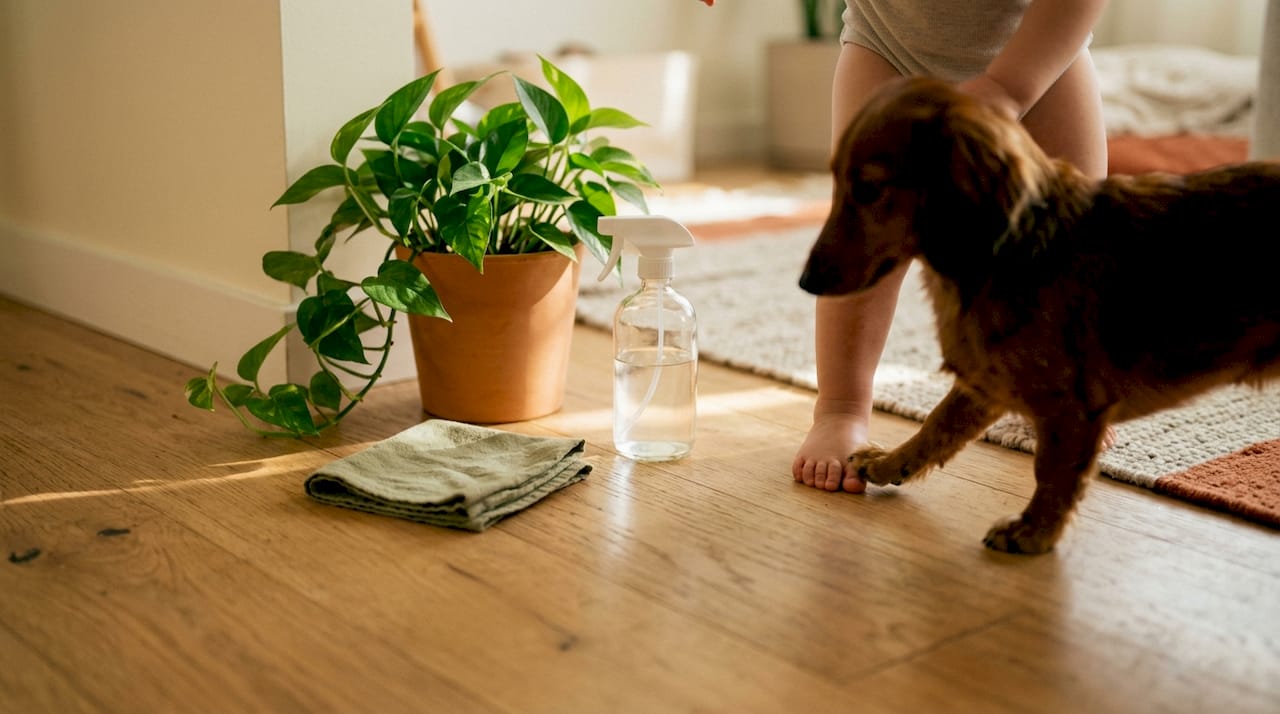
For outdoor use, eco-credentials matter more because runoff reaches soil, drains, and wildlife. Turftails is formulated to be eco-friendly and free from harsh chemicals, which makes it a practical choice for gardens where children and dogs play. The same principle applies indoors: once an enzyme cleaner has dried fully, the treated surface is safe for pets and children to use.
How to neutralise urine odours in HVAC systems and infrequently cleaned soft furnishings
HVAC systems can circulate urine odour through an entire house, particularly when a heavily contaminated room is nearby. If you suspect the system has drawn in odour, replace the air filter first — this is the most accessible fix and often resolves the problem. For ducting that has absorbed odour over time, a professional HVAC cleaning service using enzyme-based fogging is the most reliable solution; standard duct cleaning without enzyme treatment will move the odour rather than eliminate it.
Soft furnishings that are rarely cleaned — curtains, padded headboards, fabric wall panels — accumulate odour gradually and are easy to overlook. For curtains, remove and machine-wash where the care label allows, using an enzyme laundry additive. For fixed soft furnishings, a handheld steam cleaner used after enzyme treatment (not before) can help open fibres and allow a second enzyme application to penetrate more deeply. Allow full drying between each pass.
DIY homemade enzymatic cleaner alternatives
True enzymatic cleaners require live bacterial cultures or isolated enzymes that are not easily replicated at home. However, a citrus enzyme solution made from fruit peel, sugar, and water can produce some enzymatic activity after a fermentation period of roughly three months. The process involves combining citrus peel, brown sugar, and water in a ratio of approximately 3:1:10 by weight, sealing loosely to allow gas to escape, and leaving to ferment. The resulting liquid contains organic acids and some enzymatic compounds that can help break down surface odour.
The honest caveat: homemade solutions are significantly less concentrated and less reliable than commercial enzyme cleaners, and they are unlikely to reach pad-level contamination effectively. They work reasonably well as a maintenance rinse for lightly soiled surfaces or as a follow-up treatment after a commercial enzyme pass. For set-in old dog urine smell in carpet, a commercial enzyme product is worth the investment.
A simpler interim option: a solution of washing-up liquid and cold water can lift surface residue and reduce ammonia smell temporarily, but — as with baking soda and vinegar — it does not address uric acid crystals.
What actually works, and what wastes your time
The most common mistake is under-dosing. Pet owners apply a light spray, wait an hour, and conclude the enzyme cleaner has not worked. For a stain that has been sitting for weeks or months, a light spray barely reaches the surface of the carpet pile. The enzyme cleaner needs to match the depth of the original urine penetration — if the urine soaked through to the pad, the enzyme cleaner must too.
The second most common mistake is using heat too early. Steam cleaning feels thorough, but on urine it is counterproductive. The heat bonds proteins to fibres permanently and can make a manageable problem into an irreversible one.
Baking soda is not a solution for pad-level contamination. It absorbs surface ammonia and can reduce smell temporarily, which creates a false sense of progress. The uric acid crystals remain, and the smell returns within days or weeks. Measured escalation is the right approach: start with a generous enzyme application and a long dwell time, repeat if needed, then move to extraction, and consider pad replacement only when multiple passes have failed.
Patience is not optional here. Two or three full enzyme treatments over several days is normal for old, set-in stains. Rushing to the next step before the previous one has had time to work is the single biggest reason home treatments fail.
Turftails: the enzyme solution for artificial grass and outdoor surfaces
If the urine smell is coming from artificial grass, a patio, decking, or concrete, the indoor carpet protocol above does not fully apply. Outdoor surfaces need a cleaner that can handle UV exposure, drainage, and the specific way urine concentrates in artificial turf fibres.
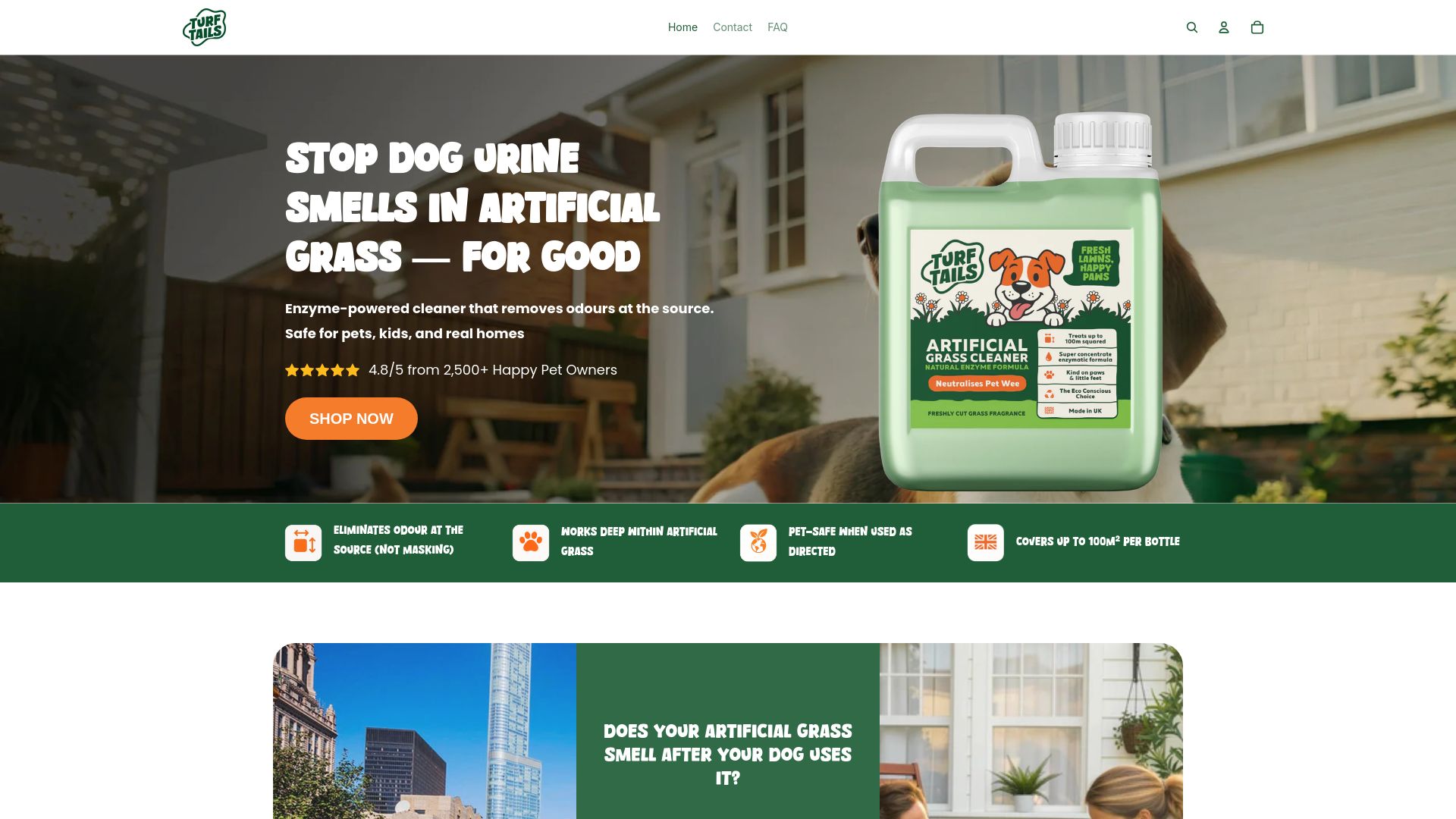
Turftails is an enzyme-based cleaner formulated specifically for artificial grass and outdoor surfaces. It breaks down urine compounds at a molecular level rather than masking them, contains no harsh chemicals or artificial perfumes, requires no rinsing, and covers up to 100m² per bottle. The formula is eco-friendly and safe for pets and children, which matters when dogs and children use the same garden space. For a detailed routine on keeping artificial grass odour-free, the Turftails blog covers the full application process. To order or find out more, visit Turftails.
Sources
- Best enzyme cleaners and oxidizers for pet stains and odours | Consumer Reports
- How To Get Dog Pee Out of Carpet, Floors, and Couches | PetMD
- How to Get Dog Pee Smell Out of Carpet for Good | Enzyme Cleaners
- How to Get Dog Urine Smell Out of Carpet (For Good)
- Removing urine stains | Stain removal help + tips (2026) | James
This article is general information, not a substitute for advice from a qualified doctor. Consult a qualified healthcare professional about your own circumstances before acting on anything here.