

A properly applied enzymatic treatment, with thorough saturation and the right dwell time, is the only reliable DIY way to remove dog urine smell from concrete. Here is what to do right now:
- Locate the spot using paper towels or a UV blacklight torch in low light.
- Soak it generously with an enzyme-based cleaner such as Turftails, covering the full wet area plus 15–30 cm beyond the visible stain.
- Cover and leave it. Lay plastic sheeting over the treated area and allow 24–72 hours of contact time. The process is not instant, but it is thorough.
Turftails is the recommended enzyme option here. It breaks down urine compounds at the molecular level, contains no harsh chemicals, and is safe for pets and children once dry.
Key takeaways
Enzymatic saturation with a 24–72 hour dwell time is the only DIY method that reliably removes dog urine odour from concrete by breaking down uric acid crystals at their source.
| Point | Details |
|---|---|
| Act immediately on fresh urine | Blot, rinse with cold water, apply enzyme cleaner, and cover within the first hour. |
| Saturate beyond the visible stain | Treat at least 15–30 cm past the edge of the stain; urine spreads under the surface. |
| Test for sealed concrete first | Water-bead test reveals sealed surfaces; strip sealer before enzyme treatment or it will not penetrate. |
| Seal after treatment | Apply a penetrating sealer 48–72 hours after the concrete is fully dry to prevent future absorption. |
| Turftails for concrete | Covers up to 100 m², enzyme-based, no harsh chemicals, and safe for pets and children once dry. |
Table of Contents
- Why concrete holds dog urine odor
- Removing fresh dog urine from concrete quickly
- Treating deep-set or long-standing urine odour in concrete
- Products and mistakes that make the problem worse
- Stopping the smell returning: sealing and behaviour
- Turftails enzyme cleaner on concrete: how it works
- Realistic costs and timeline for UK dog owners
- When DIY has failed and you need a professional
- Sources
Why concrete holds dog urine odor
Think of concrete as a porous sponge. Urine does not just sit on the surface; it seeps into microscopic pores and, as it dries, forms uric acid crystals that bond to the material. Standard cleaners, hot water, and disinfectants reach the surface but cannot dissolve those crystals. Every time humidity rises, the crystals reactivate and release that sharp, ammonia-heavy smell all over again.
The behavioural consequence is just as frustrating. Dogs navigate largely by scent, and uric acid molecules act as a chemical bookmark. If those molecules remain in the concrete, your dog will almost certainly return to the same spot and mark it again.
Pro Tip: Use a UV blacklight torch (available from most UK hardware shops for under £10) in a darkened area to reveal dried urine patches that are invisible in daylight. Treat every patch you find, not just the ones you can smell.
Removing fresh dog urine from concrete quickly
Speed matters. The longer urine sits, the deeper it penetrates and the harder it becomes to remove. Follow these steps as soon as you spot an accident.
- Blot immediately. Lay several sheets of paper towel or an old cloth over the wet patch and press down firmly. Remove as much liquid as possible before it soaks further in. Do not rub — that spreads the urine.
- Sweep and prepare the surface. Remove loose grit, leaves, or debris so the enzyme cleaner can make direct contact with the concrete.
- Rinse lightly with cold water. A brief rinse dilutes the remaining urine and opens the pores slightly. Avoid hot water — it can drive urine deeper into the concrete.
- Apply your enzyme cleaner. Dilute Turftails concentrate according to the label, then pour or spray it generously over the affected area. For a fresh accident on a small patch, one thorough application is usually sufficient to begin.
- Cover and wait. Lay plastic sheeting or a bin bag over the treated area to keep it damp. For fresh urine, 24 hours is typically enough. Enzymatic bacteria need moisture to stay active and digest the uric acid.
- Keep pets and children away until the area is fully dry. Once dry, Turftails leaves no harmful residue, but wet enzyme product on paws is best avoided.
- Check and repeat if needed. After the dwell time, remove the covering, allow the area to air dry, and smell-test. A single treatment resolves most fresh accidents.
For PPE, a pair of disposable gloves is sufficient for handling enzyme cleaners. Avoid touching your face, and wash hands after application.
A two-stage routine — a light surface clean followed by enzymatic treatment — is widely recommended even for fresh accidents, because it removes surface debris that would otherwise block the enzyme from reaching the concrete.
Treating deep-set or long-standing urine odour in concrete
Old or repeated accidents are a different challenge. The uric acid has had time to bond deep in the pores, and a single light application will not reach it.
Check whether the concrete is sealed first
Drip a few drops of water onto the surface. If the water beads up, the concrete is sealed. If it soaks in within a few seconds, it is unsealed. This single test changes everything about your approach.
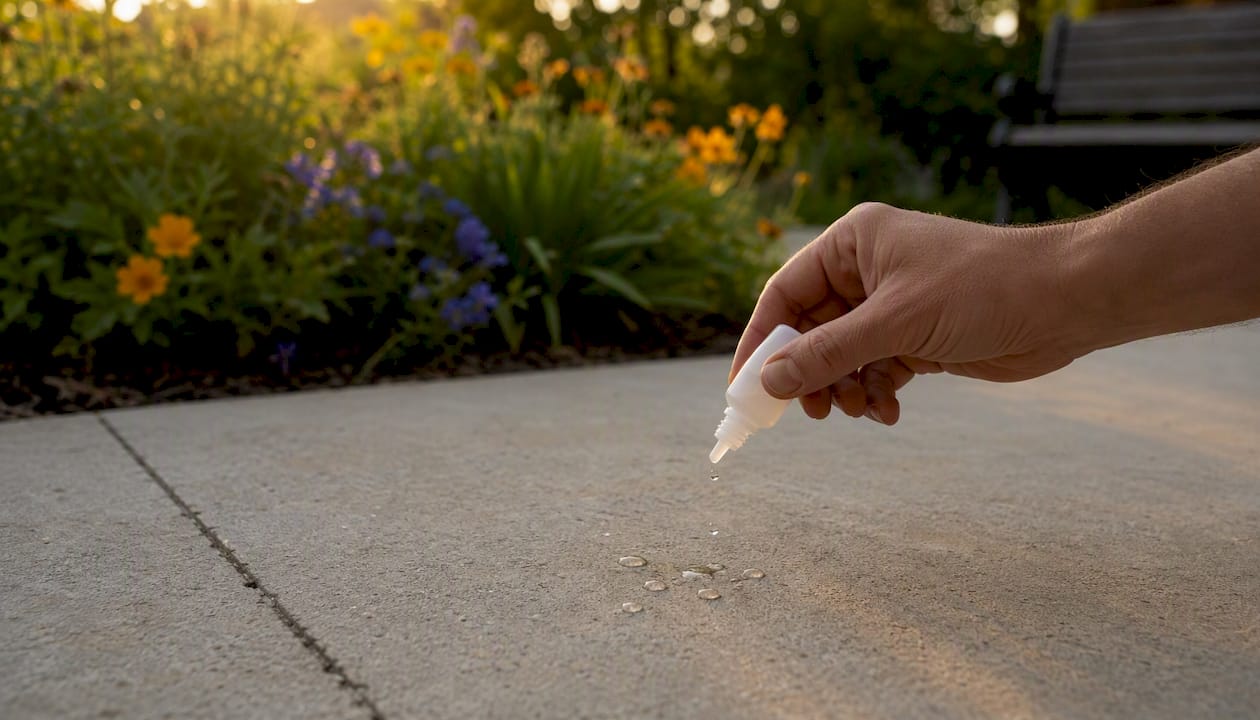
For unsealed concrete, the pour-on-and-cover method is the most effective DIY approach. Pour the enzyme cleaner generously — far more than you think is necessary. Extend the treated area at least 15–30 cm beyond the visible stain, because urine spreads under the surface well beyond what you can see. Cover tightly with plastic sheeting and leave for 48–72 hours. For a heavily contaminated area, a second treatment after the first has dried is often needed.
For a poultice approach on stubborn patches: mix a small amount of enzyme cleaner with an absorbent powder such as bicarbonate of soda or diatomaceous earth to form a thick paste. Apply it over the stain, cover with plastic, and leave for 24–48 hours. The paste draws moisture and odour compounds up out of the concrete as it dries. Wear gloves, and keep the mixture away from nearby plants.
For sealed concrete, the sealer itself is the problem. Enzyme cleaners cannot penetrate an intact coating, so they sit on top and never reach the urine underneath. You need to strip the sealer in the affected area first, using a chemical stripper or light mechanical abrasion, before applying the enzyme treatment. After treatment, allow the concrete to dry fully (48–72 hours minimum) before resealing.
Covered patios, garages, and porches need more aggressive treatment than open outdoor areas. Rain and UV exposure can help break down outdoor contamination over time, but a covered surface gets no such help and may need several rounds of enzyme treatment.
Signs you need to repeat the treatment:
- The smell returns within a few days of drying.
- The UV light still shows active patches after treatment.
- The concrete feels tacky or discoloured in the treated area.
Pro Tip: Before a long soak, protect any nearby plants, painted surfaces, or timber by covering them with plastic sheeting. Enzyme cleaners are generally eco-friendly, but prolonged contact with plant roots or painted wood is worth avoiding.
Products and mistakes that make the problem worse
Some of the most common household cleaning products actively work against you when it comes to concrete urine smell.
- Bleach sanitises and may lighten the visible stain, but it does not break down uric acid crystals. The smell returns, often within days.
- Ammonia-based cleaners are particularly counterproductive. Urine contains ammonia, so cleaning with an ammonia product reinforces the scent signal and can encourage re-marking.
- Hot water can drive urine deeper into the concrete rather than lifting it out.
- Jeyes Fluid and similar garden disinfectants may mask the smell briefly, but they can seal odour compounds under a coating and make enzymatic treatment harder afterwards.
- Vinegar is mildly acidic and can neutralise some surface odour, but it does not dissolve uric acid crystals embedded in concrete. It is a temporary fix at best.
- Bleach mixed with vinegar or ammonia produces chlorine gas or chloramine vapour. Never mix these products. Work in a ventilated area and wear gloves whenever you are using any cleaning product on concrete.
The pattern with all of these is the same: they address the surface, not the source. Uric acid crystals sit below the surface, and only enzymatic action digests them. For safer alternatives to harsh garden disinfectants, see Turftails’ guide to Simple Green alternatives.
Stopping the smell returning: sealing and behaviour
Once the odour is gone, the goal is to keep it gone. Two things matter: sealing the concrete and changing the behaviour pattern.
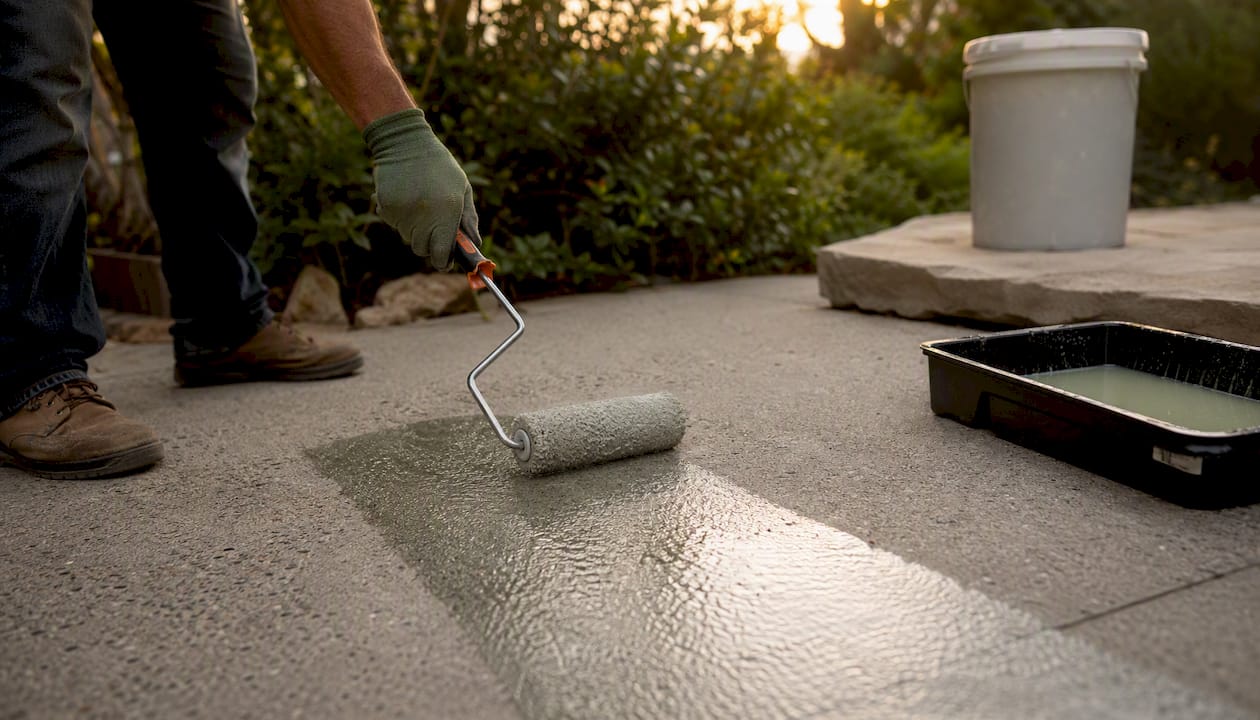
Choosing and applying a concrete sealer
A penetrating sealer fills the microscopic pores in the concrete rather than sitting on top as a film. This is the type you want for odour prevention. Surface coatings (epoxy paints, for example) can trap future urine beneath them and create the same problem you just solved.
Wait at least two to three days after enzyme treatment before applying any sealer, and confirm the concrete is completely dry. Do a patch test in an inconspicuous corner first. Most penetrating sealers cover several square metres per litre on typical patio concrete.
Behaviour and maintenance
Redirecting your dog away from the treated area while the scent memory fades is worth the effort. Use a lead to guide them to a designated toilet spot, reward them consistently for using it, and clean any new accidents immediately. A regular enzyme-cleaner maintenance wash every few weeks prevents build-up before it becomes a problem.
For disposal of rinse water after treatment, dilute it well and pour it down an outdoor drain rather than into a water course or near plant roots.
Pro Tip: After resealing, apply a light maintenance spray of enzyme cleaner once a month to the area your dog favours. It takes two minutes and prevents the gradual build-up that leads to a full deep-treatment job.
Turftails enzyme cleaner on concrete: how it works
Turftails is an enzyme-based cleaner formulated to break down urine compounds at the molecular level rather than masking them. It works on concrete, patios, decking, artificial grass, kennels, and fabrics, making it a practical single-product solution for most outdoor surfaces.
- No harsh chemicals or artificial perfumes. The formula is eco-friendly and safe for pets and children once the treated area is dry.
- No rinsing required. Apply, cover, and leave. The enzymes do the work without a follow-up rinse step.
- Concentrated formula. One bottle covers up to 100 m², making it cost-effective for larger patios or repeated treatments.
- Dilution for concrete. Follow the label for the recommended dilution ratio. For deep-set stains, a stronger concentration applied generously outperforms a diluted spray applied lightly.
- Storage. Keep the concentrate in a cool, dry place away from direct sunlight and freezing temperatures. Heat and frost both degrade enzyme activity, reducing effectiveness.
For detailed enzyme cleaning routines and dwell-time guidance, Turftails’ own blog covers the technical side clearly.
Pro Tip: Buy the concentrate rather than a ready-to-use spray if you have more than one or two patches to treat. The cost per litre of working solution drops significantly, and you control the dilution for different surface types.
Realistic costs and timeline for UK dog owners
Enzyme cleaner concentrates in the UK typically cost £10–£25 per bottle, with a single bottle covering enough working solution for several treatments of a standard patio. Ready-to-use sprays run slightly cheaper upfront but cost more per square metre treated.
A penetrating concrete sealer costs roughly £15–£40 per litre in the UK, covering 4–8 m² depending on porosity. For a 10 m² patio, budget £20–£50 for sealer.
Professional odour remediation or concrete cleaning services in the UK vary widely, but a single-job treatment for a domestic patio typically starts at £80–£150, rising for larger areas or heavily contaminated garages.
| Stage | Typical timeframe | Estimated UK cost |
|---|---|---|
| Fresh urine treatment | 24 hours dwell time | £10–£25 (enzyme cleaner) |
| Deep-set odour treatment | 48–72 hours per round, 1–3 rounds | £10–£25 per bottle |
| Concrete sealing (after treatment) | 48–72 hours drying, then apply | £20–£50 for a standard patio |
| Professional remediation | 1 day on-site | £80–£150+ |
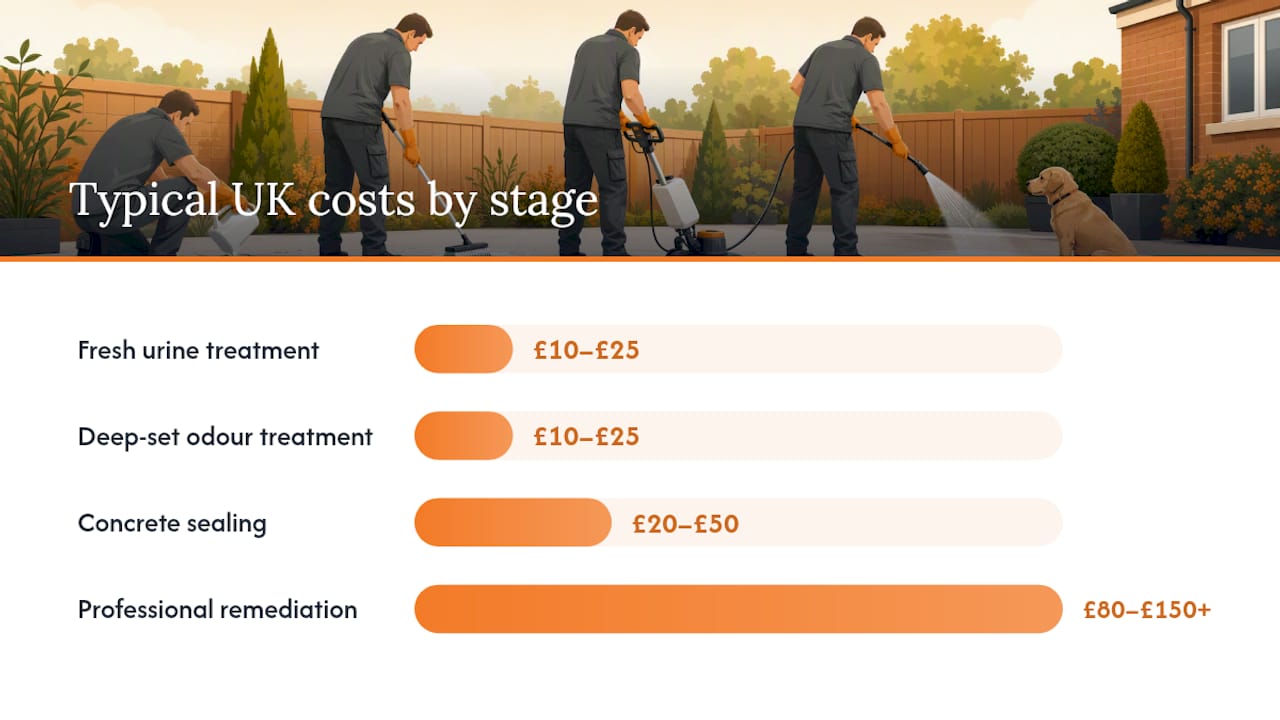
For dwell-time expectations and what to look for at each stage, Turftails’ timing guide is worth a read before you start.
When DIY has failed and you need a professional
Most concrete odour problems respond to two or three rounds of enzyme treatment. A few situations genuinely call for professional help.
- Persistent smell after three or more enzyme treatments, applied correctly with full dwell time.
- Urine beneath a large sealed area where stripping and retreating the whole surface is beyond a DIY budget or skill level.
- Structural staining or widespread contamination across a garage floor or large patio.
- Urine that has penetrated a concrete screed into the substrate below.
When searching for a professional in the UK, try terms such as “concrete odour remediation [your town]”, “hard floor deep cleaning specialist”, or “patio cleaning and sealing service.” Before booking, ask whether they use enzymatic or oxidising treatments (both can work), what their process is for sealed surfaces, and whether they guarantee odour removal or offer a follow-up visit.
Professional methods include mechanical grinding to remove the top layer of contaminated concrete, targeted chemical sealer removal, and industrial wet-extraction equipment that pulls enzyme solution deep into the slab and extracts it along with the dissolved uric acid. These are not DIY options, but knowing what to expect helps you ask the right questions.
The case for doing this properly once
Concrete is unforgiving. Unlike carpet or artificial grass, you cannot lift it, wash it, and replace it easily. That is exactly why a half-measure with bleach or a quick spray of disinfectant is such a false economy: you spend money, the smell returns within a week, and the uric acid crystals are still there, slightly deeper than before.
The enzyme approach works because it addresses the actual chemistry of the problem. Turftails recommends it not because it is the most convenient option, but because it is the one that actually stops the cycle. A dog that can no longer smell its own uric acid at a spot has no chemical reason to return to it. That is the outcome worth waiting 48–72 hours for.
The safety question comes up often, and it is a reasonable one. Enzyme cleaners work through biological activity, not corrosive chemistry. Once the treated area is dry, there is nothing harmful left on the surface. For households with dogs, children, or both, that matters.
Turftails enzyme cleaner: the practical next step
If you have a concrete patio, path, or garage floor that smells of dog urine, Turftails is the enzyme cleaner built for exactly this job. It breaks down uric acid at the molecular level, covers up to 100 m² per bottle, and contains no harsh chemicals or artificial fragrances. No rinsing needed. Safe for pets and children once dry.
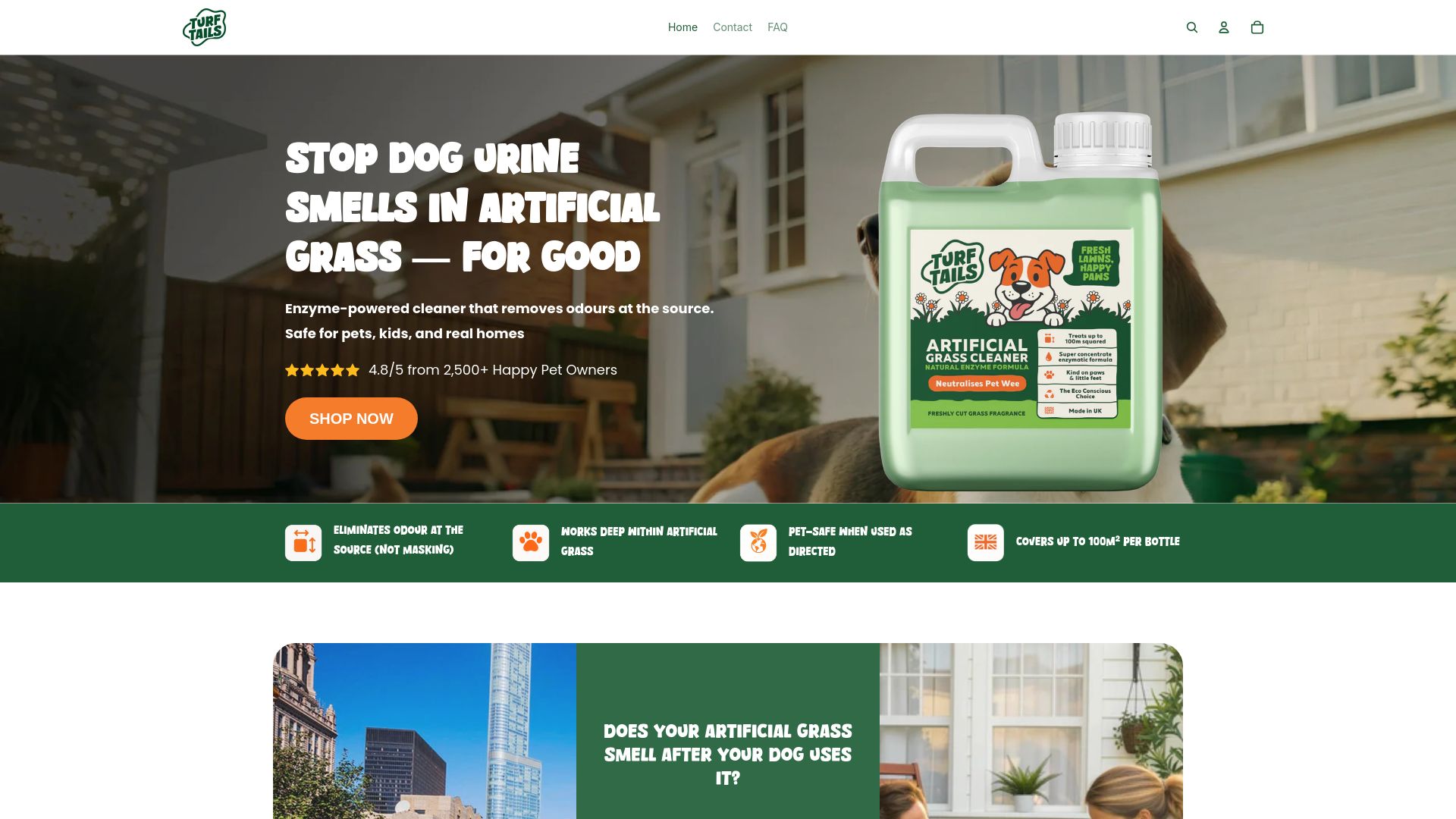
One bottle handles multiple treatments of a standard patio, and the concentrated formula means you are not paying for water. Available as a one-time purchase or on subscription so you never run out mid-treatment. Visit Turftails to order or find out more about the full product range.
Sources
- How to Remove Pet Urine from Concrete with Enzymes | Enzyme Cleaners
- How to Clean Dog Urine from a Concrete Patio: Odor and Stains 2026
- How to Get Dog Pee Smell Out of Concrete & Garages: 5 Proven Methods
- The Best Way To Banish Gross Dog Urine Smells From Concrete Floors
- How to Remove Dog Urine Smell From Concrete - CretoSeal