

The fastest fix for an ammonia smell on artificial grass is to remove any solids, flush the area thoroughly with a hose, then apply a pet-safe enzyme or microbial cleaner at dusk when UV levels are low. That sequence handles most fresh odour within a single treatment. If the smell returns within a day or two, or gets noticeably worse after rain, you are dealing with a structural problem, not a surface one, and cleaning alone will not solve it.
Three-step plan to tackle it now:
- Clear all solid waste and rinse the affected area with a hose, directing water away from the centre of the patch to flush uric acid crystals downward through the backing.
- Apply a pet-safe enzyme or microbial cleaner (such as Turftails) at dusk, covering the full hotspot and allowing it to dwell overnight without rinsing.
- Monitor the area for 48 hours. Repeat in high-use corners weekly until the smell stops returning.
Pro Tip: If the odour spikes after rain or on hot afternoons, uric acid crystals are trapped in the infill or sub-base. Surface rinsing will not reach them. Move straight to the deep-clean method below.
When smell persists after three or four treatments, or when you notice soggy turf, visible pooling, or a saturated base, the sub-base drainage is likely compromised. A correctly installed MOT Type 1 sub-base with permeable backing is the only permanent fix at that point, and you will need a professional.
Key takeaways
Uric acid crystals in the infill and sub-base are the root cause of persistent ammonia smell on artificial grass, and enzyme or microbial treatment at dusk is the most effective way to break them down.
| Point | Details |
|---|---|
| Uric acid crystals cause the smell | Rinsing alone does not remove them; heat and rain reactivate them, causing odour to return. |
| Apply treatments at dusk | UV degrades enzyme and microbial products; overnight dwell time gives them the best chance to work. |
| Poor drainage drives persistence | Poor drainage or a saturated sub-base is the root cause of most persistent odour cases |
| Call a professional when cleaning fails | If smell returns within 48 hours after repeated treatments, the sub-base needs assessment or replacement. |
| Turftails for routine and deep treatment | Turftails enzyme cleaner is pet-safe, covers up to 100m², and requires no rinsing after application. |
Table of Contents
- Why does artificial grass smell of ammonia?
- What to do right now to reduce the ammonia smell
- Deep-clean methods for persistent, baked-in ammonia smells
- Does your drainage or sub-base need fixing?
- Routine maintenance schedule to prevent odour returning
- How Turftails enzyme cleaner works
- When should you call a professional or replace the turf?
- A practical perspective on artificial grass odour
- Turftails: the pet-safe enzyme cleaner for UK dog owners
- Sources
Why does artificial grass smell of ammonia?
Dog urine contains urea, which bacteria break down into ammonia. On natural grass, the soil absorbs and processes those compounds. On artificial turf, there is nowhere for them to go.
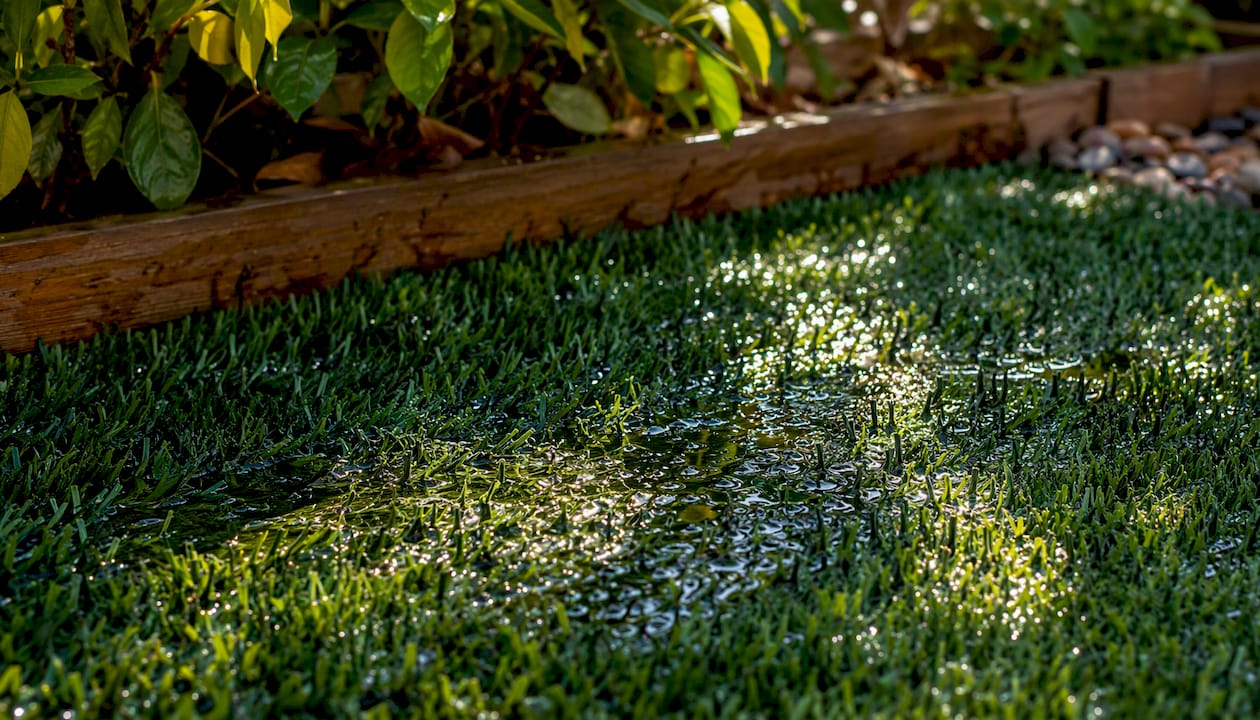
When urine passes through the grass fibres, it deposits uric acid crystals in the infill and backing. Unlike urea, uric acid crystals are not water-soluble, which is why a simple rinse rarely removes the smell permanently. Research confirms that those crystals remain embedded after rinsing and are reactivated by heat or rewetting, which explains why the smell often spikes on warm afternoons or directly after rain.
The main contributors to a persistent ammonia odour:
- Uric acid crystal build-up in the infill layer, which off-gasses ammonia when warmed or dampened
- Anaerobic bacterial growth beneath the turf when water pools and oxygen is excluded
- Blocked or non-permeable backing, which traps urine above the sub-base rather than letting it drain
- Compacted or impermeable sub-base, which prevents drainage and allows urine to saturate the base layer
- Poor installation depth, where insufficient excavation leaves no room for a proper drainage layer
Poor drainage and an incorrectly prepared sub-base are the root cause in most persistent odour cases, which is why surface cleaning so often provides only temporary relief. The smell is not in the grass blades. It is in the structure beneath them.
What to do right now to reduce the ammonia smell
Work through these steps in order. They are safe for pets, children, and the turf itself.
- Pick up all solid waste before applying any water or cleaner. Hosing over solids spreads bacteria rather than removing them.
- Flush with a hose using a directional spray. Push water from the edges of the affected patch inward and downward, not outward across clean turf.
- Agitate gently with a soft-bristled brush on small, heavily used patches to dislodge debris trapped in the fibres.
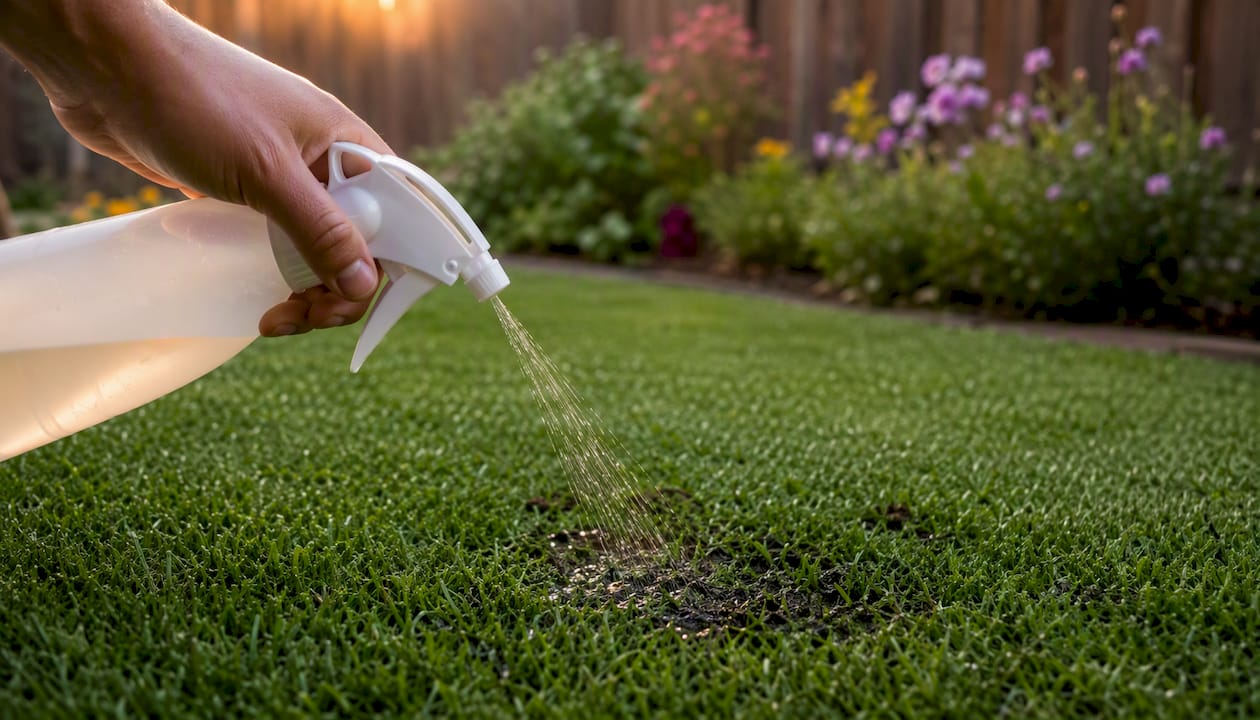
- Apply a pet-safe enzyme cleaner or microbial product formulated for outdoor turf. Apply at dusk so the product can work overnight without UV degradation or rapid evaporation. Keep the treated area damp for several hours if possible.
- Leave to dwell without rinsing for at least six to eight hours. Rinsing immediately after application removes the active treatment before it can work.
- Repeat on high-use areas every five to seven days until the smell stops returning between treatments.
What to use and what to avoid:
- Use: pet-safe enzyme cleaners, microbial outdoor turf products, diluted white vinegar as a short-term temporary measure (it neutralises ammonia briefly but does not break down uric acid crystals)
- Avoid: bleach, chlorine-based products, strong foaming detergents, and high-concentration ammonia cleaners. These can damage turf fibres, harm beneficial soil microbes, and are unsafe for pets. For safer alternatives to harsh disinfectants, the Turftails guide on Jeyes Fluid alternatives is worth reading before you reach for the cupboard.
Keep pets and children off the treated area until the product has fully dried, typically two to four hours after application in normal UK weather conditions.
Deep-clean methods for persistent, baked-in ammonia smells
If the smell returns within 48 hours of a surface clean, uric acid crystals have worked their way into the backing or sub-base. Standard enzyme application will not reach them at surface dilution. You need heavier saturation and longer dwell time.
Signs you need a deep clean rather than a surface treatment:
- Smell returns within one to two days of cleaning
- Odour is noticeably worse after rain or on warm afternoons
- The turf base feels soft or spongy underfoot
- Visible water pooling beneath or around the turf edges
Step-by-step deep-clean method:
- Clear and rinse the full affected zone as described above.
- Saturate heavily with a microbial cleaner at a higher dilution than standard maintenance doses. Microbial (live bacteria) treatments are particularly effective for deep-set uric acid crystals because the bacteria consume the crystals rather than simply breaking down surface molecules. Enzymes alone may only provide temporary relief on heavily contaminated bases.
- Cover with a tarp immediately after application. This retains moisture, prevents UV degradation, and keeps the microbial environment active overnight. Leave in place for eight to twelve hours.
- Remove the tarp and allow to dry naturally. Do not rinse for at least 12 hours after removing the cover.
- Repeat after 72 hours if the smell persists. Two or three heavy treatments over a week will address most deep-set contamination.
Pro Tip: The tarp method works best when overnight temperatures are above 10°C. Below that, microbial activity slows significantly. In colder months, extend dwell time to 16–18 hours and consider a second application the following evening.
For timing guidance on how long enzyme and microbial treatments take to work, the Turftails article on enzyme cleaner timings gives practical benchmarks. When the smell returns despite repeated deep cleans, the sub-base itself is saturated and no amount of surface treatment will provide a lasting fix.
Does your drainage or sub-base need fixing?
Surface and deep cleaning address the symptom. Drainage fixes address the cause. If urine cannot pass through the turf system and drain away, it will always accumulate and always smell.
Installation checklist for a correctly drained artificial grass system:
- Excavation to a minimum depth of 100mm below finished level
- Compacted MOT Type 1 aggregate base (crushed stone), which provides a stable, free-draining foundation
- Sharp sand levelling layer (25–30mm) over the MOT Type 1
- Permeable weed membrane between the sand and turf
- Turf with a permeable backing, meaning water passes through it freely rather than pooling on top
- Drainage channels or falls built into the sub-base to direct water away from the turf area
Infill options and their trade-offs for pet areas:
Signs your sub-base or backing is failing:
- Puddles on the turf surface after moderate rain
- Soft or spongy feel underfoot, particularly in corners
- Smell that returns within 24 hours of any cleaning
- Visible water sitting beneath lifted turf edges
A partial repair, such as improving drainage channels or replacing infill with zeolite, is sometimes enough when the base itself is intact. Full base replacement is necessary when the MOT Type 1 layer is saturated or compacted to the point where water no longer drains through it.
Routine maintenance schedule to prevent odour returning
Consistent, low-effort maintenance prevents the build-up that makes deep cleans necessary. The key is frequency, not intensity.
| Frequency | Task |
|---|---|
| Weekly | Rinse high-use areas with a hose; remove any solid waste promptly |
| Bi-weekly | Apply a diluted enzyme cleaner to hotspot areas at dusk |
| Monthly | Brush fibres upright with a stiff broom; check drainage is clear |
| Annually | Professional deep clean or heavy microbial saturation treatment; top up infill as needed |
Preventive measures that make a real difference:
- Zeolite infill in high-use corners passively absorbs ammonia between treatments, reducing the load on enzyme applications
- Designated toilet areas reduce the concentration of urine in a single patch; training your dog to use one corner of the garden, or a gravel area, limits the hotspot problem
- Prompt rinsing after every toilet visit is the single most effective low-effort habit. Uric acid crystals form as urine dries, so flushing before it dries prevents crystal build-up
- Consistent enzyme treatment every two weeks in summer (when heat accelerates off-gassing) keeps bacterial populations low
Rain does not clean artificial grass. It reactivates dormant uric acid crystals in the infill, which is why a garden that smells fine in dry weather can become noticeably unpleasant after a wet spell. A consistent routine prevents that cycle from establishing itself. For a full product routine, the Turftails guide on the best artificial grass cleaner for dog owners covers scheduling in more detail.
How Turftails enzyme cleaner works
Turftails is an enzyme-based cleaner formulated specifically for artificial grass and pet urine odour. It works by breaking down the urine compounds, including uric acid, at a molecular level rather than masking the smell with fragrance.
Key product features:
- Enzyme-based formula that targets urine compounds at source
- No harsh chemicals, bleach, or artificial perfumes
- Safe for pets and children once dry
- Covers up to 100m² per bottle
- Works on artificial grass, patios, decking, concrete, kennels, and fabrics
- Available as a one-time purchase or subscription for regular users
- Concentrated formula with no rinsing required after application
How to apply Turftails for best results:
- Remove solids and rinse the area with a hose first.
- Dilute according to the label instructions and apply evenly across the affected area.
- Apply at dusk to reduce UV exposure and allow overnight dwell time.
- Do not rinse. Allow to dry naturally.
- Repeat on high-use areas every one to two weeks as part of a routine maintenance schedule.
Turftails can be used on the same surfaces where urine odour is a problem beyond the turf itself, including patio slabs, decking, and kennel floors. For guidance on using it safely near pets, the Turftails pet-safe patio cleaner article covers surface compatibility and safety notes.
When should you call a professional or replace the turf?
Some odour problems cannot be solved with cleaning products, however good they are. Use this checklist to decide whether you need professional help.
- Smell returns within 48 hours of a correctly applied enzyme or microbial treatment, repeated across three or more sessions.
- Smell worsens after rain, indicating uric acid crystals are embedded in the base layer and being reactivated by moisture.
- The turf base is visibly wet or spongy after dry weather, suggesting the sub-base is saturated.
- Water pools on the surface after moderate rainfall and does not drain within 30 minutes.
- The turf is more than eight to ten years old and has had heavy pet use throughout, as backing permeability degrades over time.
A professional will typically lift the turf, assess the sub-base, recompact or replace the MOT Type 1 layer, replace contaminated infill, and re-lay the turf with a permeable backing. This is disruptive and costs more than any cleaning programme, but it is the only reliably permanent solution when the base is saturated. The Turftails article on when enzyme treatments are insufficient explains the decision point in more detail.
A practical perspective on artificial grass odour
The most common mistake dog owners make is treating an artificial grass odour problem as a cleaning problem when it is actually an installation problem. Bleach gets reached for. Heavy foaming cleaners get applied. Rain is assumed to do the work. None of these address uric acid crystals in the base, and bleach actively damages turf fibres and kills the beneficial microbes that would otherwise help break down residues.
The second mistake is underestimating how quickly hotspots develop. A dog that uses the same corner of the garden every day will deposit enough uric acid to overwhelm any surface treatment within weeks, particularly in summer. The fix is not more cleaning product. It is either a designated toilet area, zeolite infill in that corner, or both.
Cost versus permanence is a real trade-off. A professional sub-base replacement costs significantly more than a bottle of enzyme cleaner, but if the base is saturated, the cleaner is not solving the problem. The honest answer is to try two or three properly applied deep-clean treatments first. If the smell returns within 48 hours each time, the money spent on more cleaner is wasted. At that point, a professional assessment is the more cost-effective route.
Turftails: the pet-safe enzyme cleaner for UK dog owners
Persistent artificial grass odour from dog urine is a problem that enzyme cleaning solves reliably when the drainage is sound. Turftails is formulated specifically for that job: no harsh chemicals, no artificial perfumes, and safe for pets and children once dry.
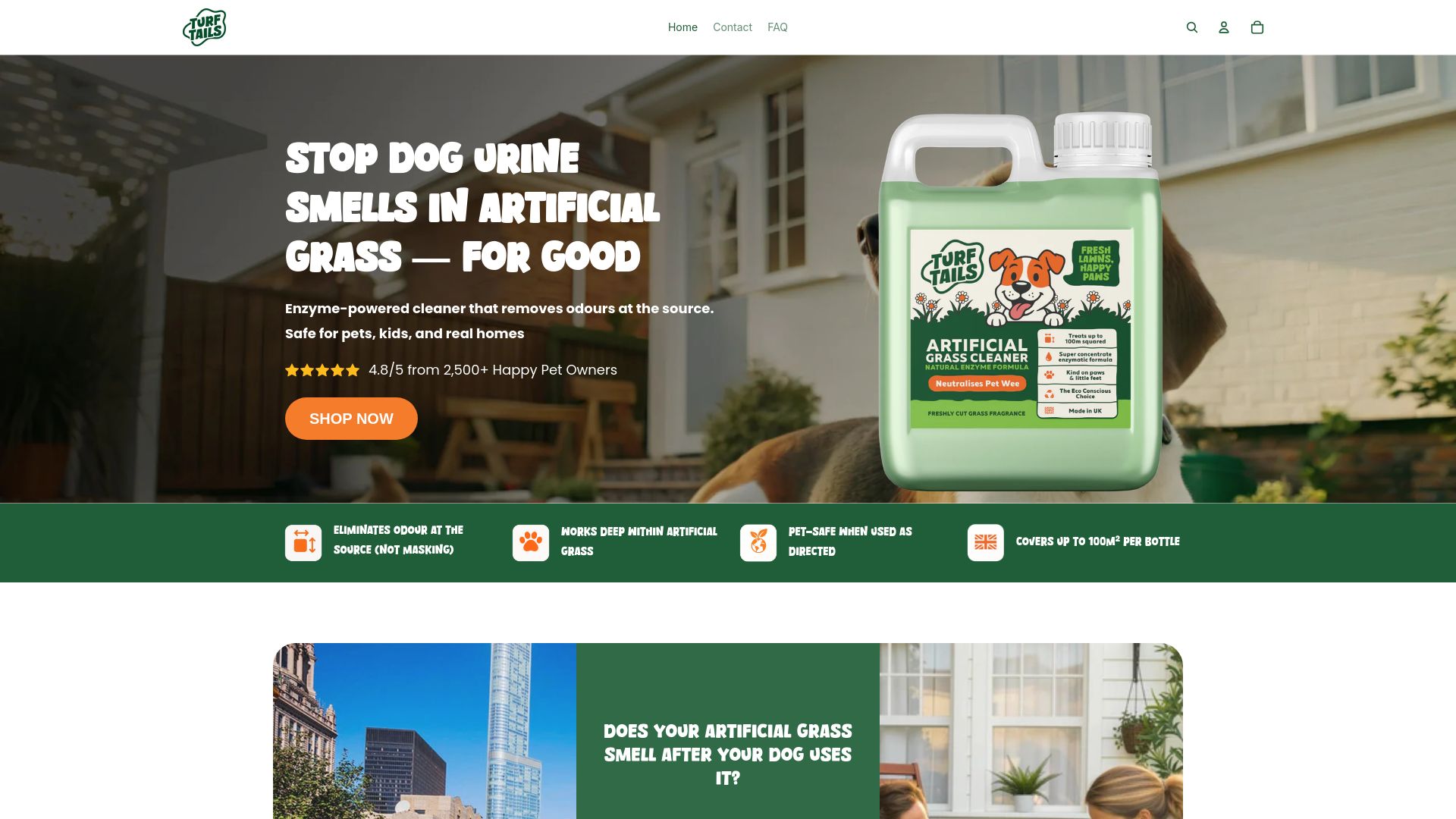
One bottle covers up to 100m² and requires no rinsing after application. Apply at dusk, leave overnight, and repeat fortnightly on high-use areas. A subscription option is available for households with regular pet use, keeping the routine consistent without reordering. Turftails ships quickly across the UK and works on artificial grass, patios, decking, kennels, and fabrics.
Try it on a small hotspot area first to see the difference before treating the full lawn. Order Turftails directly from the UK site and get the odour under control this week.
Sources
- How to stop artificial grass smelling of dog urine (UK guide 2026)
- Remove dog urine smell from artificial grass (2026) | Turf guide | INSTALL-IT-DIRECT
- Why your artificial turf smells after your dog uses it — Turfscapes of Arizona LLC
- How to clean artificial grass (dog urine) | Simple Green