

If your artificial grass smells of dog urine, the honest answer is that Zoflora is the wrong tool. Fragranced disinfectants mask odour temporarily; they do not break down uric acid crystals lodged in the turf fibres and backing. The right Zoflora alternative for artificial grass is a pet-safe enzymatic or live-microbe cleaner that digests urine compounds at the source.
Turftails is the recommended pick for UK dog owners. Here is why it stands out:
- Breaks down uric acid at the molecular level rather than masking it
- Explicitly formulated for artificial grass
- Pet-safe and child-safe when dry, with no harsh chemicals or artificial perfumes
- No-rinse formula — apply and leave
- Covers up to 100m² per bottle
- Eco-friendly and biodegradable
Household disinfectants, including Zoflora, rely on fragrance and broad-spectrum antimicrobials. On synthetic turf, that means the smell returns within days because the uric acid crystals remain. Some phenol-based formulas can also degrade turf fibres and backing over time.
Table of Contents
- What are the real Zoflora alternatives for artificial grass?
- How to choose the right Zoflora alternative for your turf
- Are enzyme cleaners safe for pets, children, and the environment?
- Key takeaways
- A note from Caroline at Turftails
- Turftails: the pet-safe enzyme cleaner built for artificial grass
What are the real Zoflora alternatives for artificial grass?
Not all cleaning categories work the same way on synthetic turf. Pet-safe enzyme-based cleaners are the most effective option, and manufacturers warn against bleach and harsh chemicals for artificial grass. Here is how the main solution types compare.
| Dimension | Enzymatic concentrate | Ready-to-use enzyme spray | DIY approaches | Professional deep clean |
|---|---|---|---|---|
| What it does | Digests uric acid and organic waste | Same enzymatic action, pre-diluted | Masks or temporarily absorbs odour | High-pressure enzyme treatment |
| Artificial grass suitability | Excellent | Good | Limited | Excellent |
| Pet & child safety | Safe when dry | Safe when dry | Variable (vinegar acidity) | Safe post-treatment |
| Formulation | Concentrate | Ready-to-use | Homemade | Service |
| Coverage per bottle | Up to 100m² (e.g. Turftails) | Typically 10m² | Unlimited but ineffective long-term | Whole lawn |
| No-rinse requirement | Yes (Turftails) | Usually yes | No — rinse required | Rinse included |
| Scented vs unscented | Unscented (Turftails) | Often lightly scented | Unscented | Unscented |
| Typical price shape | Lower cost per m² | Higher cost per m² | Very low upfront | Highest cost |
| Eco claims | Biodegradable (Turftails) | Varies by brand | Not applicable | Varies |
Best for routine maintenance: enzymatic concentrate. Best for spot treatments: ready-to-use spray. Best for baked-in build-up: professional deep clean.
Live bacteria cleaners consume uric acid crystals and convert them to harmless carbon dioxide and water, giving permanent removal rather than temporary masking. That is the key difference between an enzymatic turf cleaner and a fragranced disinfectant.
Coverage note: Turftails’ concentrated formula covers a large area per bottle, making it more economical per treated square metre than many ready-to-use sprays.
Vinegar and baking soda are temporary measures at best. Baking soda does not kill bacteria and can affect drainage and cause compaction with repeated use. Vinegar may ease a light smell but will not tackle repeated toilet spots.
How to choose the right Zoflora alternative for your turf
Before you buy anything, run through this checklist.
Non-negotiables:
- Enzymatic or microbe-based action that specifically digests uric acid (not just a broad disinfectant)
- Explicit artificial-grass suitability stated by the manufacturer
- Pet and child safety confirmed when the product is dry
- Clear no-rinse or rinsing instructions
- Coverage claim stated in m² with a clear dilution ratio
- Ingredient transparency or an MSDS available on request
- Biodegradability claim
Questions to ask before buying:
- Which enzymes or microbes are used, and are they active against uric acid specifically?
- What is the recommended dilution ratio and contact time?
- Does the manufacturer recommend a test patch on your turf type?
- How was the coverage figure measured — diluted or neat?
Red flags: phenol-based or strongly phenolic formulas, bleach or chlorine, high fragrance loads that mask rather than remove odour, and vague coverage claims with no dilution guidance. Bleach and harsh household disinfectants damage fibres and backing and should be avoided entirely on synthetic turf.
For cost comparison, divide the product price by the stated coverage. A bottle covering 100m² at £X works out to £X/100 per square metre treated. That figure is what matters, not the shelf price.
Also consider your turf system. Zeolite infill and permeable backing help trap and drain ammonia, reducing odour retention at the structural level. If your turf lacks these, a good enzyme cleaner does more of the heavy lifting. You can read more about safe enzymatic alternatives to household disinfectants on the Turftails blog.
Are enzyme cleaners safe for pets, children, and the environment?
The short answer is yes, when used correctly and allowed to dry. Enzyme and live-microbe formulas work by biological action rather than chemical aggression, which is why they do not carry the same risks as bleach or phenolic disinfectants.
Ingredients to avoid on artificial grass:
- Phenols and phenolic compounds (found in some traditional disinfectants)
- Bleach and chlorine-based products
- Quaternary ammonium compounds without explicit pet-safety guidance
- High fragrance concentrations that mask rather than remove odour
These ingredients can irritate paws and skin on contact, and some phenols are toxic to cats even at low concentrations. They can also degrade the latex or polyurethane backing on synthetic turf over time.
Enzyme cleaners that are biodegradable and free from artificial perfumes pose minimal risk to garden beds and drainage. Still, check the product’s MSDS for runoff guidance if your turf drains directly into a planted border or a water feature.
When to call a vet or a professional cleaner: if odour persists despite correct enzyme treatment, if your dog is showing signs of skin irritation or paw-licking after being on the turf, or if you notice visible discolouration or backing damage, stop using the current product and seek advice. Persistent odour after multiple enzyme treatments can indicate a structural issue with the turf’s drainage layer rather than a product failure.
Key takeaways
Enzymatic cleaners that digest uric acid are the only Zoflora alternatives that permanently remove dog urine odour from artificial grass rather than masking it.
| Point | Details |
|---|---|
| Choose enzymatic action | Only enzyme or live-microbe cleaners digest uric acid crystals; fragranced disinfectants mask odour temporarily. |
| Test patch before full treatment | Always test on a small area first to check backing and infill compatibility. |
| Apply at dusk | Evening application protects live microbes from UV degradation and extends contact time. |
| Avoid bleach and phenols | These damage turf fibres and backing and can be toxic to pets, especially cats. |
| Turftails covers up to 100m² | Turftails’ concentrated, no-rinse enzyme formula is the recommended pet-safe option for UK artificial grass owners. |
A note from Caroline at Turftails
The question I see most often from dog owners is whether they can just use a household disinfectant on their artificial grass and be done with it. The honest answer is no, and the reason matters. Fragranced disinfectants do not touch the uric acid crystals that cause the smell; they sit on top of them. When the temperature rises, those crystals off-gas ammonia again, and the odour returns. Enzyme cleaners work differently because they consume the source material rather than covering it.
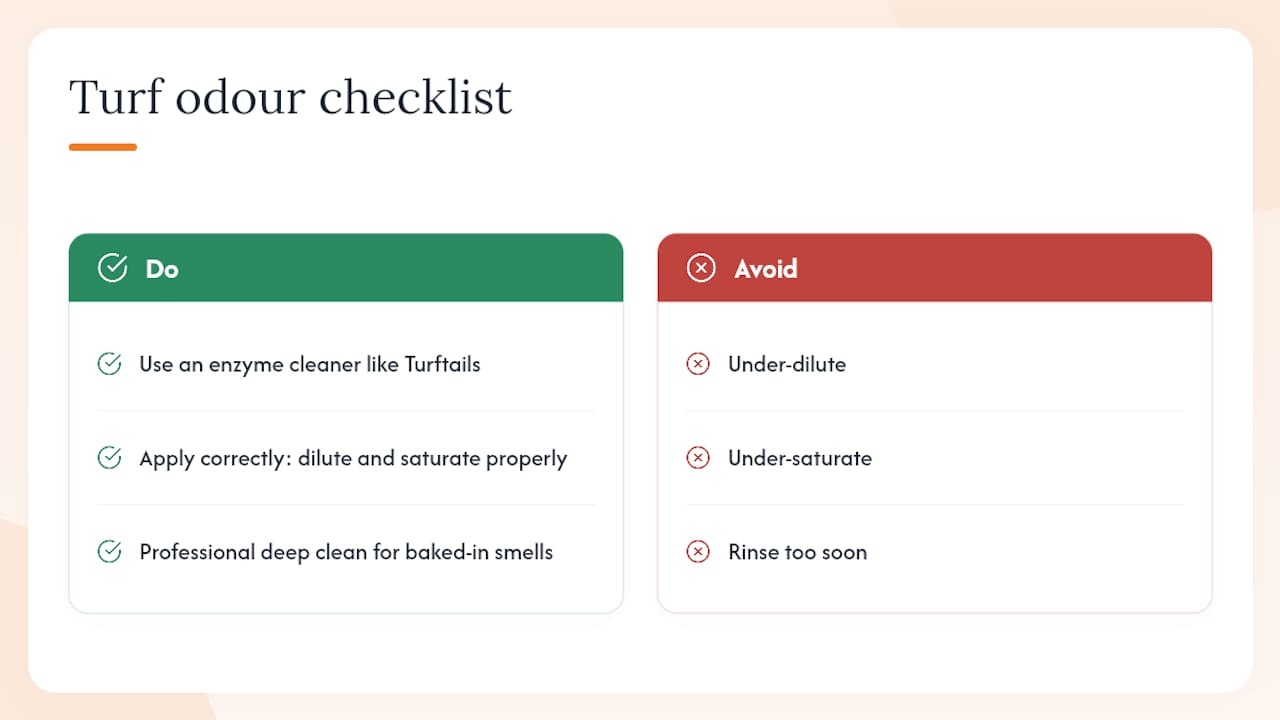
What I would add from writing about turf maintenance is that most odour problems are not a product failure — they are an application failure. Under-diluting, under-saturating, or rinsing too soon are the three most common mistakes. Get those right, and an enzyme cleaner like Turftails handles the vast majority of cases. For genuinely baked-in smells from years of use, a professional deep clean first gives the enzyme product a clean slate to maintain.
Turftails: the pet-safe enzyme cleaner built for artificial grass
Turftails is the concentrated, no-rinse enzyme cleaner designed specifically for dog urine odour on artificial grass. It covers up to 100m² per bottle, contains no harsh chemicals or artificial perfumes, and is safe for pets and children once dry.
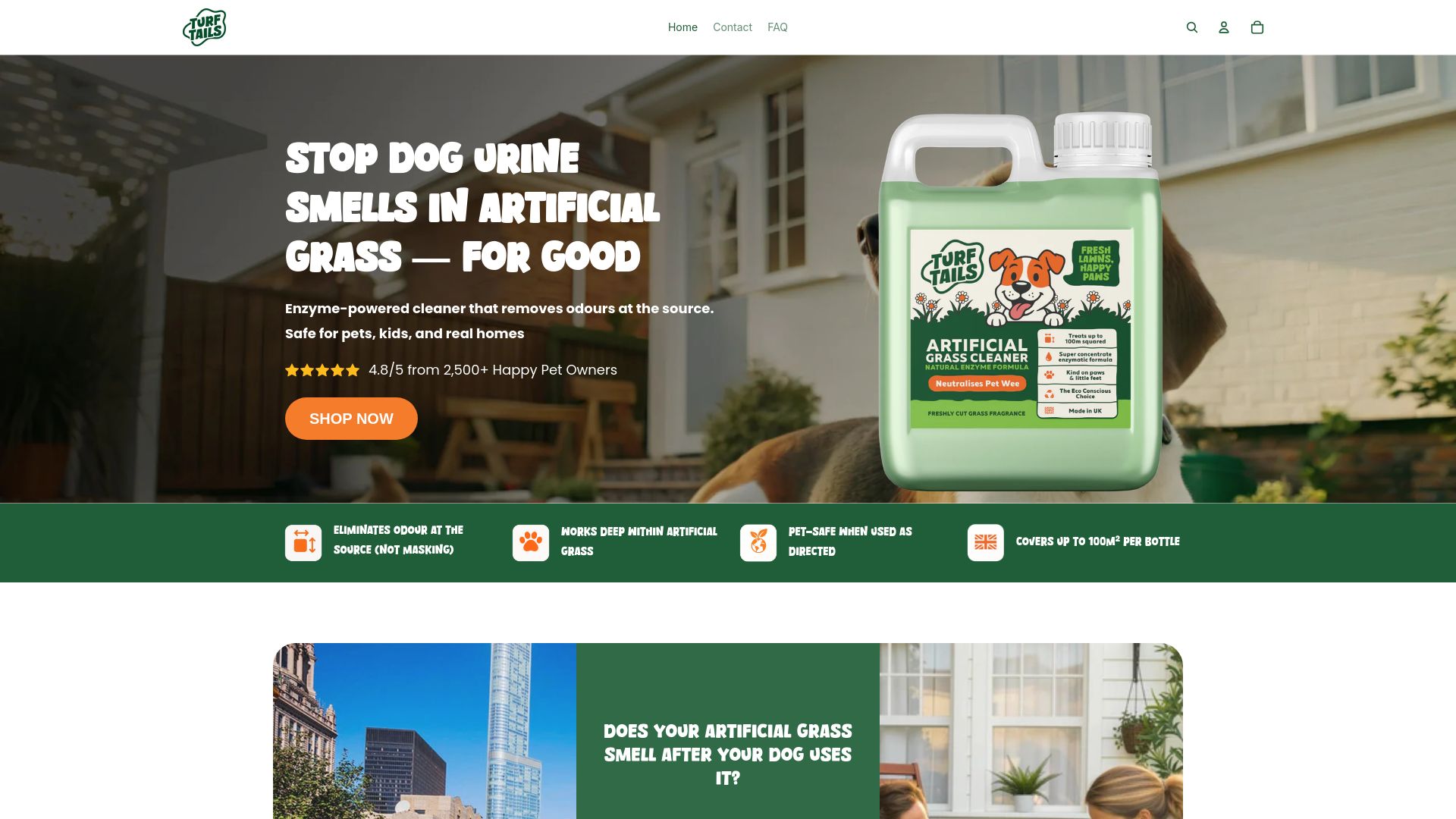
It works on artificial grass, patios, decking, concrete, kennels, and fabrics — so one bottle handles the whole outdoor space. Available as a one-off purchase or on subscription, with customer support included.
Order Turftails today and tackle the smell at the source rather than covering it up.
Sources used in this guide
- Remove Dog Urine Smell From Artificial Grass (2026) | Turf Guide | INSTALL-IT-DIRECT
- How to Stop Artificial Grass Smelling of Dog Urine (UK Guide 2026)
- How To Clean Dog Urine From Artificial Grass | Enzyme Cleaner Guide
- Enzyme vs Vinegar vs DIY Cleaners for Artificial Grass Odours — TurfGlo - Australia’s First Turf Sanitising & Odour Removal Service
- Can You Disinfect Artificial Grass? Safe Cleaning Guide
- Turf Tails