

Use an enzyme-based cleaner to remove dog urine odour from artificial grass and kennel areas. It digests uric acid rather than masking it, which is why bleach and air fresheners never quite finish the job. If you’re trying to sanitize kennels without bleach right now, here’s the immediate move:
- Blot or rinse away fresh urine with water first.
- Saturate the area with an enzyme cleaner, working it into the fibres or mat surface.
- Leave it wet for several hours so the enzymes have time to work.
- Keep pets off the area until it’s fully dry, and never reach for bleach or ammonia. Both can damage turf backing and confuse dogs into re-marking the same spot.
Key Takeaways
Enzyme cleaners remove dog urine odour permanently by digesting uric acid crystals, while bleach and ammonia only mask smell temporarily and risk damaging turf.
| Point | Details |
|---|---|
| Enzymes digest, bleach masks | Protease enzymes break uric acid into harmless byproducts; bleach just covers the smell temporarily. |
| Dwell time is non-negotiable | Leave enzyme cleaner wet on the surface for several hours, ideally overnight, for it to fully work. |
| Never use bleach or ammonia | Both can damage turf backing and ammonia’s scent can trigger repeat marking behaviour. |
| Deep odour needs the tarp method | Heavy saturation covered with plastic sheeting for 24 to 48 hours reaches uric acid trapped in the base. |
| Turf Tails covers the routine | Its enzyme formula is pet-safe when dry, eco-friendly, and covers up to 100m² per bottle. |
Table of Contents
- Why enzyme cleaners beat bleach for urine odour
- How to sanitize kennels without bleach: a step-by-step routine
- Deep-clean techniques for baked-in odours
- What actually matters when you’re fighting kennel odour
- Turf Tails: the enzyme cleaner built for this exact job
- Sources
- FAQ
Why enzyme cleaners beat bleach for urine odour
Uric acid is the culprit behind that stale, ammonia-like smell that clings to kennels and artificial turf. It’s not water-soluble, which is exactly why hosing it down or scrubbing with soap only ever gives you a few hours of relief. The crystals stay locked into the fibres, the matting, or the crushed-stone base underneath, and as soon as humidity rises, the smell comes back.
Enzyme cleaners solve this differently. Protease enzymes act like molecular scissors, breaking uric acid crystals and urine proteins down into harmless byproducts such as water and carbon dioxide, according to research from DOG by Dr Lisa. That’s a chemical breakdown of the source, not a cosmetic cover-up.
Bleach and ammonia cause their own problems on top of not fixing the odour:
- Bleach and harsh solvents can permanently damage the polyurethane backing and synthetic fibres in artificial grass, according to turf installers, and may void a manufacturer’s warranty.
- Ammonia-based products smell chemically similar to urine to a dog’s nose, which can actually encourage repeat marking in the same spot, Rover notes.
- Household staples like vinegar or baking soda can freshen light, recent accidents but rarely touch the crystallised uric acid that causes long-term smell, per the same Rover analysis.
Enzymes need contact time to work. A quick spray-and-walk-away treatment barely scratches the surface. The dwell time is where the real cleaning happens, which is exactly what the step-by-step routine below is built around.
How to sanitize kennels without bleach: a step-by-step routine
Treating fresh accidents and treating months-old odour spots call for slightly different approaches, but both follow the same core logic: dilute, saturate, then wait.
- Blot and rinse fresh urine immediately. Use paper towels or a cloth to lift as much liquid as possible, then rinse the spot with a hose or watering can to dilute what’s left before it dries into the fibres.
- Apply the enzyme cleaner generously. Use a pump sprayer for turf and larger kennel runs, or pour directly onto mats and concrete. You want the surface properly saturated, not lightly misted. On artificial grass, that usually means working the solution down to where the fibres meet the backing, since that’s where uric acid tends to settle.
- Let it dwell. This is the step people rush, and it’s the one that actually determines whether the smell comes back. Enzymes are biological, not instant. Leaving the treated area wet for several hours, ideally overnight, gives the microbes time to fully break down the uric acid, a point enzyme-cleaning research backs up directly.
- Keep it moist if the weather’s working against you. On hot days, cover the treated patch with a damp towel or a sheet of plastic to slow evaporation. Dry enzymes stop working, full stop.
- Repeat on stubborn or older spots. If the smell returns after a day or two, or if you can still detect it after the area’s dried, treat it again. Set-in stains from months of repeat use often need two or three applications before the odour is fully gone.
- Rinse lightly once dwell time is up, especially on concrete or decking, to clear away any residue.
Tools worth keeping to hand: a pump sprayer for even coverage, a hose for the initial rinse, a stiff outdoor brush for working solution into matted turf fibres, and a tarp or plastic sheeting for anything that needs longer dwell time (more on that below).
Pro Tip: Treat problem spots in the late afternoon or early evening rather than at midday. Cooler temperatures slow evaporation, so the enzymes stay active for longer instead of drying out before they’ve finished the job — a timing detail enzyme researchers specifically flag as worth planning around.
Deep-clean techniques for baked-in odours
Some smells don’t budge no matter how many times you spray the surface. That’s usually because urine has worked its way past the turf and into the crushed-stone base underneath, where years of use have let uric acid crystallise deep in the material.
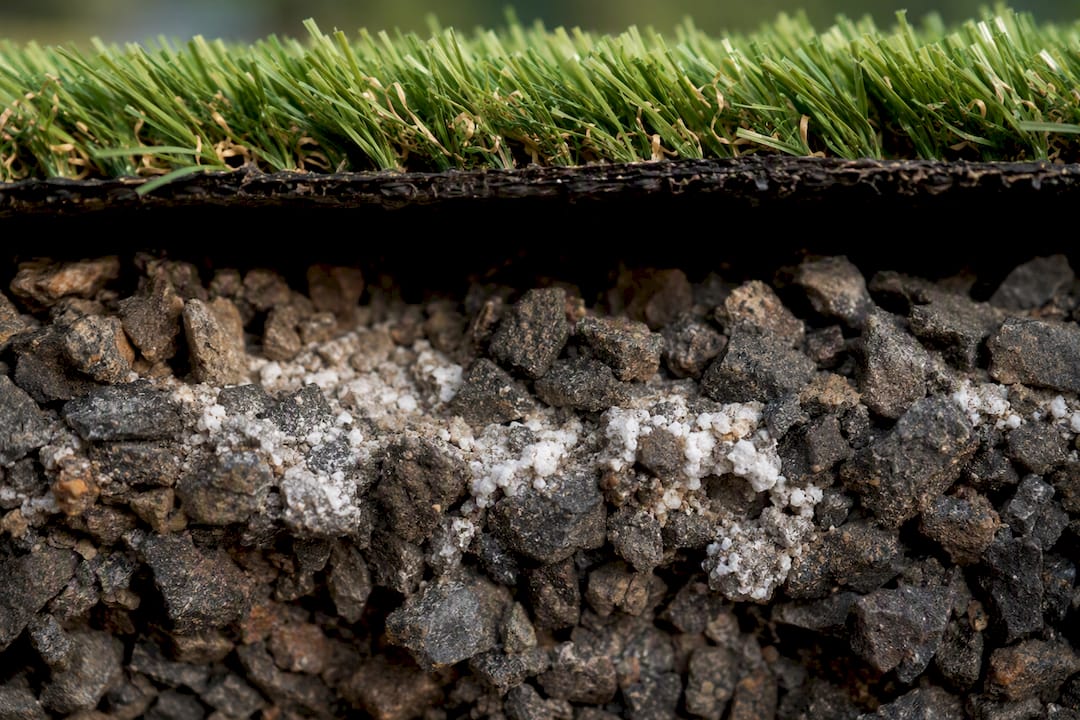
For that, surface treatment isn’t enough. The fix is heavy saturation combined with a tarp: soak the affected area thoroughly with enzyme cleaner, then cover it with plastic sheeting to trap moisture and heat. This creates a humid environment where microbes can stay active for 24 to 48 hours, giving them enough time to penetrate down to the base rather than just sitting on top, a method detailed by turf specialists at Install It Direct.
A few signs tell you it’s time for this approach rather than a standard spray:
- The smell returns strongly after rain, when trapped moisture reactivates old uric acid.
- Repeated surface cleaning has stopped making any noticeable difference.
- The odour is concentrated in one or two fixed spots your dog visits repeatedly.
If deep saturation and repeat treatments still don’t shift it, the problem may lie with the installation itself. Poor drainage or the wrong infill can trap urine permanently, and at that point a professional turf clean, or a partial base replacement with pet-specific infill like zeolite, becomes the more realistic fix, as ArtTraGrass’s UK guide points out. It’s a bigger job, but it’s rare, and most kennels and turf areas never reach that stage if enzyme treatment is applied consistently.
Pet safety, surface compatibility and things to avoid
Wait until the treated area is completely dry before letting pets back on it, and give the space some airflow while it dries to avoid anyone inhaling concentrated cleaner. Skip bleach and ammonia entirely: both can damage turf backing over time, and ammonia’s scent can trigger repeat marking rather than discouraging it.
Enzyme cleaners work well on artificial grass, concrete, decking and kennel matting. Leather is the one common exception. It’s porous in a different way and can dry out or discolour with repeated liquid treatments, so check any leather bedding or accessories separately.
Pro Tip: If you’ve got young children who use the same outdoor space, treat kennel areas and turf in the evening so everything’s dry by morning play time.
A simple maintenance routine to prevent odour return
Odour control isn’t a one-off job. It’s a light, repeatable habit that stops uric acid building up in the first place.
- Weekly: clear solid waste and hose down the areas your dog uses most.
- Every two to four weeks: apply a light enzyme spray to known toilet spots, adjusting frequency upward if you’ve got multiple dogs or you’re in a warmer climate where bacteria and odour compounds develop faster.
- Annually: brush the turf fibres to keep them upright, and check that drainage and infill are still doing their job, since poor drainage is a common cause of smells that won’t quit. If you’re reinstalling or topping up infill, pet-specific options like zeolite are worth the extra cost.
What actually matters when you’re fighting kennel odour
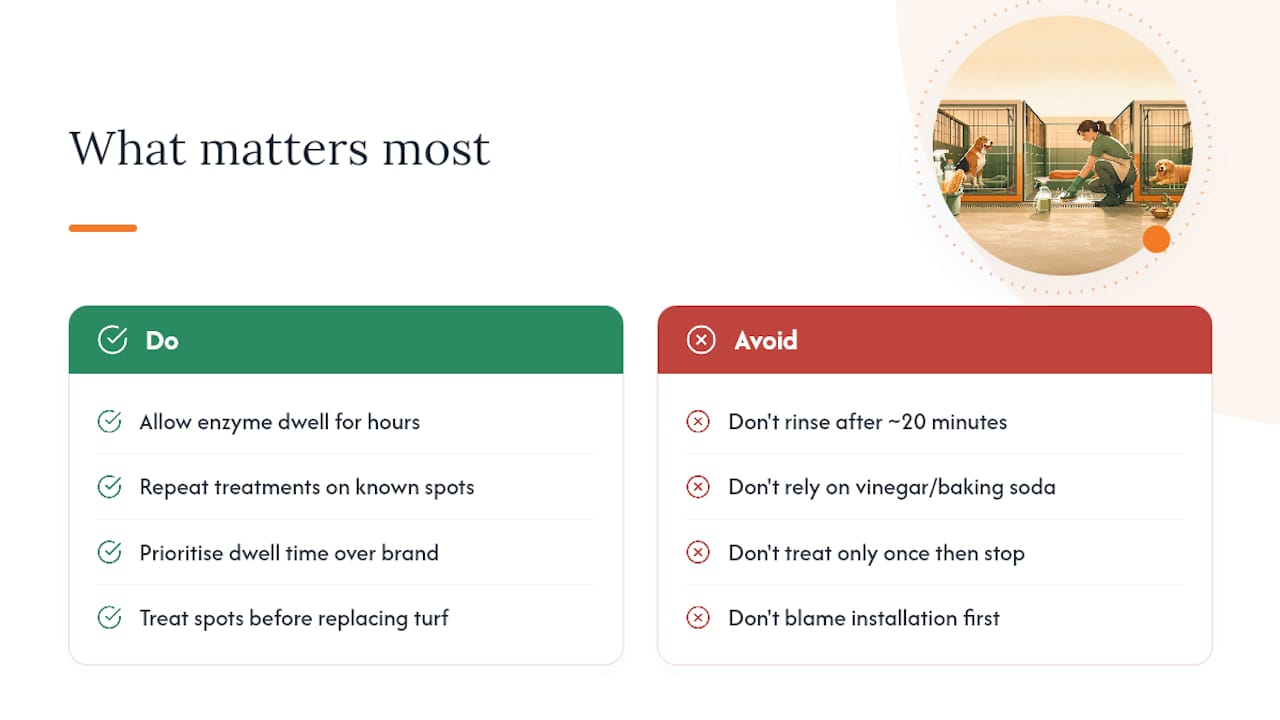
Most advice on this subject focuses on which product to buy, and barely touches on the one variable that decides whether any of them work: time. An enzyme cleaner left on a surface for twenty minutes before someone hoses it off has done almost nothing. The microbes need hours, not minutes, to fully digest uric acid crystals, and that single detail is where most DIY attempts quietly fail.
The conventional wisdom that “any pet-safe spray will do” also undersells how differently household remedies and true enzyme formulas behave. Vinegar and baking soda can knock back a fresh, mild smell, but they don’t touch crystallised uric acid sitting in turf backing or kennel matting. That’s not a minor gap. It’s the entire reason smells come back after weeks of surface cleaning that felt thorough at the time.
If there’s one thing to prioritise, it’s dwell time and repeat treatment on known problem spots, before you spend money on a deep-saturation job or start blaming the turf installation. Most persistent odour is a treatment-schedule problem, not a hardware problem.
Turf Tails: the enzyme cleaner built for this exact job
Turftails was built around the same principle covered above: break down uric acid at the source instead of masking it. The formula uses enzyme technology to digest urine compounds molecularly, which is why it keeps working after the smell has been sitting for weeks, not just minutes after spraying.
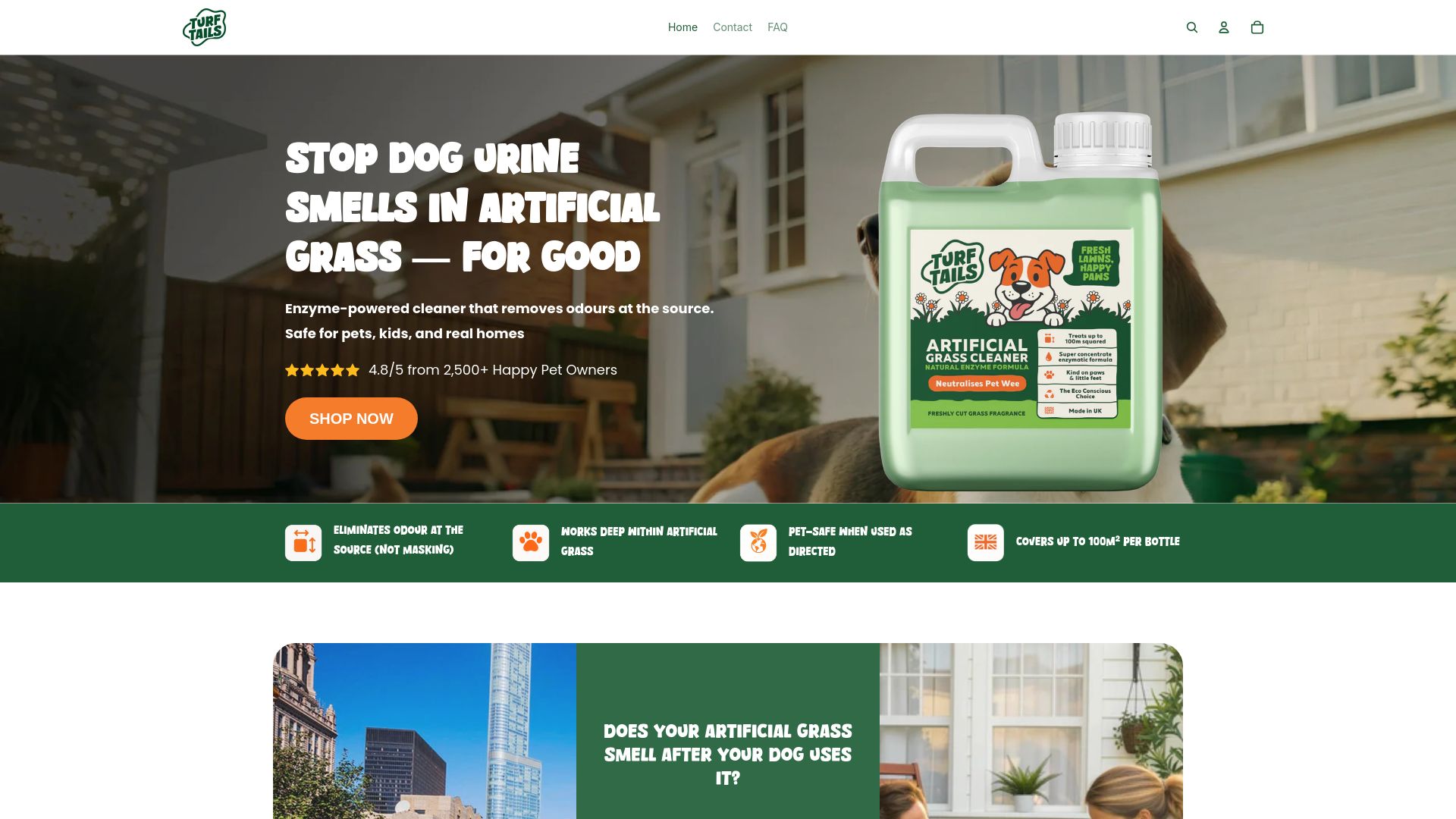
It’s eco-friendly, contains no harsh chemicals or artificial perfumes, and is safe around pets and children once the treated area has dried. One bottle covers up to 100m², enough for most gardens, kennel runs and patios without needing to ration it across a single problem spot, as detailed on the product page. It requires no rinsing afterwards, works across artificial grass, decking, concrete, kennels and fabrics, and is also available as a concentrate for anyone treating larger areas regularly.
If you’re dealing with a kennel run or turf patch that’s been fighting you for months, this is the point to try a dedicated enzyme routine rather than another round of surface spraying. Head to Turf Tails to order a one-off bottle or set up a subscription so you’re never caught without it during peak shedding or wet-weather season.
Sources
- The science of enzymatic dog wee cleaners (and why they work) – DOG by Dr Lisa
- Remove dog urine smell from artificial grass (2026) | INSTALL-IT-DIRECT
- Do enzyme cleaners really work on dog urine? – IERE
- How to clean dog urine from artificial grass | As Good As Grass
FAQ
Can I sanitize kennels without bleach and still kill odour completely?
Yes. Enzyme-based cleaners break down uric acid at the molecular level, which removes the odour source rather than covering it, unlike bleach or air fresheners.
Why does the smell come back after I’ve cleaned with soap or bleach?
Uric acid isn’t water-soluble, so surface cleaning with soap or bleach doesn’t dissolve the crystals sitting in the turf fibres or kennel matting, letting the smell return once humidity rises.
How long should I leave enzyme cleaner on artificial grass?
Leave it wet for several hours, ideally overnight, since enzymes need sustained contact time with moisture to fully break down uric acid.
Is it safe to use enzyme cleaners like Turf Tails around dogs and kids?
Yes, once the treated area is completely dry. Turf Tails is formulated to be pet and child safe after drying, with no harsh chemicals in the mix.
What’s the best way to treat a urine spot that’s been there for months?
Use the heavy-saturation and tarp method: soak the area thoroughly, cover it with plastic sheeting for 24 to 48 hours, then rinse, since old uric acid often sits deep in the base beneath the turf.