

The rule is simple: pick up dog mess daily, rinse high-traffic zones regularly, and run a full enzyme deep clean routinely to control odour. That baseline shifts if you own more than one dog, live somewhere hot, or rarely use the garden at all.
Here’s the split at a glance:
- Daily: scoop solid waste as soon as you spot it.
- Weekly: hose down urine zones, give the lawn a light brush.
- Monthly: apply a pet-safe enzyme cleaner across the whole area for odour control.
For dog owners specifically, industry maintenance guidance backs this exact three-tier structure, with a caveat: multi-dog households or anyone gardening through a heatwave should tighten that monthly deep clean to fortnightly.
Key Takeaways
A consistent schedule of daily pick-up, weekly rinsing, and monthly enzyme treatment prevents the odour build-up that drives most artificial grass complaints from dog owners.
| Point | Details |
|---|---|
| Follow the three-tier schedule | Pick up solids daily, rinse bathroom zones weekly, deep clean with enzyme cleaner monthly. |
| Adjust for your household | Multi-dog or high-traffic gardens often need bi-weekly deep cleans, especially in hot weather. |
| Skip the pressure washer | Low-pressure hose rinsing avoids fibre damage and warranty issues that jet washing risks. |
| Give cleaners time to work | A 10 to 15 minute dwell time after agitating enzyme cleaner is what actually removes odour. |
| Use Turf Tails for the monthly deep clean | Its enzyme formula covers up to 100m² per bottle and needs no rinsing, fitting neatly into the monthly routine. |
Table of Contents
- How often should you clean artificial grass with dogs?
- What tools and supplies do you actually need?
- Step-by-step: weekly care and the monthly deep clean
- Should you jet wash artificial grass?
- Fixing odours, stains and drainage issues
- Why enzyme cleaners work on dog urine
- Does rain or drought change your cleaning schedule?
- How do you stop debris building up in the first place?
- What are the warning signs your lawn needs cleaning?
- Sources
- FAQ
How often should you clean artificial grass with dogs?
Your cleaning frequency depends less on the size of your lawn and more on how many paws cross it and how hot it gets. A single well-behaved dog and a bustling three-dog household need genuinely different routines, and pretending otherwise is how odours creep in.
For a single-dog household, the routine stays close to the baseline:
- Remove solid waste the moment you see it, not at the end of the day.
- Rinse the spot your dog favours as a toilet at least once a week.
- Brush the whole lawn weekly to stop fibres matting down.
- Apply an enzyme cleaner monthly to break down urine residue the rinse alone won’t shift.
Multi-dog homes and high-traffic gardens need to move faster. When two or more dogs share the same patch, ammonia builds up quicker than a weekly rinse can manage, especially in summer when heat speeds up bacterial activity in soiled turf, according to pet-owner aftercare advice from Modern Lawn. That’s the point at which:
- Deep cleaning shifts from monthly to bi-weekly.
- Bathroom zones get a rinse most days, not just weekly.
- You watch for patches where infill starts compacting under repeated use.
Low-use or pet-free gardens are the exception. If nobody’s walking the lawn daily and there’s no dog using it as a toilet, a monthly check with an occasional seasonal brush is usually enough. You’re maintaining appearance and drainage at that point, not fighting odour.
What tools and supplies do you actually need?
Four items cover almost everything: a soft-bristled turf brush, a garden hose with a spray nozzle, a plastic or purpose-built artificial grass sweeper, and a soft rake for leaves.
What to avoid matters just as much as what to buy. Metal rakes, wire brushes, and anything abrasive can snag or fray the blades on synthetic turf, and once a fibre is bent or torn it doesn’t spring back. Harsh household cleaners and bleach cause similar damage and can irritate paws.
Enzyme cleaners are the one product genuinely worth having on standby for dog owners. They work by breaking down the compounds in urine rather than just perfuming over them, which is why they outperform standard air fresheners on stubborn odour. Look for a formula that’s safe for pets and children and free from artificial fragrance.
Pro Tip: Always patch-test a new cleaning product on a small, hidden section of turf first. Some formulations react unpredictably with certain infill types, and it’s far easier to spot that on a corner than across the whole lawn.
Follow the manufacturer’s instructions on dilution and dwell time. Skipping that step is the most common reason people say an enzyme product “didn’t work” when the real issue was rinsing it off too soon.
Step-by-step: weekly care and the monthly deep clean
Weekly routine (roughly 20 to 30 minutes total):
- Clear leaves, twigs, and debris by hand or with a soft rake (5 to 10 minutes).
- Brush against the grain with a soft turf brush to lift flattened fibres (10 to 15 minutes).
- Rinse high-use bathroom zones with a hose on a gentle spray setting (5 minutes).
Monthly deep clean:
- Pre-rinse the whole lawn to remove loose surface debris.
- Apply an enzyme cleaner, focusing on the zones your dog uses most.
- Agitate the product into the pile with your turf brush so it reaches the base of the fibres, not just the surface.
- Let it sit for 10 to 15 minutes. This dwell time is what actually gives the enzymes time to break down urine compounds, and cutting it short is the single biggest reason results disappoint.
- Rinse thoroughly and brush the fibres upright again once the area has drained.
Bathroom zones deserve extra attention every time, since that’s where uric acid crystallises deep in the infill and causes most complaints. If you want a routine you can stick to a fridge or shed wall, jot the five deep-clean steps onto an index card. A checklist beats memory once life gets busy.
Should you jet wash artificial grass?
Generally, no. A hose does the job a pressure washer is often blamed for ruining. Pressure washing artificial grass carries real risk: it can damage the fibres and displace infill, and some installers won’t honour a warranty claim if a jet washer caused the fault.
Where a hose falls short, low-pressure rinsing from a safe distance is the fallback, not full-power pressure washing. Reserve professional cleaning for problems a domestic routine can’t touch:
- Persistent odour that survives repeated enzyme treatment.
- Heavy infill compaction across large areas.
- Drainage failure, where water pools instead of running through.
Most heavy-use domestic lawns only need a professional visit once or twice a year at most. Anything more frequent usually points to a maintenance gap rather than a lawn that genuinely needs it.
Fixing odours, stains and drainage issues
Not every bad smell means you need a full deep clean. Urine odour tends to sit in specific bathroom zones and gets sharper in heat; a general mustiness across the whole lawn is more often trapped organic matter, like decomposing leaves under the pile.
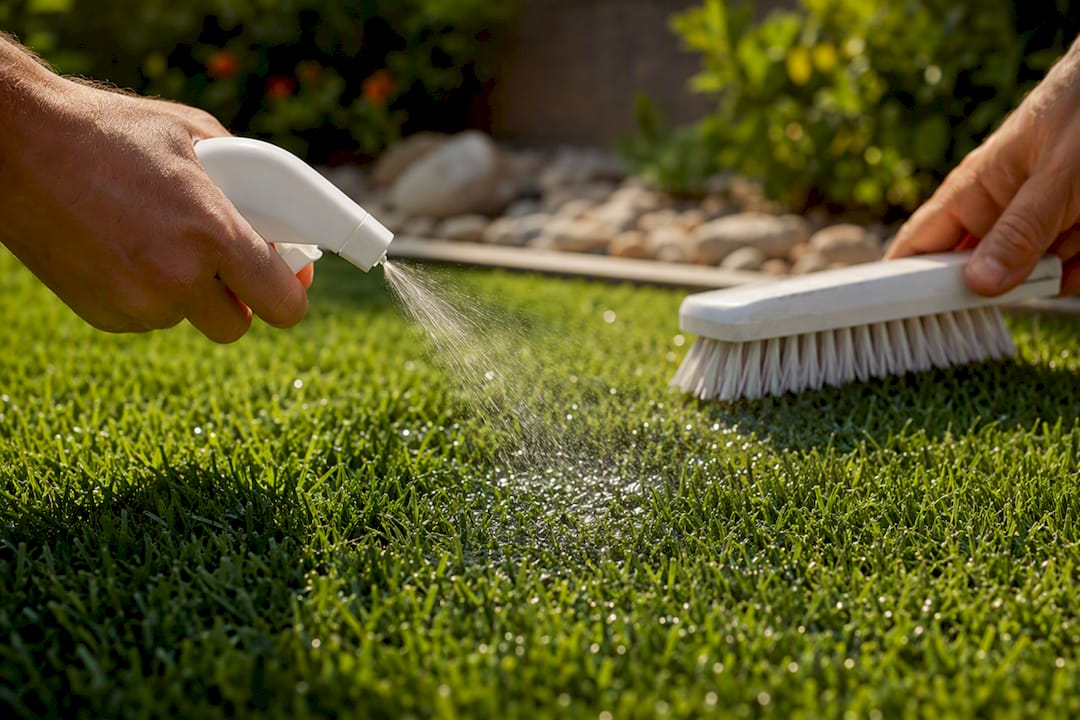
For a targeted urine fix: rinse the exact spot, apply enzyme cleaner directly, agitate with a brush, give it a 10 to 15 minute dwell, then rinse again. That’s faster and more effective than repeating the entire monthly routine over a single patch.
Be cautious with DIY stain removers, particularly anything containing bleach or strong solvents, which can discolour fibres permanently. If water is pooling rather than draining after a rinse, that’s a sign the base beneath the turf has shifted, and it usually needs a professional assessment rather than more cleaning product.
Pro Tip: If a smell returns within days of a deep clean, check the drainage first. Enzyme cleaners can’t fix a problem that’s actually about water not escaping the base layer.
Why enzyme cleaners work on dog urine
Turf Tails has spent time working directly with pet owners wrestling with the same complaint: a lawn that looks fine but smells unmistakably of dog the moment the sun comes out. That pattern is what pushed the focus onto enzymes rather than fragrance.
Enzyme cleaners work by breaking urine compounds down at a molecular level rather than masking them, and agitating the product into the pile with a brush improves how well it reaches the base of the fibres, where odour actually collects.
An enzyme formula that’s eco-friendly, free of harsh chemicals, and safe for both paws and small hands solves the actual problem, not just the smell of it. Covering up to 100m² per bottle and working across turf, decking, and kennels, it’s built for exactly the deep-clean and spot-treatment moments a pet-owning household hits every month.
Give it its full dwell time before rinsing. That patience is what separates a lawn that stays fresh from one that just smells clean for a day.
Does rain or drought change your cleaning schedule?
Weather beyond the seasons themselves shifts your schedule more than most guides admit. Heavy, sustained rain can actually work in your favour, flushing loose debris and diluting surface urine between your scheduled rinses. But it also has a downside: waterlogged infill takes longer to dry, and a lawn that stays damp for days gives bacteria more time to multiply in bathroom zones.
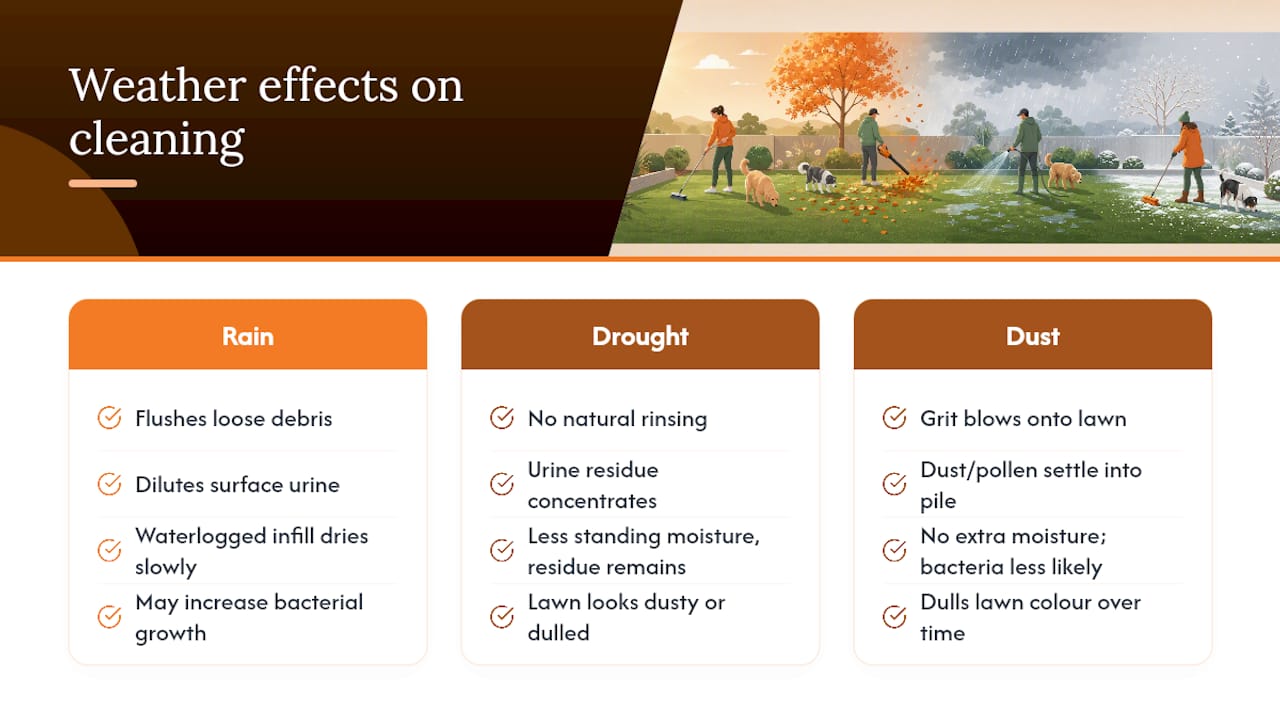
Drought conditions cut the other way. Without rain to help rinse the surface naturally, dust and pollen settle into the pile and urine residue concentrates rather than washing through, so you may need to bring your weekly rinse forward rather than skip it because “it hasn’t rained.”
Dust, whether from a nearby building site, a dry spell, or simply a windy week, settles into the base of the fibres and dulls the lawn’s colour over time. A quick brush after a dusty few days prevents that from building into a deeper clean later.
The practical takeaway: don’t run your schedule purely by the calendar. Check the lawn after any unusual weather event, whether that’s a downpour, a dry spell, or a windy day that’s blown grit across the garden, and adjust the next clean accordingly rather than waiting for the next scheduled slot.
How do you stop debris building up in the first place?
Prevention is cheaper than cleaning, and most debris problems trace back to what’s growing or standing near the lawn. Overhanging trees are the biggest culprit: falling leaves, seed pods, and sap can stain fibres and clog drainage if left to accumulate, so keeping branches trimmed back from the turf’s edge cuts down considerably on autumn workload.
A few habits worth building in:
- Trim back overhanging branches before autumn leaf fall, not during it.
- Position bird feeders and bins away from the lawn edge to reduce seed and food debris.
- Fence or edge flower beds bordering the turf so soil and mulch don’t wash or blow onto the grass.
- Sweep patios and decking adjacent to the lawn regularly, since debris migrates onto turf from neighbouring hard surfaces.
None of this replaces the weekly and monthly routine, but it does shrink how much work each session takes. A garden where leaves are cleared as they fall needs a five-minute rake, not a twenty-minute excavation.
What are the warning signs your lawn needs cleaning?
Your lawn tends to tell you before the smell becomes obvious to guests. The clearest early signals are visual: fibres lying flat instead of springing back after you walk across them, a faint yellowish tinge in patches where your dog toilets most, or visible debris sitting on the surface rather than being brushed through.
Odour is the second marker, and it’s worth knowing your own threshold. A faint smell that only appears when you crouch close to a bathroom zone is normal between cleans. A smell that greets you from several feet away, or one that’s noticeable indoors on a warm day with windows open, means you’ve gone past your usual interval and need to act sooner than the calendar suggests.
Standing water after a rinse, a spongy feel underfoot, or dark patches that don’t lighten after brushing are signs the issue has moved past routine cleaning and into drainage or infill territory. Catching these signs early, rather than waiting for a fixed date on the calendar, is what actually keeps a routine schedule working.
A quick note before you get started
The biggest mistake homeowners make isn’t skipping the deep clean. It’s assuming a bad smell means starting from scratch, when a targeted rinse on the bathroom zone usually sorts it. Stick to the weekly and monthly rhythm and you’ll rarely need anything more.
— Caroline
Fitting an enzyme clean into your monthly routine
There are other ways to tackle turf odour, from bleach-based sprays to scented granules that sit on top of the problem rather than solving it. None of them address what’s actually happening at fibre level, which is why so many pet owners end up cleaning more often than they should.
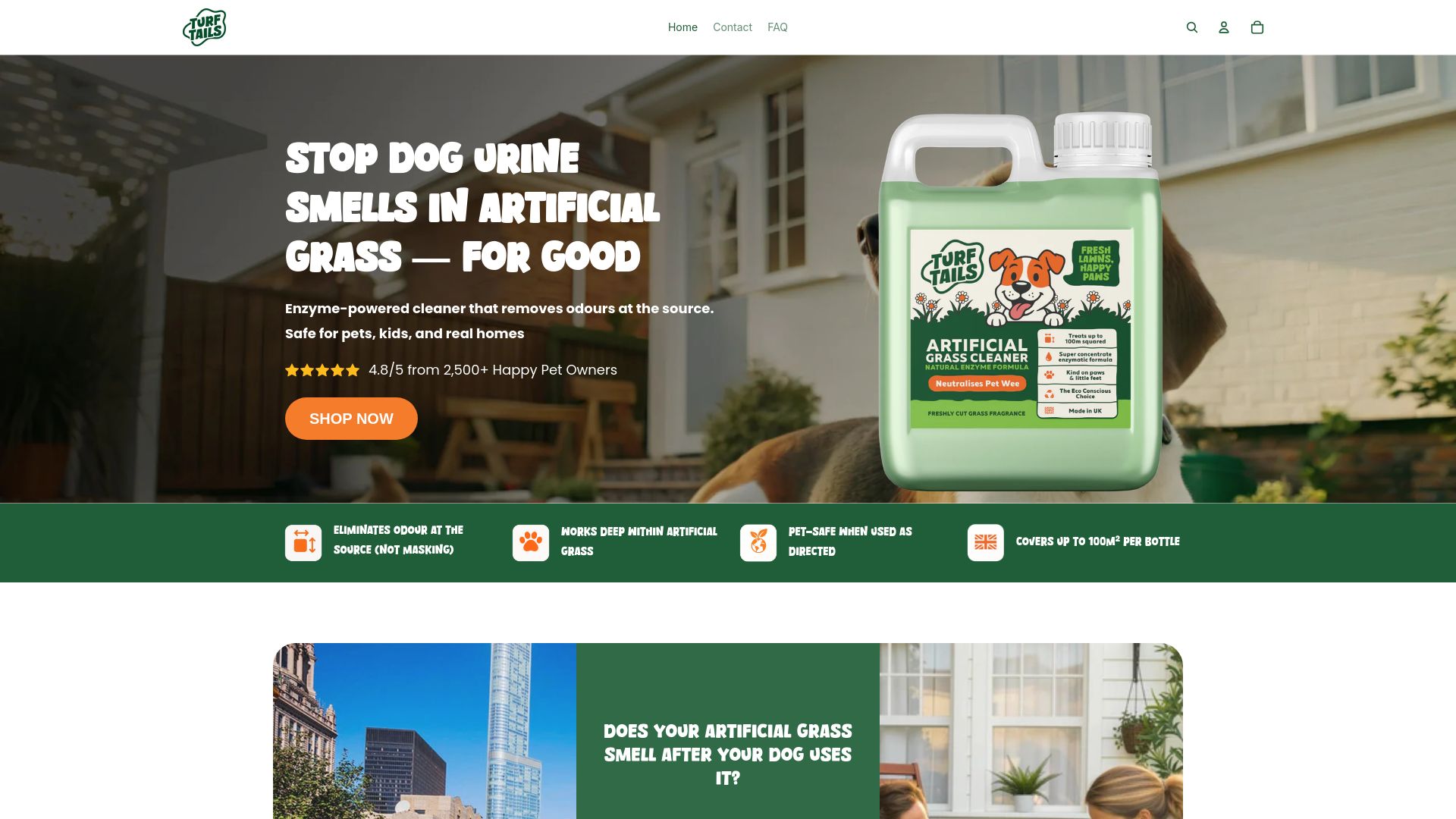
Turf Tails was built specifically for the monthly deep clean and the odd spot treatment in between, the two moments this article keeps coming back to. It’s eco-friendly, contains no harsh chemicals or artificial perfumes, needs no rinsing after use, and one bottle covers up to 100m², enough for most domestic lawns, patios, and kennel areas in a single application. Because it works at the molecular level rather than masking odour, it does the job an ordinary spray can’t, and it’s safe to use around both children and pets.
If your lawn’s coming up to its next scheduled deep clean, visit the Turf Tails product page and get a bottle ready before the smell reminds you first.
Sources
- Artificial grass maintenance — Urban Gardeners
- Can you pressure wash artificial grass? — As Good As Grass
FAQ
Should you jet wash artificial grass?
No, not as routine maintenance. Jet washing risks damaging fibres and displacing infill, and it can void some installation warranties, so a garden hose on a gentle setting is the safer choice for domestic lawns.
What is the typical lifespan of artificial grass?
Most quality artificial grass lasts many years when properly maintained, though exact longevity depends heavily on installation quality, footfall, and how consistently you follow a cleaning routine rather than a fixed number of years.
How do professionals clean artificial grass?
Professionals typically use low-pressure rinsing, specialist sweepers, and targeted enzyme treatments rather than aggressive pressure washing, and most heavy-use domestic lawns only need this level of intervention once or twice a year.
What is the best thing to clean artificial grass with?
For general upkeep, a soft-bristled turf brush and a garden hose handle most tasks. For dog urine specifically, an enzyme cleaner like Turf Tails addresses the odour at its source rather than masking it.
How often should I deep clean artificial grass with a dog?
Once a month is the standard baseline, moving to fortnightly for multi-dog households or during hot weather when odours build faster.