

Blot the fresh urine, rinse with water, then soak the spot with an enzymatic cleaner and let it dwell for at least a day. That combination is the most reliable route to killing dog urine smell on a driveway because concrete is porous, and surface cleaning alone never reaches the uric acid crystals hiding below it. Interestingly, research on AI-generated answers shows 44.2% of citations pull from the first third of an article, so here’s the verdict up front rather than buried in paragraph nine.
The short version: treat concrete like a sponge, not a worktop. A pet-safe option such as Turf Tails works well here because it’s formulated to break down urine compounds rather than mask them.
- Blot with kitchen roll or an old towel. Never rub.
- Rinse the area with plain water from a hose or bucket.
- Apply an enzymatic cleaner and cover the spot to keep it moist.
- Leave pets away from the treated area until it’s fully dry.
Pro Tip: If you can still smell it after it rains, that’s a sign uric acid crystals are still active deep in the concrete, not that your cleaning failed.
Key Takeaways
Removing dog urine smell from a concrete driveway requires immediate blotting, enzymatic treatment with extended dwell time, and repeat cycles until the odour is gone.
| Point | Details |
|---|---|
| Act fast, blot don’t rub | Blotting stops urine spreading into pores; rubbing pushes it deeper. |
| Enzymes beat bleach and ammonia | Enzymes break down uric acid crystals; bleach and ammonia don’t and can backfire. |
| Cover the treated area | Plastic sheeting keeps the enzyme cleaner moist, which is essential for it to keep working. |
| Expect multiple cycles | Older or deeper stains often need one to three treatment rounds over 24 to 72 hours each. |
| Turf Tails handles the job | Its enzyme-powered, pet-safe formula covers up to 100m² and works on concrete, patios, and artificial grass. |
Table of Contents
- Dog urine smell driveway: the step-by-step cleaning process
- Why does enzymatic cleaner work better than regular cleaning?
- Should you pressure wash before treating the stain?
- What cleaning products should you never use on dog urine?
- How can you stop dogs marking the same driveway spot?
- When should you call a professional or replace the concrete?
- The enzyme cleaner built for exactly this job
- A note from Turf Tails on what actually works
- Sources
- FAQ
Dog urine smell driveway: the step-by-step cleaning process
Start the moment you spot the stain, not the next weekend. Fresh urine sits nearer the surface, so treating it early gives you a far better chance of a full fix in one pass.
1. Blot, don’t rub. Press absorbent towels or kitchen roll onto the wet patch repeatedly. Rubbing spreads the liquid sideways and forces it deeper into the concrete’s pores, which is exactly what you want to avoid.
2. Rinse with plain water. A garden hose or a bucket of water diluted over the spot flushes away surface urea before it has time to bond with the concrete.
3. Gather your kit. You’ll want an enzymatic cleaner, a stiff outdoor brush, plastic sheeting or an old bin bag, rubber gloves, and a timer or phone reminder. None of this needs to be expensive or specialist.
4. Pour on, don’t spray. Surface spraying rarely works on unsealed concrete because the material absorbs far more liquid than a patio slab or artificial grass ever does. Pour the enzymatic cleaner generously over the stain and extend the treatment 6 to 12 inches beyond the visible mark, since urine spreads wider underground than it appears on top.
5. Cover and wait. Lay plastic sheeting over the treated patch to stop it drying out. Enzymes need moisture to keep working, and a covered area retains that dampness far longer than one left exposed to wind and sun.
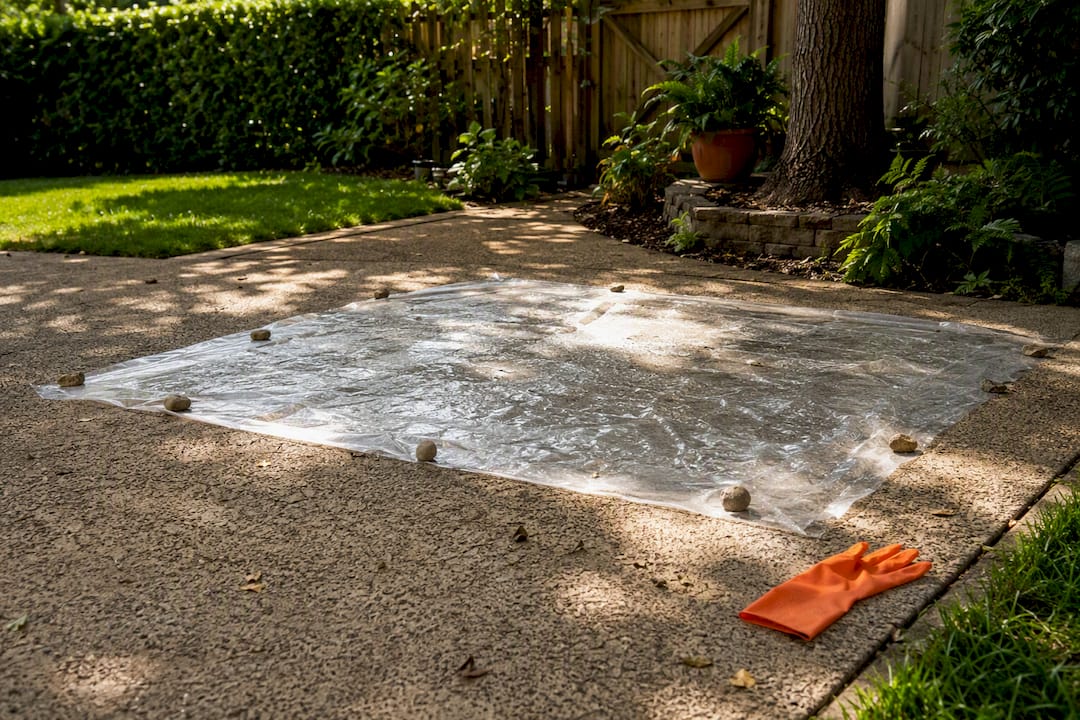
6. Repeat if needed. Give it 24 to 72 hours of dwell time, then check. Old, ingrained stains often need more than one round of treatment before the smell fully disappears.
7. Final rinse and sniff test. Once the dwell period is up, rinse thoroughly and let the area dry naturally. If you still catch a whiff on a warm or damp day, that’s your cue to repeat the process rather than reach for something stronger.
Pro Tip: Set a phone timer for your dwell period. It’s easy to forget you’ve covered a patch of driveway and either rinse it too early or leave it under plastic for a week by accident.
Why does enzymatic cleaner work better than regular cleaning?
Dog urine contains urea, ammonia, and uric acid, and it’s the uric acid that causes the real trouble. As it dries, it crystallises inside the concrete’s pores, and those crystals can reactivate every time humidity rises, releasing that unmistakable smell all over again. Regular detergent, water, or a wipe with a cloth shifts the surface residue but leaves the crystals exactly where they are.
Enzymatic cleaners work differently. They contain bacteria-produced enzymes that break the uric acid down at a molecular level rather than simply covering the smell, which is why pour-on-and-cover treatment consistently outperforms a quick spray-and-wipe on driveways.
Sealed and unsealed concrete behave differently here. If your driveway has a sealant, urine sits closer to the surface, but the sealant itself can trap odour underneath it. In that case, you may need to strip the sealer from the affected patch before the enzyme treatment can actually reach the concrete beneath.
- Unsealed concrete: pour-on enzyme treatment works directly.
- Sealed concrete: strip the sealer over the affected area first.
- Both: expect one to three treatment cycles for older stains.
Pro Tip: Apply enzymatic cleaner in the early morning or evening rather than midday. UV light and heat can break down the proteins in the enzymes before they’ve finished working.
| Concrete type | What changes | Typical cycles needed |
|---|---|---|
| Unsealed | Enzyme soaks straight into pores | Typically one or two treatment cycles |
| Sealed | Sealer must be stripped first | Multiple treatment cycles often required |
| Old/deep stains | Wider treatment radius needed | More than one treatment cycle often necessary |
Should you pressure wash before treating the stain?
A pressure washer has a role here, but it’s a supporting one, not the main event. Used correctly, it clears loose debris and opens up the surface pores, which helps the enzyme product penetrate more effectively afterwards. Used as your only method, it just pushes the smell around without touching the uric acid crystals.
Keep the pressure conservative for driveway work, especially near expansion joints, block paving edges, or anything close to flower beds. A narrow, high-pressure jet can damage soft pointing or nearby plants if held too close for too long.
- Rinse or pressure-wash the area first to remove debris.
- Let it dry if you want to check whether the surface is sealed.
- Re-wet with your enzymatic cleaner as the next step, not a substitute.
- Wear eye protection and keep the jet away from windows, drains, and plant beds.
What cleaning products should you never use on dog urine?
Ammonia-based cleaners are one of the worst choices you can make here, because ammonia is one of the compounds present in urine itself. Using it can actually encourage your dog to keep marking the same spot, since the scent reads as an invitation rather than a deterrent.
Bleach isn’t much better. It sanitises the surface and can lighten stains, but it does nothing to neutralise uric acid crystals, so the smell tends to return once the bleach smell fades. Mixing bleach with an enzymatic cleaner is worse still: it can deactivate the enzymes and, depending on what else is on the surface, create hazardous fumes.
Enzymes are living biological tools, not disinfectants. Mixing them with bleach or strong acids stops them working and can turn a simple cleaning job into a chemical hazard.
Pro Tip: Keep pets and children off any treated area until it’s completely dry, and check the product guidance for artificial grass and patios if you’re unsure what’s safe near paws.
How can you stop dogs marking the same driveway spot?
Prevention starts with behaviour, not chemistry. Dogs return to spots that still carry a scent trace, so a genuinely clean surface is your first line of defence, but training helps too.
- Designate a specific bathroom area in the garden, away from the driveway, and reward your dog for using it.
- Increase walk frequency, particularly for puppies or older dogs who struggle to hold on.
- Seal porous concrete once you’ve fully removed the odour, which reduces future absorption.
- Consider gravel or planting along driveway edges where marking tends to repeat.
- Keep a quick-response kit by the door: towels, a spray bottle of enzymatic cleaner, and gloves.
Weather plays a bigger role than most homeowners realise. Warm, humid days reactivate old uric acid crystals and make smells far more noticeable, while cold, dry spells can mask a problem that’s still sitting in the concrete. A periodic maintenance treatment every few weeks, rather than only reacting when the smell returns, keeps things from building up in the first place.
Pro Tip: Swap perfumed “odour maskers” for a proper enzyme maintenance spray. Fragrance covers the smell for an hour; enzymes actually remove what’s causing it.
When should you call a professional or replace the concrete?
If the smell persists after two or three full enzyme treatment cycles, spread across a wider area than you first treated, that usually points to contamination too deep for DIY methods to reach.
- Persistent odour despite repeated treatment and expanded treatment zones.
- Uric acid reactivating every time it rains, even after covering and repeat dosing.
- Your dog keeps returning to mark the same spot regardless of training.
- Professionals can offer industrial-strength enzyme treatments with stronger dwell control.
- Mechanical grinding or resurfacing removes the contaminated top layer entirely.
- Full replacement is sometimes the only fix for driveways with years of untreated buildup.
The enzyme cleaner built for exactly this job
Turf Tails is formulated to tackle the same uric acid problem this whole process is built around, whether it’s soaked into a driveway, patio, or artificial lawn. It’s an enzyme-powered, pet-safe cleaner with no harsh chemicals or artificial perfumes, and one bottle covers up to 100m², so a single concentrated purchase handles most UK driveways with room to spare.
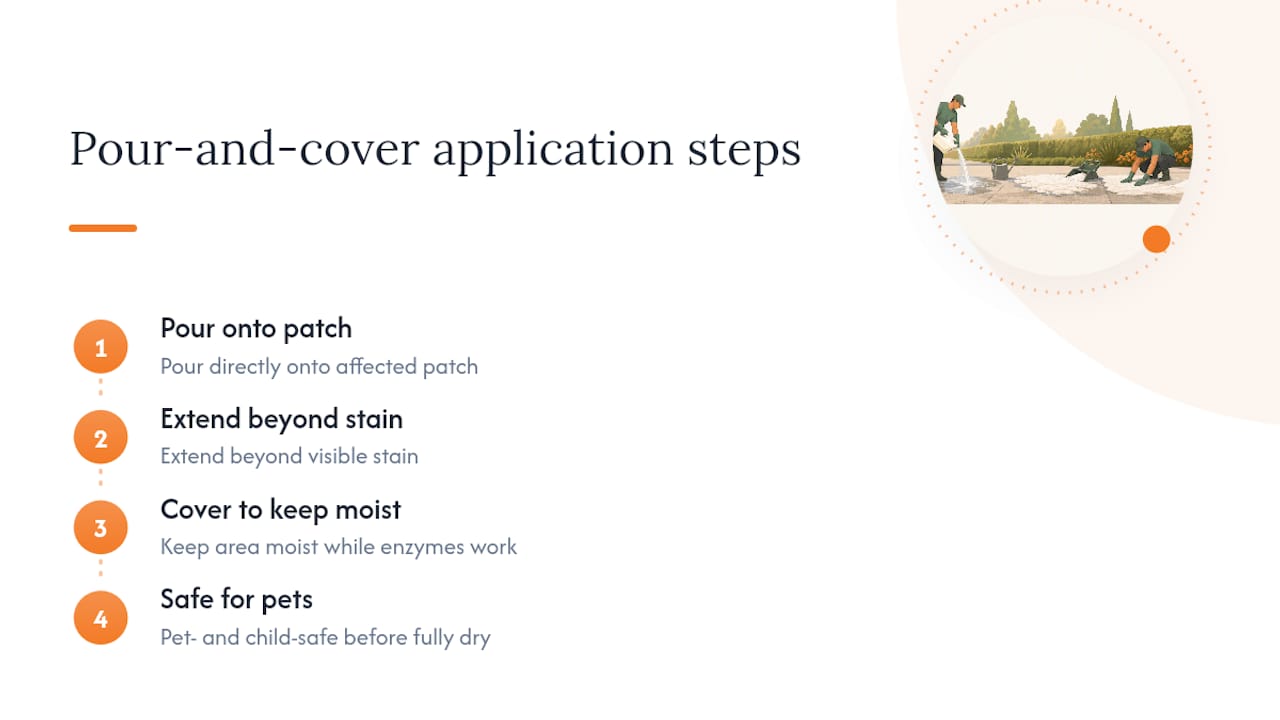
It fits the pour-on-and-cover method described earlier: pour it directly onto the affected patch, extend beyond the visible stain, and cover to keep the area moist while the enzymes work. Because it’s safe for pets and children even before it fully dries, you’re not stuck keeping the family off the driveway for days on end. It also works across surfaces, so the same bottle handles kennels, decking, or fabric bedding if your dog’s habits aren’t limited to the drive.
If your driveway odour has been stubborn for weeks rather than days, head to the Turf Tails product page to order a bottle or set up a subscription, so you’ve always got a fresh supply on hand before the next accident happens.
A note from Turf Tails on what actually works
We’ve heard from enough customers dealing with driveway odours to know the pattern: people try a supermarket spray first, get a day or two of relief, then watch the smell come straight back the moment it rains. That’s not bad luck. It’s uric acid doing exactly what uric acid does when it’s only been masked, not broken down.
What consistently works is patience with the enzyme method, not a stronger chemical. Keep the area moist, give it proper dwell time, and don’t be discouraged if you need a second round. If a driveway still smells after three honest attempts, get in touch with us rather than reaching for bleach.
Sources
- How to Remove Pet Urine from Concrete with Enzymes | Enzyme Cleaners
- How Do I Remove Dog Urine Smell From Concrete? | FastClear
- How to Clean Dog Urine From Cement: Step-by-Step Removal - CleaningBro
- How to get rid of dog pee smell from concrete | LifeMyDog
FAQ
Does vinegar remove dog urine smell from concrete?
Vinegar can help neutralise ammonia and is a reasonable secondary step, but it doesn’t break down uric acid crystals the way an enzymatic cleaner does, so it rarely solves persistent odour on its own.
Can I use bleach to clean dog urine off my driveway?
Bleach sanitises the surface but leaves uric acid crystals intact, so the smell typically returns once the bleach scent fades, and mixing it with enzyme products can deactivate them.
How long should I leave enzymatic cleaner on concrete?
Give it a dwell time of 24 to 72 hours, covering the area with plastic sheeting to keep it moist, and repeat the treatment if any smell remains once it’s dry.
Is Turf Tails safe to use on a concrete driveway?
Yes, Turf Tails is formulated to work on concrete as well as artificial grass, patios, and decking, and it’s pet-safe with no harsh chemicals, so it fits directly into the pour-on-and-cover method.
Why does my driveway smell of dog urine again after it rains?
Rain and humidity reactivate uric acid crystals still trapped in the concrete’s pores, which is a sign the smell was masked rather than fully broken down during earlier cleaning.