

Bleach is not recommended for cleaning artificial grass. Used undiluted or as a routine cleaner, it can fade fibres, weaken the backing, and corrode metal fixings nearby, and it does nothing to solve the actual cause of pet odour. Enzyme cleaners are the safer, more effective route for dog urine and general odour control, and they’re what most turf specialists point people towards instead.
If you’ve already reached for the bleach bottle, here’s what matters right now:
- Damage risk: chlorine-based bleach can bleach or embrittle synthetic fibres over repeated use, and it can discolour and weaken the backing.
- Safety risk: bleach fumes and residue are unpleasant for paws, noses, and small children who play or sit on the lawn.
- Better fix: enzyme-based cleaners break down the actual urine compounds rather than masking or bleaching them out.
If bleach has already touched your turf, flood the area with water straight away, keep pets and kids off it until it’s completely dry, and check for any colour change or stiffness in the fibres before you let anyone back on it.
Key Takeaways
Bleach damages artificial grass fibres and backing over time and fails to remove the source of pet urine odour, which is why enzyme cleaners are the safer, more effective standard.
| Point | Details |
|---|---|
| Bleach isn’t recommended | It can fade fibres, weaken backing, and corrode metal fixings with repeated use. |
| Enzymes beat bleach on odour | Enzyme cleaners break down urine compounds at the source instead of masking the smell. |
| Emergency-only bleach rule | Only use heavily diluted bleach after checking your warranty, spot-testing, and flood-rinsing afterwards. |
| Act fast after accidents | Blot, dilute with water, apply enzyme cleaner, brush, then rinse and dry before reuse. |
| Call a pro for structural damage | Seam separation, backing collapse, or brittle fibres need professional inspection, not more cleaning. |
| Turf Tails for pet odour | Turf Tails’ enzyme formula covers up to 100m², needs no rinsing, and is safe for pets and children. |
Table of Contents
- Can you use bleach on artificial grass without ruining it?
- How to use bleach safely if you must
- What actually works better for pet urine and odour?
- Products and habits that can ruin your artificial lawn
- A fast routine for pet accidents on artificial grass
- When cleaning isn’t enough
- Why enzyme cleaners, including Turf Tails, outperform bleach on pet odour
- Fix dog urine odour properly with Turf Tails
- Sources
- FAQ
Can you use bleach on artificial grass without ruining it?
The honest answer is: rarely, and only under tightly controlled conditions. Artificial grass is made from polyethylene or polypropylene fibres bonded to a latex or polyurethane backing, and neither material was designed to cope with regular chlorine exposure.
Bleach is an oxidising agent. That’s precisely what makes it good at killing bacteria and lifting stains on tile grout or bathroom surfaces, but it’s also what makes it hostile to plastic fibres over time. Repeated contact gradually breaks down the polymer chains in the yarn, and the visible result is fading, a slightly waxy or brittle texture, and fibres that snap rather than spring back underfoot.
The backing is arguably more vulnerable than the blades themselves. Latex backing can discolour or lose its bond strength when soaked in bleach solution, and where seams have been glued together, that adhesive can weaken enough to let the joins lift. Metal edging pins, staples, and any nearby zip fixings on artificial lawn boundaries are also at risk of corrosion from splashback, and manufacturer guidance consistently advises against harsh chemical use for exactly this reason.
What should you actually look for if you’re worried bleach has already caused harm?
- Patches of fibre that look lighter or washed out compared with the surrounding lawn.
- Blades that feel stiff, dry, or snap when bent rather than flexing back.
- Seams that have started to lift or gap at the edges.
- A chemical smell that lingers even after a thorough hose-down.
Turf specialists are unusually consistent on this point: bleach isn’t recommended for routine grass cleaning because it can discolour fibres, weaken the backing, and corrode fixings nearby, with enzyme cleaners named as the preferred solution for pet urine and odour control instead.
How to use bleach safely if you must
If you’re dealing with something genuinely exceptional, biohazard-level contamination, for instance, and your turf manufacturer’s own guidance doesn’t rule it out, there’s a way to reduce the risk. This is not a routine cleaning method, and it should never become part of your normal maintenance schedule.
- Check your warranty first. Many turf warranties explicitly exclude damage from harsh chemicals, so a quick call or email to the manufacturer before you start could save you an expensive replacement bill.
- Dilute heavily. A weak solution, well diluted with water, applied briefly to a small, isolated spot is a different proposition to pouring bleach neat onto the lawn.
- Spot-test first. Apply a small amount to an inconspicuous corner and wait at least 24 hours to check for colour change before treating the main area.
- Wear gloves and work in an open, ventilated space. Bleach fumes build up quickly in still air, particularly near fencing or walls.
- Apply, don’t soak. Dab or lightly spray rather than pouring, so the solution doesn’t pool and seep down into the backing and infill.
- Flood-rinse immediately after. Use plenty of clean water to fully wash the treated area, and repeat rinsing if you can still smell chlorine.
- Clear the area. Keep pets and children away until the section is completely dry and odour-free.
Never mix bleach with vinegar, ammonia, or any other household cleaner. The chemical reaction produces toxic chlorine gas, and it’s a genuine and well-documented hazard rather than a theoretical one.
Pro Tip: If you notice any stiffness, fading, or seam movement after a spot-test, stop immediately. That’s your turf telling you it can’t tolerate the treatment, and pushing on will only make the damage worse and harder for a professional to repair.
What actually works better for pet urine and odour?
Enzyme cleaners break the odour-causing molecules apart at a chemical level, rather than simply covering the smell. That’s the core reason turf specialists and manufacturers alike point pet owners towards enzymes over bleach or bathroom sprays.
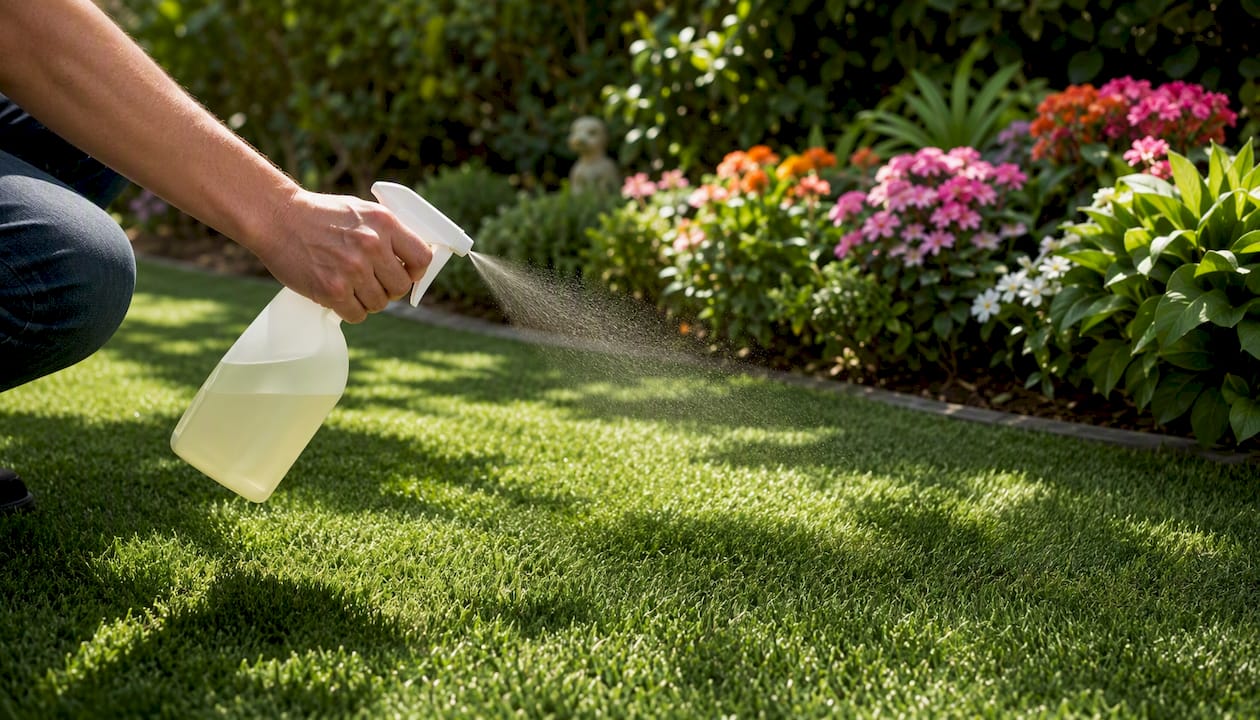
Urine odour comes from organic compounds, urea, uric acid crystals, and bacterial by-products, that settle into the infill and the base of the pile. Enzymes such as proteases and amylases target those specific molecules and break them into smaller, odourless components. Bleach, by contrast, can mask a smell temporarily and may even react with ammonia present in old urine, but it doesn’t remove the underlying residue buried in the infill.
A diluted white vinegar rinse has a place too, mainly for light, occasional odours rather than deep-set staining. A ratio of roughly one part vinegar to three parts water works for routine touch-ups, with stronger dilutions reserved for tougher spots once you’ve confirmed it won’t discolour your turf.
| Method | Effectiveness on odour | Rinse needed | Pet safety |
|---|---|---|---|
| Enzyme cleaner | High, breaks down source compounds | Often not required | Formulated to be safe |
| Diluted white vinegar | Moderate, best for light odours | Yes | Generally safe once dry |
| Mild detergent | Low to moderate, surface only | Yes | Safe once fully rinsed |
| Hydrogen peroxide (3%), spot use only | Moderate, limited use | Yes | Caution, spot-test first |
| Bleach | Low, masks rather than removes | Yes, extensive | Not recommended |
A few practical points sit behind that table:
- Enzyme cleaners are typically simplest to use because there’s no measuring dilution ratios or worrying about fume exposure.
- They avoid repeated harsh chemical contact, which matters if your dog spends hours a day on the lawn.
- Using an approved, turf-safe cleaner is one less thing to worry about if you ever need to make a warranty claim.
Products and habits that can ruin your artificial lawn
Beyond bleach, a handful of common household products and habits cause more damage to synthetic turf than most people realise. Keep these off your lawn entirely.
- Undiluted bleach or strong household disinfectants, which can discolour fibres and degrade backing with repeated use.
- Solvents and acetone, including nail varnish remover, which can melt or distort synthetic fibres almost instantly.
- Ammonia-based cleaners, which can irritate pets’ paws and respiratory systems and degrade the yarn over time.
- Abrasive scouring products, which physically scratch and dull the fibre surface.
- Aggressive, close-range pressure washing, which can displace infill and loosen seams rather than simply cleaning.
- Leaving any chemical to soak rather than applying and rinsing promptly, which multiplies the risk of every product on this list.
- Mixing cleaning products together, which risks producing dangerous fumes, as with bleach and ammonia or bleach and vinegar.
Household disinfectants such as Zoflora come up often in pet-owner forums, and while some are marketed as pet-friendly, that doesn’t automatically mean they’re turf-safe. Always check the manufacturer’s own guidance and run a small spot-test before treating a wider area, the same rule that applies to every product on this list, bleach included.
A fast routine for pet accidents on artificial grass
Speed matters more than strength when you’re dealing with a fresh accident. The quicker you act, the less chance urine has to soak into the infill and set up a lingering smell.
- Remove any solids with a poop bag or scoop straight away.
- Blot and dilute the wet area with a hose or watering can to flush the bulk of the urine through the drainage layer.
- Apply an enzyme cleaner generously, covering the full affected patch rather than just the centre.
- Leave it for its recommended contact time. Hot weather shortens how long the enzymes stay active on the surface, so you may need to reapply on warm days or in frequently used toilet spots.
- Brush the pile upright with a stiff garden broom once the treatment has worked through.
- Rinse lightly and let it dry fully before pets or children go back on the area.
Pro Tip: Skip the pressure washer for everyday accidents. High-pressure jets aimed too close can blast infill out of the base layer, which actually makes drainage worse and odour more likely to build up long term.
When cleaning isn’t enough
Some damage goes beyond what any cleaner, bleach or enzyme, can fix. If you spot any of the following, it’s time to call in a turf professional rather than keep experimenting at home.
- Seams that have visibly separated or lifted along a join.
- Backing that feels soft, spongy, or is starting to disintegrate.
- Widespread discolouration across a large section rather than one isolated patch.
- Fibres that have gone brittle and snap easily when bent.
- A chemical or urine smell that persists even after several thorough rinses.
Persistent odour trapped deep in the infill or base layer usually calls for a professional deep clean rather than another round of DIY treatment, while structural issues like seam separation or backing collapse point towards partial or full replacement. When you do call a specialist, ask them to check the infill’s condition, inspect seam integrity, and confirm whether any existing manufacturer warranty still applies before work begins.
Why enzyme cleaners, including Turf Tails, outperform bleach on pet odour
Enzymes remove the smell because they break down the molecules causing it, rather than masking them the way a scent-based spray does. That single distinction is why so many turf specialists steer pet owners away from bleach entirely.
Urine contains proteins and organic compounds that settle into the pile and infill. Proteolytic enzymes break down these protein residues, while amylolytic enzymes target starches and related organic material, converting both into simpler, odourless by-products that rinse away or break down naturally. It’s a targeted chemical process rather than a chemical assault on the whole lawn.
Turf Tails’ formula works on this principle, built specifically for dog urine odours on artificial grass. It’s eco-friendly, contains no harsh chemicals or artificial perfumes, and is formulated to be safe around pets and children, which matters if your dog is going to be back on that lawn within the hour. One bottle covers a typical garden-sized area and is designed to work without needing a rinse afterwards, useful on the mornings when you just want the smell gone before the school run.
- No harsh chemical exposure for paws or bare feet.
- No fume risk indoors or out, unlike bleach or ammonia-based sprays.
- Works across artificial grass, patios, decking, concrete, and kennels, not just the lawn.
Enzyme-based formulas are consistently favoured across turf maintenance guidance for one simple reason: they solve the odour at its source rather than covering it, and they do it without the fibre, backing, or fixture risks that come with bleach.
A note from the publisher
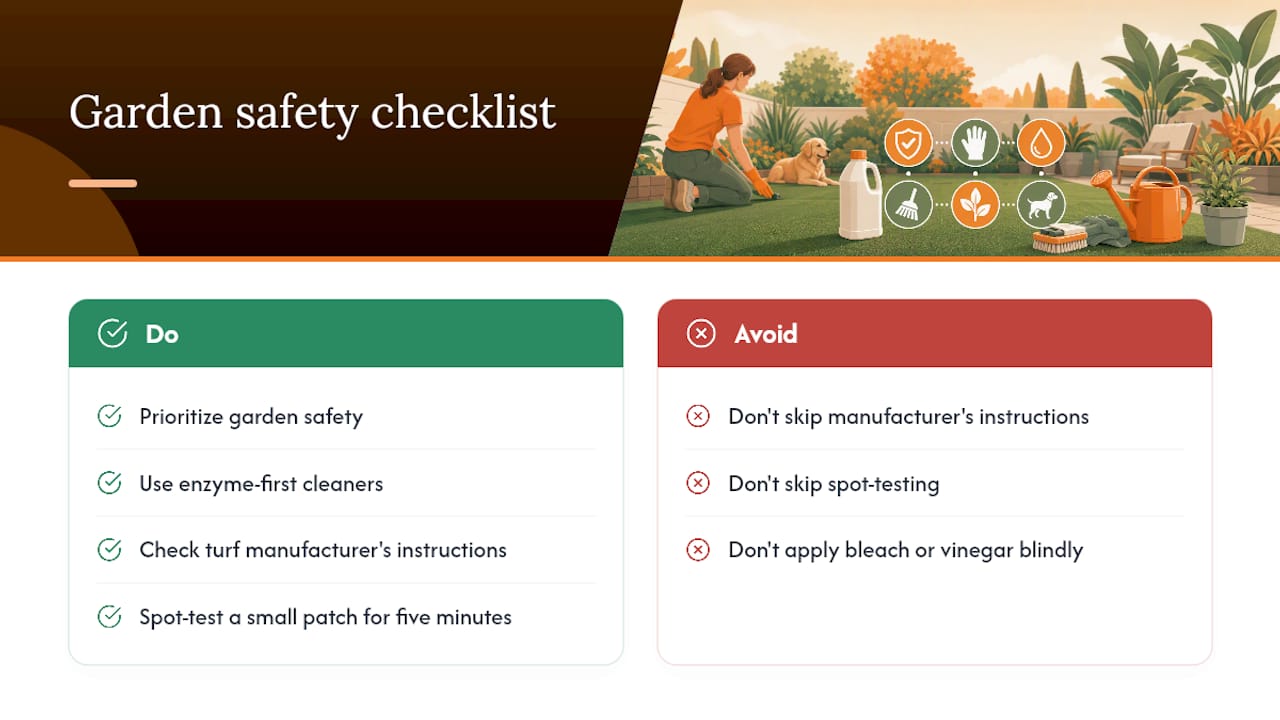
Every recommendation in this guide comes back to one priority: keeping your garden safe for the people and pets who actually use it. Enzyme-first cleaning isn’t just gentler on your turf, it genuinely does a better job on the smell that brought you here in the first place. Before trying any product, bleach, vinegar, or an enzyme formula, check your turf manufacturer’s own care instructions and spot-test on a small patch first. It takes five minutes and it could save you a much more expensive mistake.
Fix dog urine odour properly with Turf Tails
If bleach, vinegar, and generic disinfectant sprays haven’t solved your garden’s odour problem, the issue usually isn’t effort, it’s that those products were never designed to break down urine compounds in the first place. Turf Tails is built specifically for that job: an enzyme-powered cleaner that targets dog urine odour on artificial grass at the molecular level, rather than masking it for a day and letting it creep back.
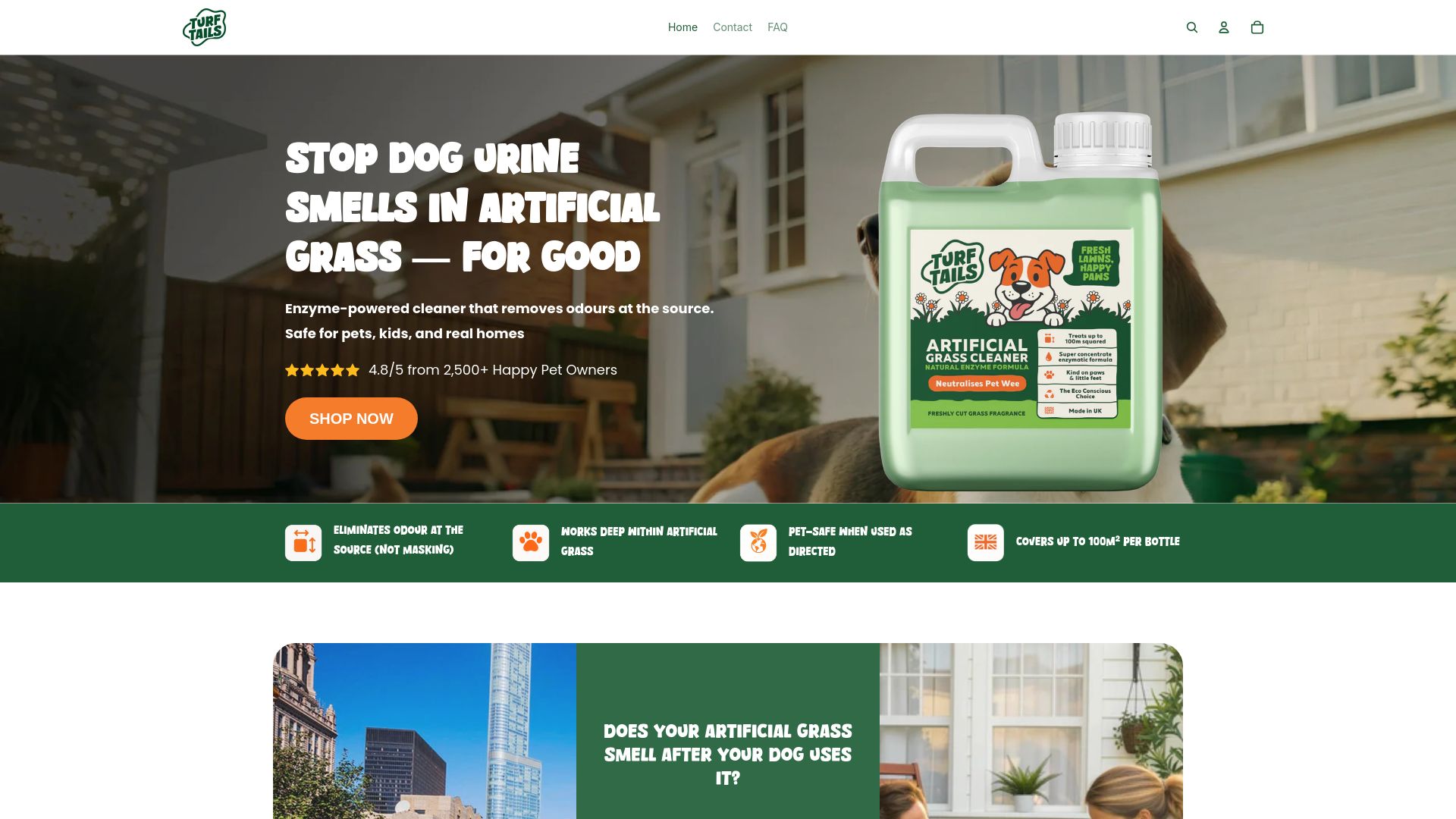
One bottle covers up to 100m², so most gardens need only a light, regular top-up rather than a full reapplication after every accident. It’s eco-friendly, free from harsh chemicals and artificial perfumes, and formulated to be safe around pets and children, which means no waiting around after use before the dog’s back out on the lawn. For households dealing with a regular toilet spot or a garden that gets embarrassing before guests arrive, it’s worth applying as part of your normal routine rather than only reaching for it in a crisis. Head to the Turf Tails shop to check sizes and get a bottle on its way to your door.
Sources
- Can I Use Vinegar or Bleach on Artificial Turf? | FusionTurf
- Can you clean artificial grass with bleach? - Lawn World
- How to clean turf for pets: complete guide | Magnolia Turf
Always check your own turf manufacturer’s warranty terms and product labels before applying any cleaner, since coverage and chemical tolerance vary between products.
FAQ
Will bleach damage artificial turf?
Yes, repeated or undiluted bleach use can fade fibres, weaken the latex or polyurethane backing, and corrode nearby metal fixings, which is why it isn’t recommended as a routine cleaner.
What is the best thing to clean fake grass with?
Enzyme cleaners such as Turf Tails are generally the best option for pet urine and general odour, since they break down the compounds causing the smell rather than masking them.
What can ruin artificial grass?
Undiluted bleach, solvents like acetone, ammonia-based cleaners, abrasive scourers, and close-range pressure washing can all cause lasting damage to fibres, backing, or infill.
Can I put Zoflora on my artificial turf?
Check the manufacturer’s own guidance and spot-test a small area first, since not every household disinfectant marketed as pet-friendly has been confirmed safe for synthetic turf fibres and backing.
Is bleach safe for pets on artificial grass?
No, bleach residue and fumes can irritate paws, skin, and airways, so if it’s used at all it must be heavily diluted, applied sparingly, and flood-rinsed before pets return to the area.