

Urine on artificial grass causes bacterial activity that converts urea into ammonia, which is the sharp, stinging smell you notice near patios and dog runs. Most cases clear up fast with the right routine: remove any solids, rinse the area thoroughly, apply a pet-safe enzyme cleaner and let it sit for its full dwell time, then brush and rinse again. Do this now:
- Pick up solid waste immediately, before it works into the fibres
- Flood the affected patch with water to flush out surface residue
- Apply an enzyme cleaner such as Turf Tails and leave it for the dwell time stated on the bottle
- Brush the pile against the grain, then rinse once more
- Skip bleach, ammonia-based products and high-pressure jets. They don’t kill the bacterial source and can push contamination deeper into the infill.
Key Takeaways
Bacteria convert urea in urine into ammonia, and treating that source with an enzyme cleaner works faster and lasts longer than any product that simply masks the smell.
| Point | Details |
|---|---|
| Ammonia comes from bacteria | Bacteria break urea in urine down into ammonia gas, which is the actual smell you notice. |
| Clean in the right order | Remove solids, rinse, apply enzyme cleaner with full dwell time, then brush and rinse again. |
| Avoid bleach and pressure washers | Both fail to address bacteria and can damage backing or drive contamination deeper into infill. |
| Backing and infill choice matter long-term | PU backing and zeolite infill reduce absorption and trap ammonia ions between cleans. |
| Turf Tails targets the source | Its enzyme formula breaks down urine compounds molecularly, covers up to 100m² and needs no rinsing. |
Table of Contents
- Why does urine cause bacteria and ammonia odour on artificial turf?
- How do you clean urine off artificial grass properly?
- What stops bacteria and odour coming back long-term?
- When is surface cleaning not enough for contaminated turf?
- How enzyme cleaners actually remove urine bacteria
- Does it matter whether it’s dog urine or human urine on turf?
- Can urine-contaminated artificial grass make you or your pets ill?
- Can bacterial build-up damage artificial turf over time?
- Do temperature and humidity affect bacterial growth on turf?
- Sources
- FAQ
Why does urine cause bacteria and ammonia odour on artificial turf?
Fresh dog urine barely smells. Give it a few hours and bacteria naturally present on the turf start breaking down the urea it contains, and that process releases ammonia gas. That is the sequence behind nearly every “my garden smells of dog wee” complaint UK pet owners raise, and it explains why the smell often gets worse the day after an accident, not immediately during it.
Bacteria don’t just sit on the surface. They colonise three distinct zones of a typical lawn:
- The fibres themselves, where thin films of urine cling to the yarn.
- The infill, sand or granules packed between the blades, which traps liquid and organic debris.
- The backing layer, where latex-backed turf absorbs and holds moisture far longer than polyurethane-backed alternatives.
That backing distinction matters more than most buyers realise. Latex backing behaves like a sponge, pulling urine down and holding it against the sub-base. PU backing sheds liquid instead of soaking it up, so there’s simply less standing moisture for bacteria to feed on.
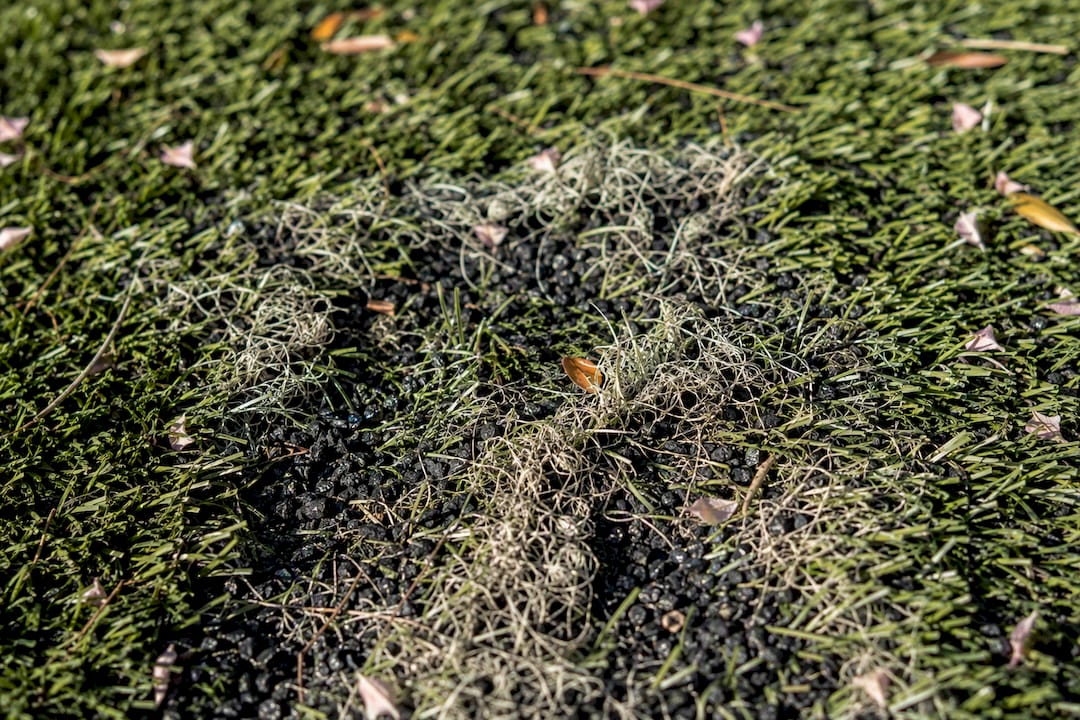
Poor drainage compounds the problem. When urine pools rather than draining through, it sits in contact with infill and backing for hours, giving bacteria time to establish colonies and, eventually, biofilms. Biofilms are a genuine complication. Once bacteria form this protective layer within turf fibres and infill, they become considerably harder to shift with a standard surface wipe, which is exactly why a quick spray-and-forget approach often fails on turf that’s been contaminated for weeks rather than days.
How do you clean urine off artificial grass properly?
Speed matters here, but so does sequence. Skipping a step, or doing them in the wrong order, is the single biggest reason pet owners end up with lingering odour despite “cleaning” regularly.
- Remove solids first. Scoop or hose away any faeces before you touch the urine patch. Working around solid waste just spreads bacteria further across the pile.
- Rinse the area from one end to the other. Use a hose with a fan nozzle and work in one direction, flushing residue towards the drainage layer rather than scrubbing it deeper in. A correct cleaning order — remove, rinse, treat, rinse again — consistently outperforms random spot-cleaning.
- Apply a pet-safe enzyme cleaner. Spread it evenly across the affected patch and let it sit. Most enzyme formulas need a few minutes of dwell time to fully break down urine proteins and uric acid crystals; cutting that short is one of the most common mistakes, because the enzymes simply haven’t finished working yet.
- Brush against the grain, then rinse. This lifts flattened fibres and helps flush out what the enzymes have loosened.
- Repeat on stubborn spots. If a patch still smells after 24 hours, treat it again rather than reaching for something stronger.
Pro Tip: Mark recurring “hot spots” with a small stone or garden marker. Dogs tend to return to the same one or two patches, and treating those specific areas twice a week stops odour building up before it ever becomes noticeable.
What you avoid matters as much as what you do. Bleach and ammonia-based cleaners don’t address the bacterial source at all, and both can damage turf fibres or backing while doing it. Ammonia is particularly counterproductive: since urine already breaks down into ammonia, spraying more of it onto the lawn can actually encourage dogs to re-mark the same spot. High-pressure washers cause a different problem. Rather than flushing contamination away, the force can drive urine and bacteria further down into the infill and sub-base, making the smell harder to reach next time.
What stops bacteria and odour coming back long-term?
The cleaning routine above deals with what’s already happened. Preventing a repeat is largely down to what the lawn is made of and a handful of weekly habits.
Backing and drainage decide most of the outcome before you ever pick up a hose. PU backing paired with a permeable sub-base lets urine pass straight through instead of pooling against the turf, which is the single biggest factor in whether odour becomes a recurring problem or a rare one.
Infill choice runs a close second. Ordinary sand absorbs and holds liquid; zeolite infill traps ammonia ions at a molecular level, which noticeably reduces smell between cleaning sessions rather than just after them.
Beyond installation, routine habits carry most of the weight:
- Rinse high-use zones regularly, more often in a multi-dog household where several animals mark the same patches
- Brush the pile after rinsing to keep fibres upright and draining properly
- Never use bleach, ammonia cleaners or a pressure washer set above a gentle fan spray
- Check the sub-base if water starts sitting on the surface after rain rather than disappearing within minutes
That last point is worth watching closely. Standing water, a musty smell that returns however often you clean, or infill that feels damp days after rain are all signs the sub-base or infill has started failing and may need reworking rather than another round of surface treatment.
When is surface cleaning not enough for contaminated turf?
Most odour problems resolve with the routine above. A smaller number don’t, and pushing on with surface cleaning alone just wastes product and time.
- Odour returns within 72 hours of a proper clean, even though you followed every step correctly
- The smell is widespread rather than confined to one or two known hot spots
- You can smell ammonia even on cool, dry days when bacterial activity should be at its lowest
Any of those point to contamination sitting deeper than a hose and enzyme spray can reach. Deep infill contamination generally needs professional extraction: specialists agitate and lift out the affected infill, sanitise the backing and sub-base underneath, then replace the infill entirely. Surface disinfection works well because synthetic turf itself is non-porous, but once urine has worked past the fibres into deeply packed infill, extraction equipment does a job a garden hose simply cannot. In rare cases where backing has degraded or odour persists even after extraction, replacing the turf section is the only realistic fix.
How enzyme cleaners actually remove urine bacteria
Enzyme cleaners work differently to anything that just masks a smell. Rather than covering ammonia with fragrance, enzymes and the beneficial microbes they carry break down urine proteins and uric acid into components that no longer feed odour-causing bacteria. Enzymes keep working after you’ve walked away, continuing to dismantle uric acid crystals that a standard detergent or deodoriser would leave completely untouched.
Turf Tails is built around that mechanism. A few things worth knowing before you buy:
- It’s formulated to be safe around pets and children, with no harsh chemicals or artificial perfumes
- One bottle covers a substantial domestic garden area and larger multi-dog runs alike
- It’s eco-friendly and works on artificial grass, patios, decking, concrete, kennels and fabrics, not just turf
- No rinsing is required after application, which matters on the days you just want the smell gone without another step
Enzymatic breakdown targets the actual source compounds in urine rather than sitting on top of them, which is why the smell doesn’t simply return a few hours later once a fragrance fades.
Does it matter whether it’s dog urine or human urine on turf?
Not all urine behaves the same way once it hits synthetic fibres, and the differences come down to concentration and volume rather than species alone.
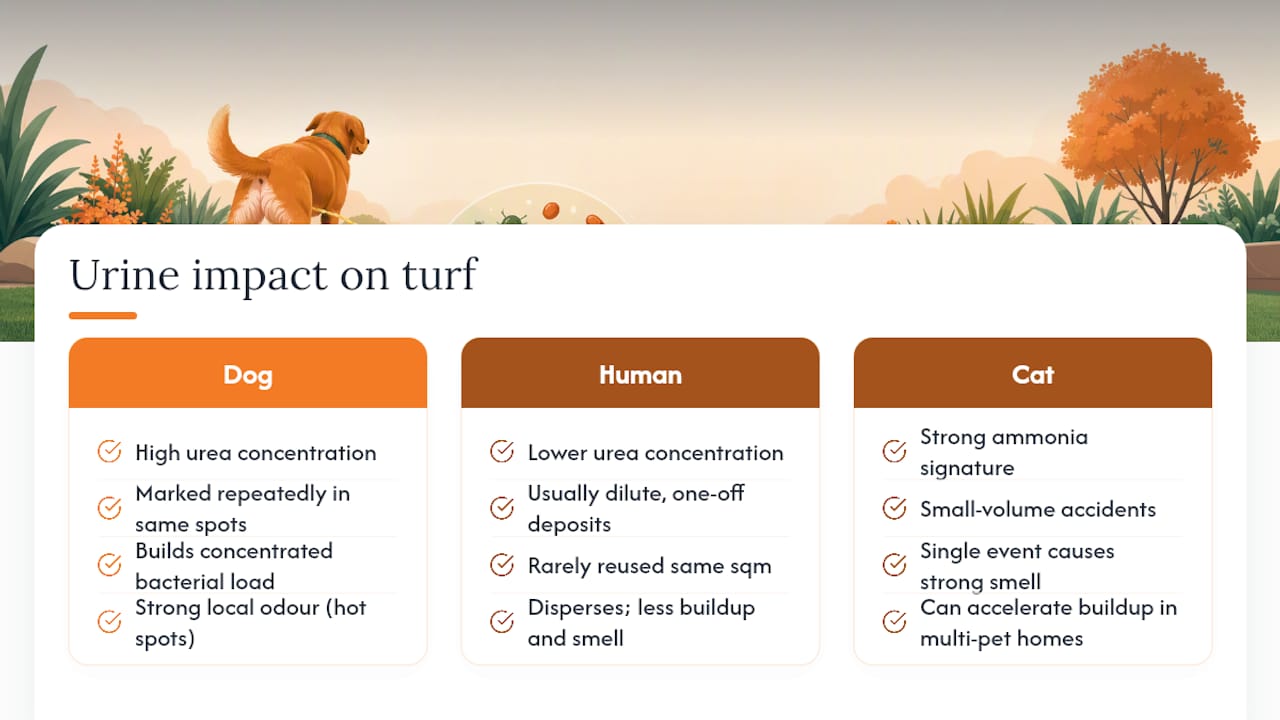
Dog urine is typically far more concentrated in urea than human urine, and dogs tend to return to the same one or two spots repeatedly, which builds up a concentrated bacterial load in a small area over weeks. That repeated marking behaviour is precisely why “hot spots” develop, and why a lawn can smell strongly in one corner while the rest stays perfectly fresh.
Human urine, by comparison, is usually more dilute and rarely deposited in the same square metre twice, so it tends to disperse rather than concentrate. Where it does become relevant is around garden parties, festivals, or properties near public paths, where accidental or deliberate use can introduce a one-off contamination event rather than a recurring pattern.
Cats present their own issue: their urine carries a notably strong ammonia signature even in small quantities, so a single accident from a cat can smell disproportionately worse than an equivalent volume from a dog. Multi-pet households, particularly those mixing cats and dogs, often see faster bacterial build-up simply because more than one urine source is feeding the same patches of turf.
Whatever the source, the underlying chemistry is identical: bacteria convert the urea present into ammonia. The practical difference is concentration and frequency, which is exactly why dog owners see recurring hot spots that cat owners and casual human contamination usually don’t.
Can urine-contaminated artificial grass make you or your pets ill?
Turf itself isn’t inherently risky, but heavily contaminated turf that’s gone unaddressed for weeks is a different story. Bacteria that colonise fibres and infill can form biofilms, and those biofilms are considerably more resistant to casual cleaning than fresh, surface-level contamination.

The realistic risks fall into a few categories. Children and pets who roll or lie directly on heavily soiled turf can pick up bacteria on skin or paws, which becomes relevant for anyone with cuts, grazes or compromised immune systems. Dogs that lick contaminated fibres are exposed more directly than family members who simply walk across the lawn. Persistent damp patches also attract flies and other pests, which introduces a secondary hygiene concern beyond the bacteria itself.
None of this means artificial grass is unsafe for a normal household. It means neglected turf, the kind left unwashed for months with visible staining and a permanent ammonia smell, carries a meaningfully higher bacterial load than turf cleaned on a regular schedule. Regular rinsing and enzyme treatment keep bacterial levels low enough that the everyday risk to pets and children stays minimal. The households that run into genuine problems are almost always the ones that have let contamination build for an extended period rather than treating it as it happens.
Can bacterial build-up damage artificial turf over time?
Odour is the symptom most people notice first, but sustained bacterial and chemical exposure also affects the material itself over months and years.
Ammonia is mildly corrosive, and prolonged exposure at high concentrations can gradually degrade certain backing materials and adhesives, particularly around seams where two pieces of turf are joined. Latex backing is more vulnerable here than polyurethane, partly because it absorbs and holds the very moisture that carries ammonia against the material.
Infill takes a similar hit. Contaminated infill that isn’t refreshed or extracted eventually compacts and clumps, which reduces drainage further and creates a feedback loop: worse drainage means more pooling, more pooling means more bacterial activity, and more bacterial activity means faster degradation. Fibres themselves can discolour or become brittle in heavily contaminated zones, particularly where staining has been left to set for extended periods rather than rinsed promptly.
None of this happens overnight. A single accident, even a large one, cleaned within a day or two, does no lasting damage. The turf that suffers structurally is the turf that’s been contaminated repeatedly for months without proper maintenance, where bacterial activity has had time to work alongside moisture and, in some cases, UV exposure to weaken the backing and infill together. Routine cleaning isn’t just about smell control; it’s what keeps the underlying material sound for the years the turf is meant to last.
Do temperature and humidity affect bacterial growth on turf?
Bacteria that break urea down into ammonia are more active in warm, humid conditions, which is why odour problems tend to spike sharply in summer and fade noticeably in winter.
Warmth accelerates the chemical and biological processes involved, so a patch that might take a day or two to start smelling in cooler weather can turn pungent within hours during a hot spell. Humidity compounds that effect: damp air slows evaporation, which means urine stays wet on the surface and in the infill for longer, giving bacteria more time to work before the moisture disappears.
Shaded, poorly ventilated corners of a garden are usually the worst offenders, because they combine warmth trapped near the ground with limited airflow to help moisture evaporate. South-facing patios that get direct sun for much of the day sometimes fare slightly better in dry weather, since intense sunlight speeds up evaporation even as it raises surface temperature.
Winter doesn’t eliminate the issue, it just slows it down. Bacterial activity continues at a reduced rate even in cold weather, and any urine that pools rather than drains during heavy rain can still generate odour once temperatures rise again in spring. That seasonal pattern is worth knowing if you’ve ever wondered why a lawn that seemed fine all winter suddenly smells the moment the weather warms up.
A realistic note on timelines and safety
Most owners expect odour to vanish the moment they clean, and get discouraged when a faint smell lingers for a day or two after treatment. That’s normal; enzymes need time to finish working, not a sign the product has failed. Done correctly and consistently, this routine resolves the vast majority of cases without any risk to pets or children.
— Caroline
Get rid of dog urine smell with Turf Tails
Turf Tails is built specifically for the problem this article covers: dog urine odour trapped in artificial grass that ordinary sprays only mask for a few hours. It works by breaking down urine compounds at a molecular level rather than covering them with fragrance, it’s safe around pets and children, and one bottle treats up to 100m², enough for most gardens without needing a second purchase halfway through.
Follow the application steps covered earlier: solids removed, area rinsed, cleaner applied and left to work, then a final brush and rinse. For step-by-step application guidance and dwell times, the full routine is laid out to match what’s already worked in your garden. When you’re ready to stop firefighting the smell every weekend, order Turf Tails directly and get the next treatment sorted before the next hot spot even develops.
Sources
- How to disinfect artificial grass for pets | TurFresh
- How to stop artificial grass smelling of dog urine (UK guide 2026) | ARTTRAGrass
- Pet friendly artificial grass UK — Frankly Flooring
- Bacteria on artificial turf: risks & removal | Murphy’s Turf
FAQ
How often should I clean artificial grass affected by dog urine?
Rinse hot spots at least once a week, and treat with an enzyme cleaner whenever you notice fresh odour rather than waiting for a scheduled clean. Multi-dog households often need rinsing two or three times a week.
What is the best disinfectant to remove dog urine from artificial grass?
A pet-safe enzyme cleaner such as Turf Tails is generally the most effective option because it breaks down urine proteins and uric acid rather than masking the smell. Bleach and ammonia-based disinfectants should be avoided, as they can damage the turf and may encourage repeat marking.
How do I clean urine out of fake grass properly?
Remove any solids first, rinse the area thoroughly with a hose, apply an enzyme cleaner and leave it for its full dwell time, usually five to ten minutes, then brush and rinse once more. Skipping the dwell time is the most common reason odour returns.
What happens if a dog urinates on artificial grass repeatedly?
Repeated urination in the same spot builds up a concentrated bacterial load that can lead to biofilms, persistent ammonia odour and, over time, damage to backing and infill if left untreated. Regular rinsing and enzyme treatment on known hot spots prevents this build-up before it becomes a bigger problem.