

Diluted white vinegar is safe to use on artificial grass for light odour control and mild algae, but it will not solve a genuine dog urine problem on its own. Vinegar works as a mild acid rinse, not a biological cleaner, so it lacks the enzymes needed to break down uric acid crystals sitting in the infill and backing.
For routine freshening, mix water with a small amount of white vinegar to dilute it. For a stubborn patch, you can increase the vinegar concentration to equal parts vinegar and water, after spot testing, but spot test an inconspicuous corner first and always rinse thoroughly afterwards.
- Do not use vinegar undiluted, straight from the bottle
- Do not mix vinegar with bleach or ammonia, ever
- Do spot test, apply, dwell briefly, then rinse until the water runs clear
- Do switch to an enzyme cleaner for recurring pet hot spots
Table of Contents
- What does vinegar actually do to artificial grass odours?
- How do you safely apply a vinegar solution to artificial grass?
- Does vinegar actually get rid of dog urine smell?
- How often should you clean and maintain artificial grass with pets?
- What should you never do when cleaning artificial grass?
- Which cleaner should pet owners actually rely on for urine?
- Does repeated vinegar use damage artificial grass over time?
- Is vinegar an environmentally friendly choice for turf cleaning?
- Where can you check turf care and cleaning guidance?
- Why the “vinegar fixes everything” advice misses the point
- Get lasting freshness with Turf Tails’ enzyme cleaner
- Sources
- FAQ
What does vinegar actually do to artificial grass odours?
White vinegar is acetic acid with moderate acidity suitable for cleaning purposes, and that acidity is what makes it useful. It neutralises alkaline residues left behind by general grime, mould spores and light surface bacteria, which is why a vinegar rinse can genuinely freshen turf that smells a bit stale or has a patch of green algae creeping along a shaded seam.
What it cannot do is dissolve uric acid. Dog urine leaves behind crystalline deposits that bond to synthetic fibres and infill granules, and those crystals need a biological process, not an acid rinse, to break down properly. A mild diluted vinegar rinse can help with odours and light algae, but it is not a substitute for an enzyme-based cleaner once urine is the actual problem.
A quick reference for dilution:
For a genuinely stubborn spot, some guides suggest going up to a 1:1 mix once you’ve confirmed on a hidden patch that it won’t affect colour, though this stronger mix is really a last resort rather than a default.
Dwell time matters more than most people assume. Letting the solution sit for a few minutes gives the acid time to work on surface residue, but that same acid has no business sitting on your turf indefinitely. Leftover vinegar can interact with adhesives at the seams or corrode metal edging over time, which is exactly why a thorough rinse always has to follow. Spot testing first isn’t optional theatre either. It’s the only way to know whether your particular turf’s dye or coating reacts to acid before you commit to a whole patio’s worth.
How do you safely apply a vinegar solution to artificial grass?
Getting this right is less about the vinegar and more about the process around it. Here’s the sequence that keeps your lawn looking sharp and avoids any nasty surprises.
- Clear the area first. Pick up solids and any loose debris, then give the fibres a quick brush upright with a stiff outdoor broom so the solution can actually reach the base of the blades rather than sitting on top.
- Check the turf before you spray. Look at the infill type and inspect seams and edging for any lifting or wear. Put on gloves before mixing your solution.
- Mix your dilution. Use 3:1 water to vinegar for routine work, or up to 1:1 for a tested stubborn spot, and pour it into a pump sprayer for even coverage rather than dousing one area from a jug.
- Apply carefully. Spray the target patch, keeping well clear of seams and any metal edging strips. Let it dwell for 3 to 10 minutes depending on how strong your mix is.
- Agitate gently. Work the solution through the fibres with a soft-bristle broom, not a stiff wire brush, so you loosen residue without fraying the blades.
- Rinse until clear. Hose the area down thoroughly and keep going until the runoff shows no more colour or foam. This step protects the backing and adhesive seams from prolonged acid exposure.
- Brush upright once dry. This restores the fibres’ natural lean and stops the treated patch looking flattened compared to the rest of the lawn.
- Check your work. Look for any residue, discolouration or stiffness in the fibres, and jot down what you used and when. That small log becomes useful if you ever need to raise a warranty query with your turf supplier.
Pro Tip: Keep a spare pump sprayer just for cleaning solutions and never the one you use for garden feed or weedkiller. Cross contamination from a poorly rinsed sprayer can do more damage than the vinegar itself.
Does vinegar actually get rid of dog urine smell?
Not reliably, and this is where a lot of pet owners waste time and money. Vinegar is a deodoriser and a mild acid. It can mask a whiff of ammonia and it will neutralise some surface residue, but it does nothing to the uric acid crystals that have already bonded to the fibres or worked their way into the infill below.
Enzyme cleaners take a different approach entirely. They contain biological agents, specifically enzymes that digest organic compounds, and they break the urine down at a molecular level instead of covering it up. Enzyme cleaners are considered the standard for pet urine precisely because they attack the source of the smell rather than the symptom. Most need a dwell time of several minutes to work through the fibres before you brush and rinse, similar in practice to the vinegar routine but with a fundamentally different outcome.
Vinegar buys you a few hours of freshness on a patch that already smells faintly off. Enzyme treatment is what stops that same patch smelling off again next week.
So which do you actually reach for?
- Use vinegar for light general odour, dust, pollen residue, or a patch of algae in a shaded corner
- Use an enzyme cleaner for any spot your dog regularly visits, for smells that keep coming back, or for heavier contamination after a long weekend of house guests and excited dogs
Vinegar has genuinely useful limitations you should respect rather than fight against. It’s a maintenance tool, not a urine remedy.
How often should you clean and maintain artificial grass with pets?
A realistic routine keeps your lawn from ever reaching the point where you need drastic action. Most pet owners find a simple weekly and monthly split works well.
- Weekly: pick up solids straight away, and give any known hot spots a light enzyme treatment before the smell has a chance to set in
- Monthly: do a full rinse and brush of the whole area, paying attention to shaded corners where algae tends to build up
- As needed: reach for diluted vinegar when you notice a stale smell that isn’t tied to a specific urine spot, or when green patches start appearing on the surface
Watch for the signs that tell you vinegar alone isn’t cutting it anymore. If the same patch keeps smelling within a day or two of cleaning, if you can see a faint residue building up on the fibres, or if the odour is noticeable from several metres away even after a rinse, it’s time to bring in an enzyme treatment rather than reaching for a stronger vinegar mix.
On tools, a pump sprayer and a soft-bristle broom cover almost everything you need. Store your vinegar solution in a clearly labelled bottle away from other garden chemicals, and steer well clear of foaming carpet cleaners. They can leave sticky residue behind that actually attracts more dirt over time, undoing the exact thing you were trying to achieve.
What should you never do when cleaning artificial grass?
Some cleaning habits that work fine on a kitchen floor will genuinely damage synthetic turf, and a surprising number of pet owners find this out the hard way. Here’s what to avoid.
- Never use bleach. It can discolour fibres, degrade the polyurethane backing, and corrode any metal edging strips over time
- Never apply undiluted vinegar. Full-strength acid left in contact with seams or backing for too long can weaken the adhesive
- Never mix cleaning chemicals together. Combining bleach and vinegar, or vinegar and ammonia, creates fumes that are unpleasant at best and hazardous at worst
- Never use foaming carpet shampoo. It leaves a sticky film that traps dirt rather than lifting it away
- Never let any solution dry on seams. Standing liquid at a join is where most long-term backing damage actually starts
Bleach and undiluted acids are a genuine risk to backing and seams, and using either can void the warranty your turf came with. Before you clean anything, check your installer’s or manufacturer’s care guide, since warranty terms vary between suppliers. Keeping a simple note of what you’ve used and when takes two minutes and can save an argument later if you ever need to make a claim.
Which cleaner should pet owners actually rely on for urine?
For everyday freshness, vinegar earns its place in the cupboard. For the actual problem most dog owners are dealing with, Turf Tails offers an enzyme-powered cleaner built specifically to break down urine compounds rather than mask them, and it’s eco-friendly with no harsh chemicals, safe around pets and children.
One bottle covers a substantial area, suitable for most domestic gardens. without needing a top-up mid-treatment. Most people notice a real reduction in odour within days of consistent use rather than weeks, since the enzymes are working on the source rather than the surface.
- Use Turf Tails on known pet hot spots and anywhere the smell keeps returning
- Use diluted vinegar for general freshness between enzyme treatments
- Rinse thoroughly after either, and brush the fibres upright once dry
| Point | Details |
|---|---|
| Vinegar’s role | Best for light odour and algae, not for urine that’s already bonded to fibres |
| Enzyme’s role | Breaks down uric acid at the source rather than masking the smell |
| Coverage | One bottle of Turf Tails treats up to 100m² of turf |
Does repeated vinegar use damage artificial grass over time?
Occasional, properly diluted and rinsed vinegar treatments do not cause lasting damage to most synthetic turf; for professional installation and maintenance advice, see Artificial Turf Installation in Tucson, AZ. The risk isn’t a single application. It’s repeated exposure without proper rinsing, or creeping up the concentration each time a smell doesn’t fully disappear.
Fibres on modern artificial grass are usually made from polyethylene or polypropylene, both reasonably resistant to mild acids in short contact. The backing, though, is more vulnerable. Polyurethane coatings and the latex used to bond seams can degrade with prolonged or repeated acid exposure, especially if vinegar is left to dry rather than rinsed away each time.
Colour is the other thing to watch. UV-stabilised dyes generally hold up fine against a diluted vinegar rinse, but cheaper or older turf can show fading or a slight texture change after months of frequent treatment, which is exactly why spot testing before every new session, not just the first one, is worth the thirty seconds it takes.
The practical takeaway is frequency and rinsing discipline, not the vinegar itself. Treat it as an occasional tool for specific problems rather than a weekly default, and you’re unlikely to see any change in how your lawn looks or performs years down the line.
Is vinegar an environmentally friendly choice for turf cleaning?
Vinegar breaks down naturally in soil and water without leaving persistent residues, which makes it one of the gentler options available for outdoor cleaning. Once it’s rinsed off your turf and into the ground beneath, the acetic acid disperses and neutralises quickly rather than lingering the way some synthetic disinfectants can.
That’s a genuine advantage over bleach, which can leach chlorine compounds into surrounding soil and nearby drainage. It’s also a reasonable point in vinegar’s favour compared with some heavily perfumed commercial cleaners that rely on synthetic fragrance and preservative chemicals.
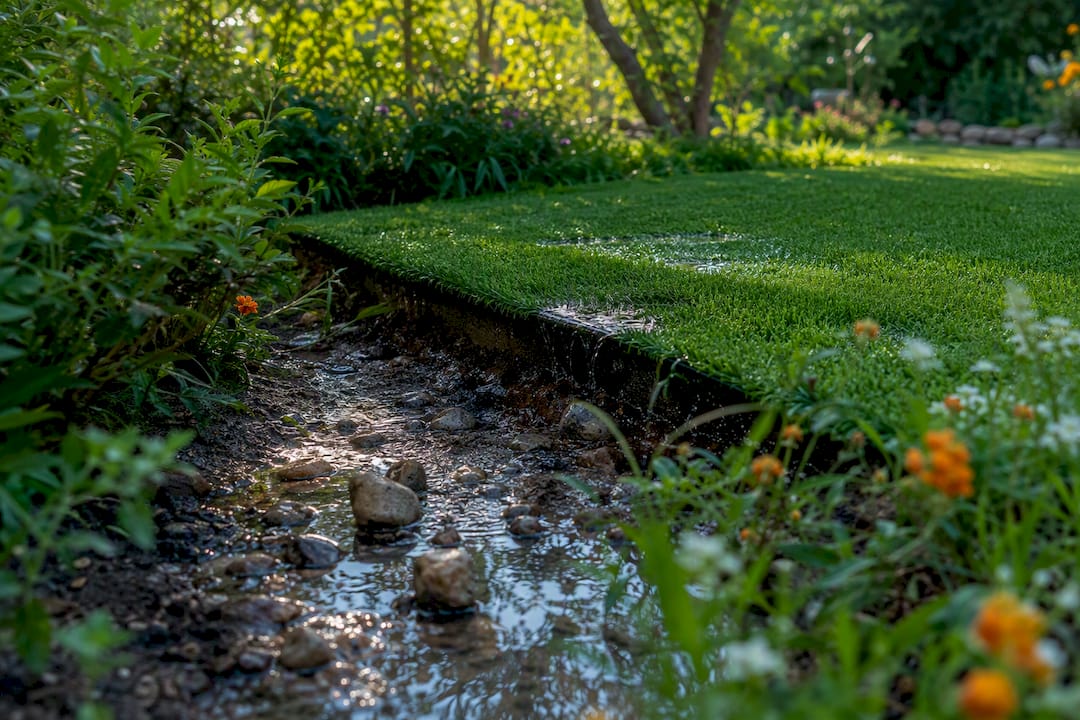
Where the environmental picture gets more nuanced is runoff and repetition. Concentrated vinegar poured straight onto turf, rather than diluted and rinsed properly, can temporarily alter the pH of the soil or gravel base beneath artificial grass, which matters if you’ve got planting beds nearby or a garden that drains into a water feature. This is another reason the dilution and rinse steps aren’t just about protecting your turf. They protect what’s underneath it too.
Turf Tails’ own enzyme formula is worth a mention here since it sits in a similar space: eco-friendly, free of harsh chemicals, and designed to work without leaving anything behind that needs flushing out of the ecosystem later.
One tight rule for the whole article: dilute, spot test, dwell briefly, then rinse thoroughly, whatever cleaning product you’re using and whatever problem you’re trying to solve.
| Point | Details |
|---|---|
| Vinegar’s real job | Light odour and algae control, not a fix for dog urine already bonded to fibres |
| Dilution ratios | 3:1 water to vinegar for routine use, up to 1:1 for tested stubborn spots |
| Rinse discipline | Always rinse until runoff is clear to protect backing, seams and edging |
| Urine problems | Enzyme cleaners like Turf Tails break down uric acid rather than masking it |
Where can you check turf care and cleaning guidance?
- Manufacturer-specific care guides for warranty-safe cleaning methods
- Your own turf installer for warranty terms specific to your lawn
Why the “vinegar fixes everything” advice misses the point
Most cleaning guides treat vinegar as a cure-all because it’s cheap, it’s already in the cupboard, and it does genuinely work for a huge range of household jobs. Artificial grass with a dog in the garden is a different problem entirely, and the conventional advice rarely draws that line clearly enough.
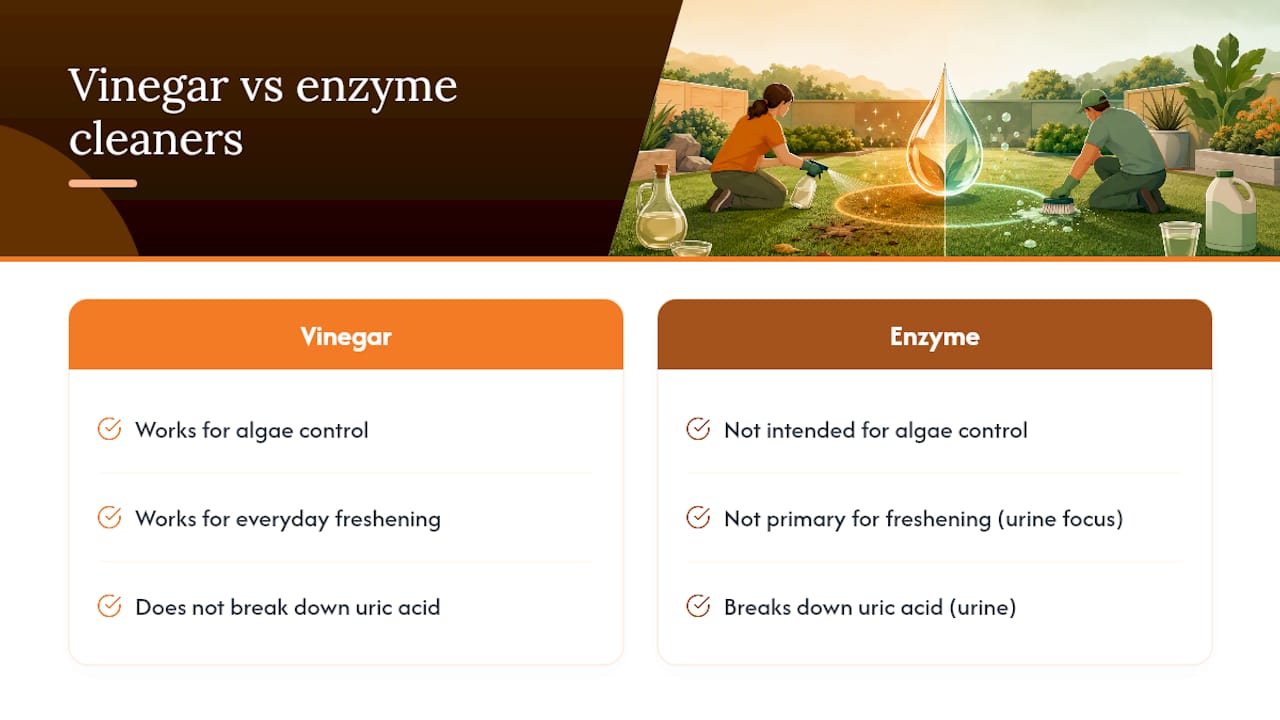
The mistake pet owners make isn’t using vinegar. It’s expecting vinegar to do a job it was never built for. Uric acid crystals need a biological process to break down, not an acid wash, and no amount of extra dilution strength or repeated applications changes that basic chemistry. What the research actually supports is a two-tool approach: vinegar for the everyday freshening and algae control it’s genuinely good at, enzyme treatment for anything urine-related.
If you take one thing from this, prioritise identifying which problem you actually have before reaching for a bottle. A patch that smells stale after rain is a different job to a patch your dog visits five times a day.
Get lasting freshness with Turf Tails’ enzyme cleaner
Vinegar earns its keep as a cheap weekly refresher, but if your garden has a genuine dog urine problem, no amount of diluting and rinsing will finish the job the way a purpose-built enzyme formula will. Turf Tails was developed specifically to break urine compounds down at the source, not mask them, and it’s safe enough to use around children and pets without any harsh chemical smell replacing the one you’re trying to get rid of.
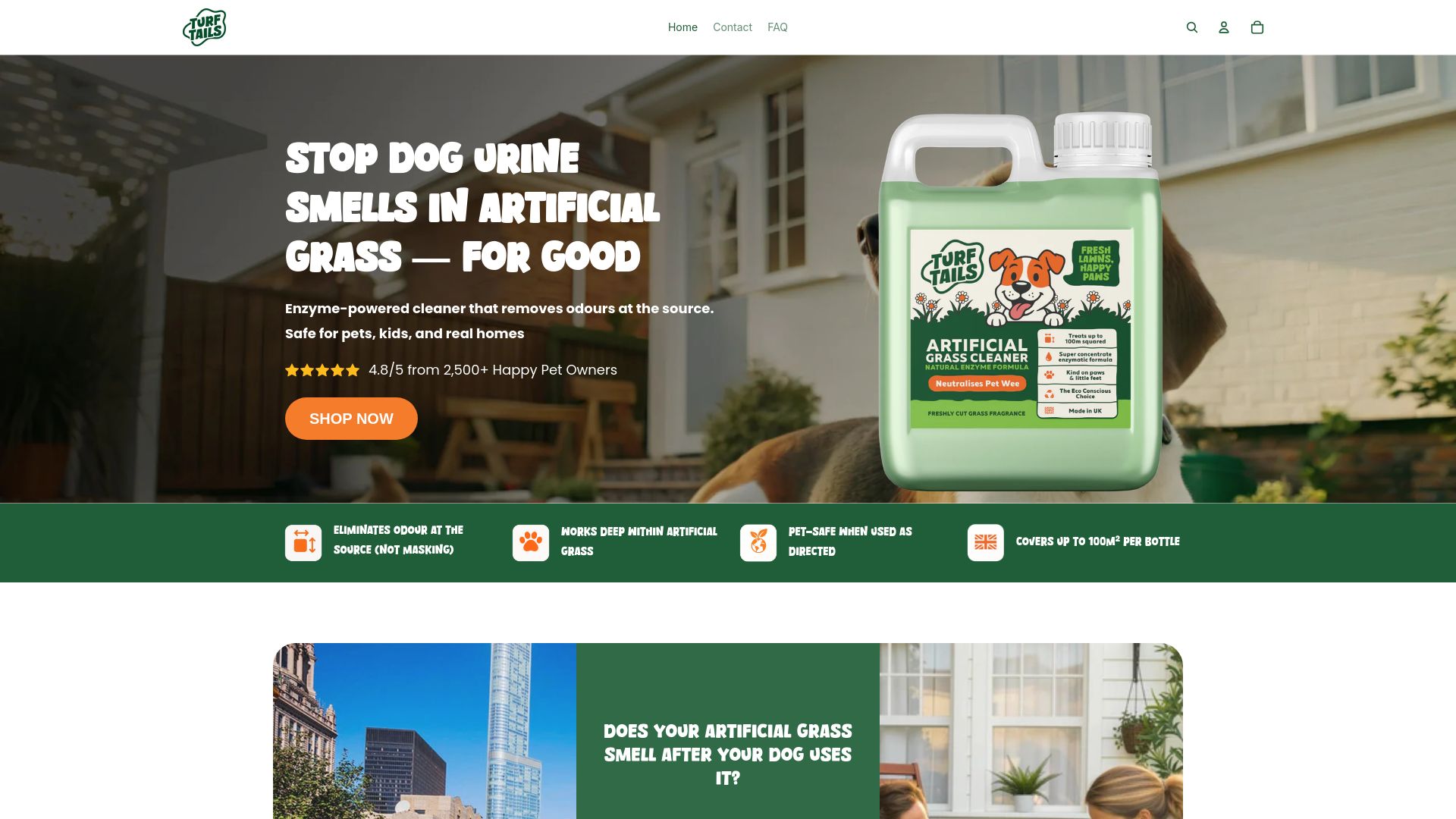
One bottle treats up to 100m², so most gardens are covered without needing several products on hand. It works across artificial grass, decking, patios, kennels and fabric, which means one purchase handles most of the outdoor spots a dog actually uses. If you’ve been cycling through vinegar mixes and carpet cleaners without lasting results, visit the Turf Tails product page to see the enzyme formula and get your garden smelling the way it should.
Sources
- Is Vinegar Safe on Artificial Turf? Cleaning Guide and Ratios | FusionTurf
- Remove Dog Urine Smell From Artificial Grass (2026) | Turf Guide | INSTALL-IT-DIRECT
- Can You Disinfect Artificial Grass? Safe Cleaning Guide
FAQ
Is vinegar safe on artificial grass?
Yes, when diluted properly and rinsed thoroughly afterwards. Undiluted vinegar or leaving it to sit on seams and backing can cause damage over repeated use.
What is the best thing to clean fake grass with?
For general grime and light odours, diluted white vinegar works well. For dog urine specifically, an enzyme cleaner is the better choice since it breaks down uric acid rather than masking it.
Will diluted white vinegar harm artificial grass?
Properly diluted vinegar, spot tested and rinsed off, is unlikely to cause harm. The risk comes from using it undiluted, mixing it with other chemicals, or letting it dry on seams and metal edging.
Will grass grow back if sprayed with vinegar?
This question applies to natural grass, not artificial turf, since synthetic grass doesn’t grow at all. On real lawns, concentrated vinegar can kill grass and surrounding plants, but that has no bearing on synthetic fibres.
Does vinegar remove dog urine smell from artificial grass permanently?
Not reliably. Vinegar can reduce surface odour temporarily, but it lacks the enzymes needed to break down uric acid crystals, which is why the smell often returns within days.