

The fastest fix for dog urine smell on synthetic turf is a turf-safe enzyme cleaner that breaks down uric acid crystals at the source. Rinsing alone won’t do it. Here’s what to do right now:
- Hose down the affected area to dilute fresh urine.
- Apply a pet-safe enzyme cleaner directly to the turf pile and infill.
- Keep pets off the area while the enzymes work.
Turftails is the recommended UK enzyme cleaner for this job. It’s concentrated, eco-friendly, covers up to 100 m² per bottle, and is safe for pets and children once dry.
Dog urine odour on artificial grass isn’t a surface problem. It’s a chemistry problem. The uric acid crystals locked into your turf’s infill and backing won’t shift until something breaks them down at a molecular level.
Key takeaways
Enzyme cleaners remove dog urine odour from artificial grass by breaking down uric acid crystals at the source, and a regular routine prevents crystals from accumulating in the infill.
| Point | Details |
|---|---|
| Rinse first, then enzyme | Hose fresh urine before applying enzyme cleaner to maximise penetration into the pile. |
| Dwell time matters | Allow the enzyme cleaner adequate contact time; agitate set-in odour with a brush before rinsing. |
| Routine prevents build-up | Weekly spot treatment and monthly full-lawn application stops uric acid crystals accumulating. |
| Persistent smell needs investigation | Recurring odour after cleaning usually signals uric acid in the infill or sub-base, not just the surface. |
| Turftails is a UK-ready option | Concentrated, pet-safe, eco-friendly, and covers up to 100 m² per bottle with no harsh chemicals. |
Table of Contents
- Why does urine smell linger on artificial grass?
- Why enzyme cleaners remove odour rather than mask it
- How do you treat fresh urine versus set-in odour on artificial grass?
- How often should you clean artificial grass to prevent odour?
- When does odour keep returning despite cleaning?
- Turftails enzyme cleaner: what it does and how to use it
- How do you choose the right enzyme cleaner for artificial grass?
- An honest word from the Turftails team
- Get Turftails delivered to your door
- Sources
- FAQ
Why does urine smell linger on artificial grass?
Uric acid crystals are the culprit. Dog urine is mostly water, but it also contains urea, ammonia, and uric acid. The water evaporates. The uric acid doesn’t. It forms microscopic salt-like crystals that bind to the turf fibres, infill material, and the backing beneath. According to independent turf guidance, poor drainage and uric acid trapped in the sub-base are the primary causes of persistent odour.
Warm weather makes it worse. Heat and humidity reactivate those crystals, which is why a lawn that smelled fine in February can become unbearable by June. Dogs also tend to use the same spots repeatedly, concentrating the problem in one area.
Pro Tip: If your turf smells worse after rain or on warm days, the issue is almost certainly uric acid crystals in the infill or sub-base, not just surface residue. That’s a drainage and depth problem, not just a cleaning one.
Why enzyme cleaners remove odour rather than mask it
Enzymes and beneficial bacteria physically break down the uric acid and organic residue that cause the smell. A perfumed spray covers the odour temporarily. An enzyme cleaner removes the material that produces it.
The targets are specific:
- Uric acid crystals embedded in the pile and infill
- Urea and ammonia compounds from the urine itself
- Bacteria and organic residue feeding the odour cycle
The safety case is equally clear. Bleach and heavy disinfectants can degrade turf fibres, harm soil microbiomes beneath permeable backings, and pose real risks to dogs that lick or roll on treated surfaces. Enzyme-based products avoid all of that. As Turftails explains in its dwell-time and pet-safety guidance, the cleaner is safe for pets and children once it has dried, with no harsh chemicals involved.
For households thinking about broader odour control around the home, resources like the BinRx household odour guide offer useful context on enzyme-based products for domestic use.
How do you treat fresh urine versus set-in odour on artificial grass?
The approach differs depending on how long the urine has been sitting.
Fresh urine spot
- Hose the area thoroughly to dilute and flush the urine through the drainage layer.
- Apply your enzyme cleaner directly to the wet turf, covering the full affected area.
- Allow the recommended dwell time (check your product label).
- No rinsing is required with Turftails’ no-rinse formula. Leave to dry naturally.
- Keep pets off the area until dry.
Set-in odour (urine that has dried and crystallised)
- Pre-rinse the area to rehydrate the crystals and open up the turf pile.
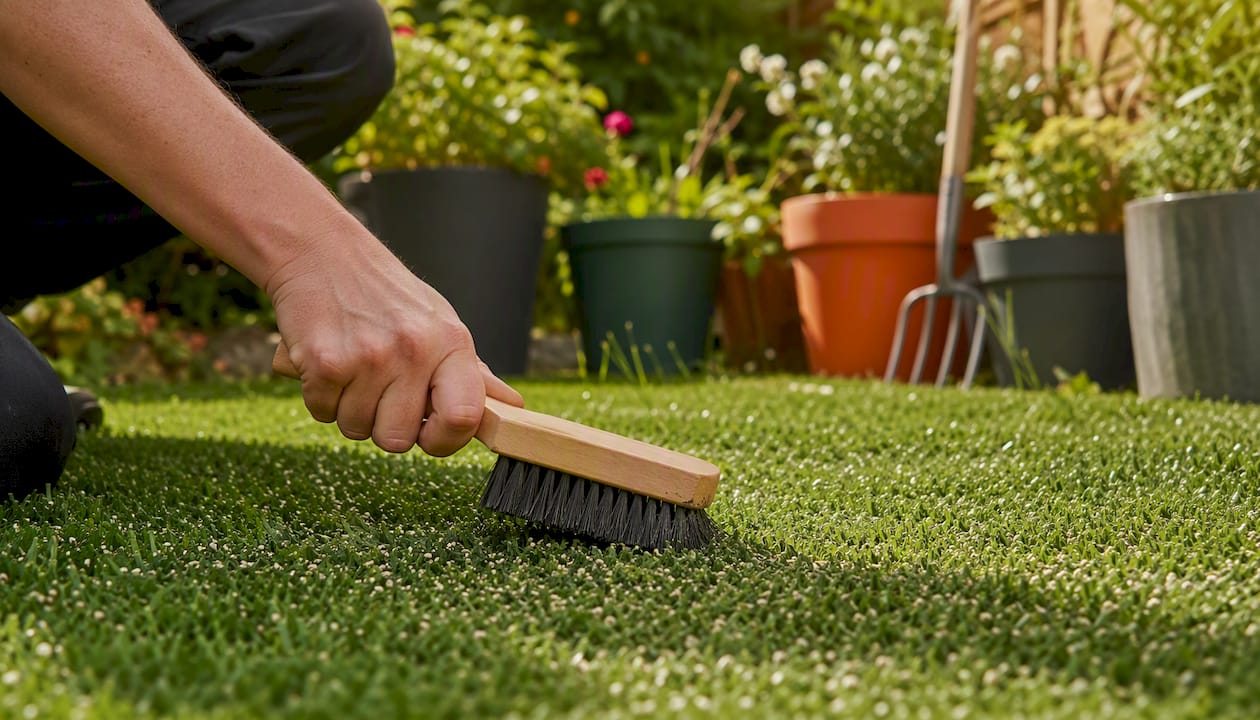
- Apply enzyme cleaner generously, working it into the pile and infill with a stiff brush.
- Allow a longer dwell time to give the enzymes time to break down the crystallised residue.
- Rinse thoroughly to flush the broken-down particles through the drainage layer.
- Repeat if the smell persists after drying.
Stepwise enzyme cleaning guidance from Turftails’ blog confirms that agitation and adequate dwell time are the two steps most often skipped, and skipping either significantly reduces effectiveness.
| Treatment type | Pre-rinse needed? | Agitation? | Rinse after? | Repeat likely? |
|---|---|---|---|---|
| Fresh urine spot | Yes | Light | No (no-rinse formula) | Rarely |
| Set-in / dried odour | Yes | Firm brush | Yes | Sometimes |
Safety note: Store enzyme concentrate out of reach of children and pets. Keep animals off treated turf until fully dry.
How often should you clean artificial grass to prevent odour?
A two-level routine keeps smells from building up. Light rinsing after each toilet visit handles the immediate load. A deeper enzyme treatment, weekly or monthly depending on how many dogs use the lawn, prevents crystals from accumulating.
A practical schedule for UK dog owners:
- Daily (or after each use): Hose down toilet spots to dilute fresh urine before it dries.
- Weekly: Apply enzyme cleaner to high-use areas, particularly any repeat toilet spots.
- Monthly: Full-lawn enzyme treatment, brushing the pile to work product into the infill.
- Seasonally: Increase frequency in warm months (May through September) when uric acid crystals reactivate more readily. After heavy rain, check whether odour returns, which can signal sub-base saturation.
The UK’s wet winters can actually help flush surface residue, but they won’t dissolve crystallised uric acid in the infill. Don’t rely on rainfall as a substitute for enzyme treatment.
When does odour keep returning despite cleaning?
Recurring smell after cleaning usually means uric acid has leached into the infill or sub-base. Surface treatment alone won’t reach it. Before repeating another round of cleaning, run these checks:
- Map the repeat spots. If the same patch smells every time, the infill beneath it is likely saturated.
- Water-drain test. Pour water onto the area and watch how quickly it drains. Slow drainage means urine is pooling rather than passing through.
- Smell after rain. A strong smell following rainfall is a reliable sign of sub-base contamination.
- Patch lift. Carefully lift a corner of the turf in the worst-affected area and smell the backing and base material directly.
Pro Tip: A simple way to isolate the problem: soak the suspect area with clean water and smell it after 10 minutes. If the odour intensifies, the crystals are in the infill or base. If it fades, the issue is surface residue and another enzyme treatment should resolve it.
If the sub-base is contaminated, the turf may need lifting, the base raked out and treated, and the infill replaced before relaying. That’s a job for a professional installer.
Turftails enzyme cleaner: what it does and how to use it
Turftails is a concentrated, eco-friendly enzyme cleaner formulated specifically for artificial grass and pet households in the UK. Its core claims:
- Breaks down uric acid and urine compounds at a molecular level, not just at the surface
- Pet- and child-safe once dry, with no harsh chemicals or artificial perfumes
- Concentrated formula covers up to 100 m² per bottle
- No-rinse application for routine maintenance
- Works on artificial grass, patios, decking, concrete, kennels, and fabrics
Dog owners who have switched to a regular Turftails routine report a noticeable reduction in odour, particularly when they combine weekly spot treatment with a monthly full-lawn application.
| Application | Dilution | Coverage | Rinse required? |
|---|---|---|---|
| Routine maintenance | As per label | Up to 100 m² per bottle | No |
| Deep treatment (set-in odour) | As per label | Concentrated to affected area | Yes, after dwell time |
For dwell times and precise dilution ratios, the Turftails enzyme guide has the full breakdown.
How do you choose the right enzyme cleaner for artificial grass?
Pick a turf-labelled, pet-safe enzyme solution with clear dilution instructions and a stated coverage figure. Those three details alone filter out most of the poor-quality options.
Must-have on the label:
- “Turf-safe” or “safe for synthetic grass” — not all enzyme products are formulated for artificial fibres
- Enzyme-based (not just bacterial or perfumed)
- Dilution ratio and coverage per bottle
- Stated contact/dwell time
- No bleach, no chlorine, no undisclosed additives
Red flags:
- Heavy fragrance with no enzyme claim (it’s a masking product)
- No coverage or dilution data
- Bleach or disinfectant as the active ingredient
- Vague language like “neutralises odours” with no mechanism stated
White vinegar diluted 1:1 with water can take the edge off a mild smell, but it won’t dissolve uric acid crystals. For anything beyond a very light, fresh odour, an enzyme cleaner is the correct tool.
Pro Tip: Check whether the product is labelled for artificial grass specifically. Some enzyme cleaners designed for carpets or hard floors use formulations that can affect turf fibres or leave residue in the infill.
An honest word from the Turftails team
Working with pet households across the UK, the pattern we see most often is this: dog owners try rinsing, then try a generic cleaner, and only reach for an enzyme product once the smell has become genuinely embarrassing. By that point, the uric acid has had weeks to crystallise into the infill.
Caroline, who works closely with Turftails’ customer feedback, notes that the households who see the best results are those who start an enzyme routine early and stick to it weekly. The product works. But it works best when it doesn’t have to fight months of accumulated crystals on its own.
Get Turftails delivered to your door
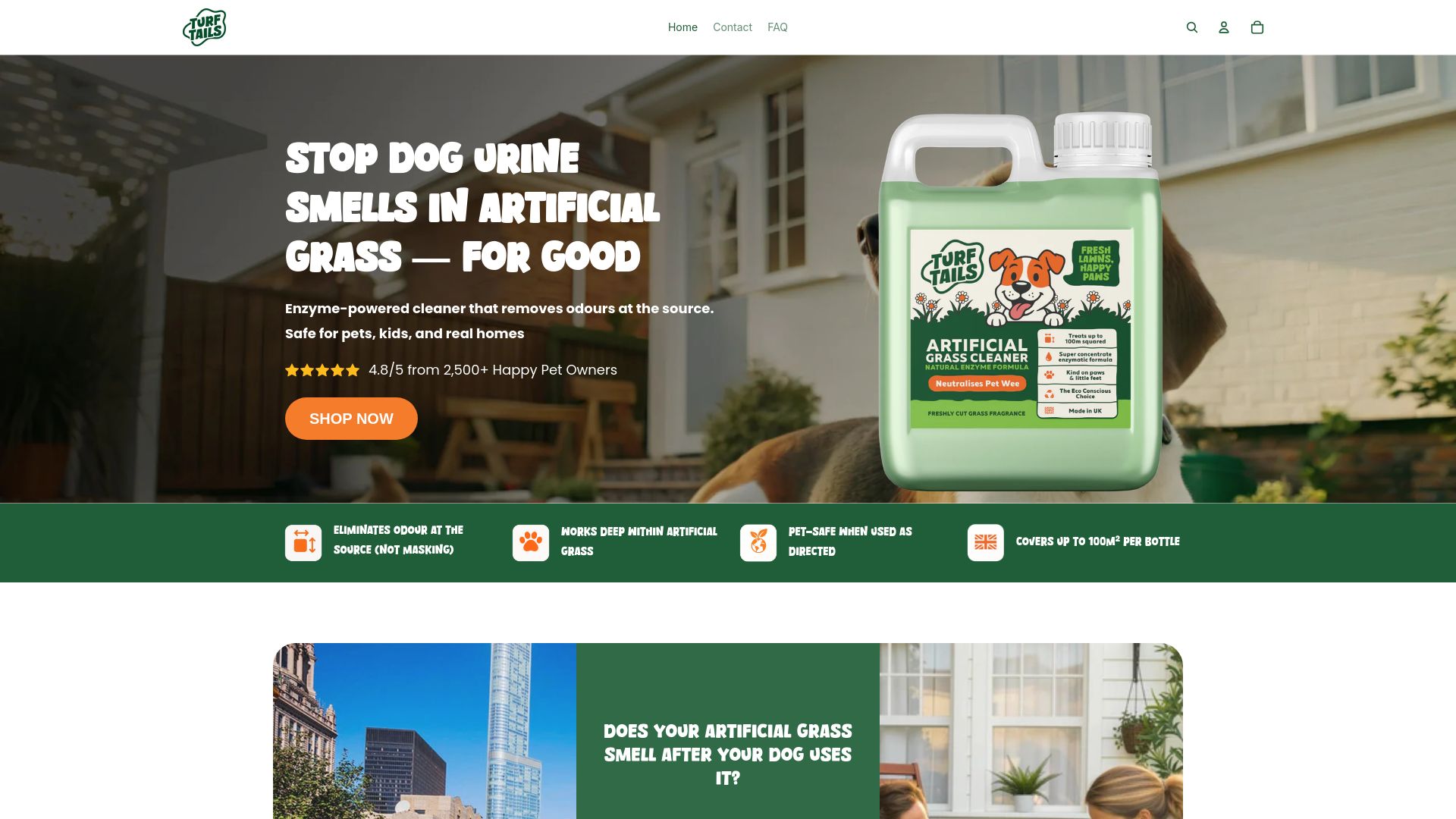
A single bottle of Turftails covers up to 100 m² and arrives ready to use. Order once or set up a subscription so you never run out mid-summer when you need it most. The formula is concentrated, so one bottle goes further than most ready-to-use alternatives on the market.
Order directly from the Turftails website. Delivery is to UK addresses, and the checkout takes under two minutes. If you want to keep a bottle in reserve for the warmer months, the subscription option locks in your supply without any commitment you can’t cancel.
Store the concentrate in a cool, dry place away from direct sunlight and out of reach of children and pets.
Sources
- How to Stop Artificial Grass Smelling of Dog Urine (UK Guide 2026)
FAQ
Why does my artificial grass still smell after cleaning?
Uric acid crystals embedded in the infill or sub-base are the most common cause. Surface cleaning won’t reach them; you need an enzyme cleaner applied with agitation and adequate dwell time.
Is Turftails safe for dogs and children?
Yes. Turftails is pet- and child-safe once dry, and contains no harsh chemicals or artificial perfumes.
How much enzyme cleaner do I need for my lawn?
One bottle of Turftails covers up to 100 m², making it sufficient for most UK residential lawns in a single application.
How often should I apply enzyme cleaner to artificial grass?
Weekly treatment of high-use spots and a monthly full-lawn application is the recommended routine, with increased frequency during warm months when uric acid crystals reactivate more readily.
Can I just use a hose to remove urine smell from artificial grass?
Rinsing dilutes fresh urine but cannot dissolve uric acid crystals. An enzyme cleaner is needed for persistent or recurring odour.