

Enzyme cleaners beat bleach for pet stains and odour, full stop. Dog urine leaves uric acid crystals behind, and only enzymes break those down at a molecular level. Bleach disinfects the surface but does nothing to eliminate the uric acid causing the smell, and mixed carelessly, it can make things worse.
Bleach still earns its place in specific situations:
- Sealed, non-porous, colourfast hard surfaces that genuinely need disinfecting (not deodorising)
- Situations with no pets, children, or fabric nearby
- Never on artificial turf, upholstery, or anything porous
For everything urine-related, from carpets to artificial grass, an enzyme-based approach is the correct tool, and Turftails builds its formula specifically around that principle for outdoor turf and hard landscaping.
Key Takeaways
Enzyme cleaners remove urine odour at the source by breaking down uric acid, while bleach only disinfects and can worsen smell or damage surfaces if misused.
| Point | Details |
|---|---|
| Enzymes win on odour | They digest uric acid molecules directly instead of masking the smell temporarily. |
| Bleach has a narrow role | Reserve it for sealed, non-porous, colourfast surfaces with no organic residue left. |
| Dwell time is non-negotiable | Set-in stains need several hours of moist contact, not a quick five-minute wipe. |
| Never mix cleaning chemicals | Bleach plus ammonia or urine can release harmful chloramine fumes. |
| Turftails suits turf and hard surfaces | Its enzyme formula covers up to 100m² per bottle with no rinsing required. |
Table of Contents
- Enzyme cleaner vs bleach: a side-by-side breakdown
- How enzymatic cleaners actually break down urine
- What bleach does well, and where it falls short on urine
- What not to mix, and how to stay safe while cleaning
- Choosing the right product for your surface
- The correct dwell-time protocol for fresh and set-in stains
- Why Turftails is built specifically for this problem
- Why the “just use bleach” advice refuses to die
- Get your garden back with Turftails
- Sources
- FAQ
Enzyme cleaner vs bleach: a side-by-side breakdown
Here’s how the two stack up against the criteria that actually matter when you’re standing over a stain deciding what to reach for.
- Odour elimination: Enzymes win outright. They digest the uric acid molecules causing the smell rather than covering them up. Bleach can mask odour briefly, then lets it return once the disinfectant smell fades.
- Visible stain removal: Enzymes gradually lift protein-based staining as they break down residues. Bleach can bleach out colour rather than remove the stain, particularly on dyed fabric or coloured turf infill.
- Safety for pets and children: A good enzyme formula, Turftails included, is designed to be safe once dry. Bleach requires full rinsing, ventilation, and a strict no-contact window.
- Surface compatibility: Enzymes suit porous and soft materials, artificial grass, fabric, foam, and grout. Bleach is limited to sealed, non-porous, colourfast surfaces.
- Dwell time and repeat treatment: Enzymes need patience, often 15 minutes to several hours depending on how set-in the stain is. Bleach acts fast but doesn’t need to “work” on uric acid, because it can’t.
- Cost and effort: Bleach is cheap but you’ll be reapplying it constantly as odour returns. Enzyme cleaners cost more per bottle but need far fewer repeat applications when used correctly.
Bleach still has a genuine niche: sanitising a sealed patio slab or a kennel floor where no organic residue remains. For anything with an odour source still embedded in it, enzymes are doing a job bleach was never built to do.
How enzymatic cleaners actually break down urine
Enzymes are biological catalysts. In a cleaning product, they’re selected to target specific molecules, proteases for proteins, ureases for urea, and enzymes that help dismantle uric acid crystals into water-soluble by-products that rinse or evaporate away. This is fundamentally different to bleach’s approach of oxidising surface bacteria; enzymes physically dismantle the compound causing the smell.
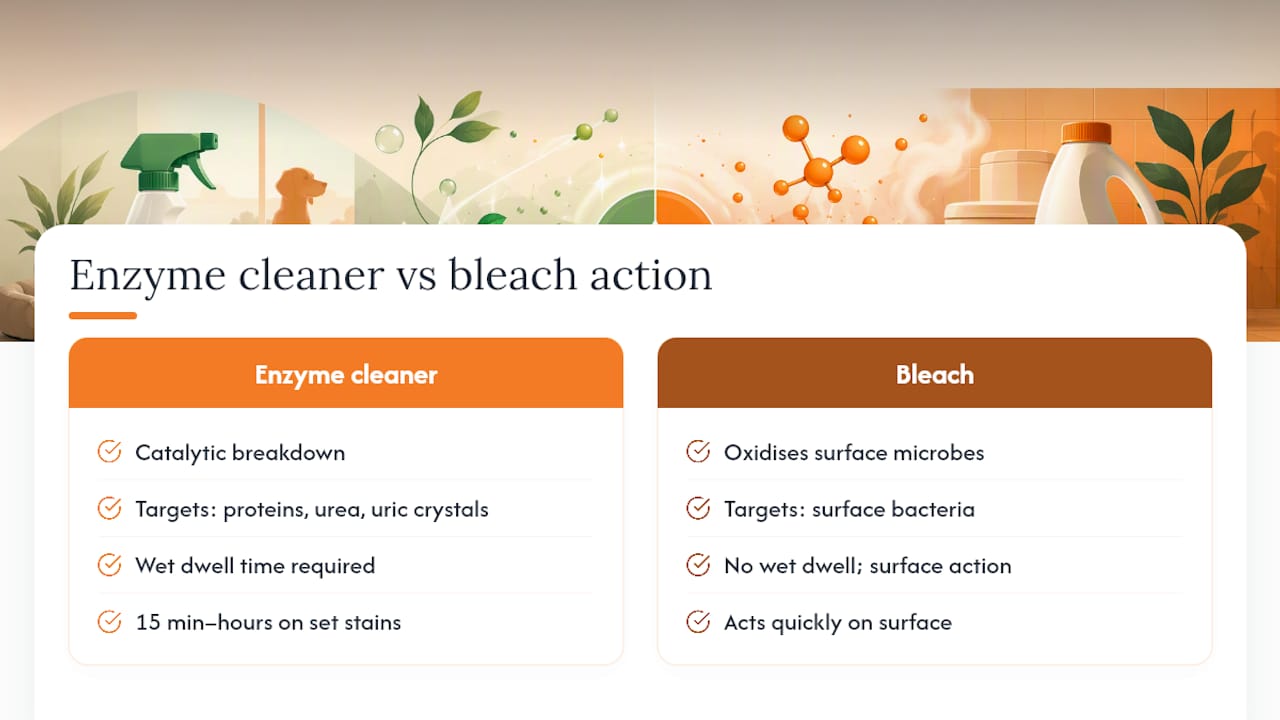
That’s why dwell time and moisture matter so much. Enzymes need a wet environment and time to keep working, sometimes 15 minutes on a fresh spot, several hours on something set in. Let it dry out too early and the reaction stops halfway.
Three things routinely sabotage enzyme cleaners: hot water, which can denature the enzymes before they start working; prior bleach or disinfectant residue, which deactivates the enzymes on contact; and old or expired product, since enzymes lose potency over time.
Pro Tip: Always use cool or lukewarm water with enzyme cleaners, never hot. Heat is one of the fastest ways to kill the very enzymes you’re relying on.
What bleach does well, and where it falls short on urine
Bleach is an oxidiser and disinfectant. It kills bacteria and viruses on a surface, which is genuinely useful for general hygiene. What it does not do is dissolve or break down uric acid crystals, the actual source of that lingering ammonia smell in old urine stains.
Roughly one in three UK households now has a pet, and bleach remains a default reach for many when odour strikes, despite the mismatch between what it’s designed to do and what the smell actually requires.
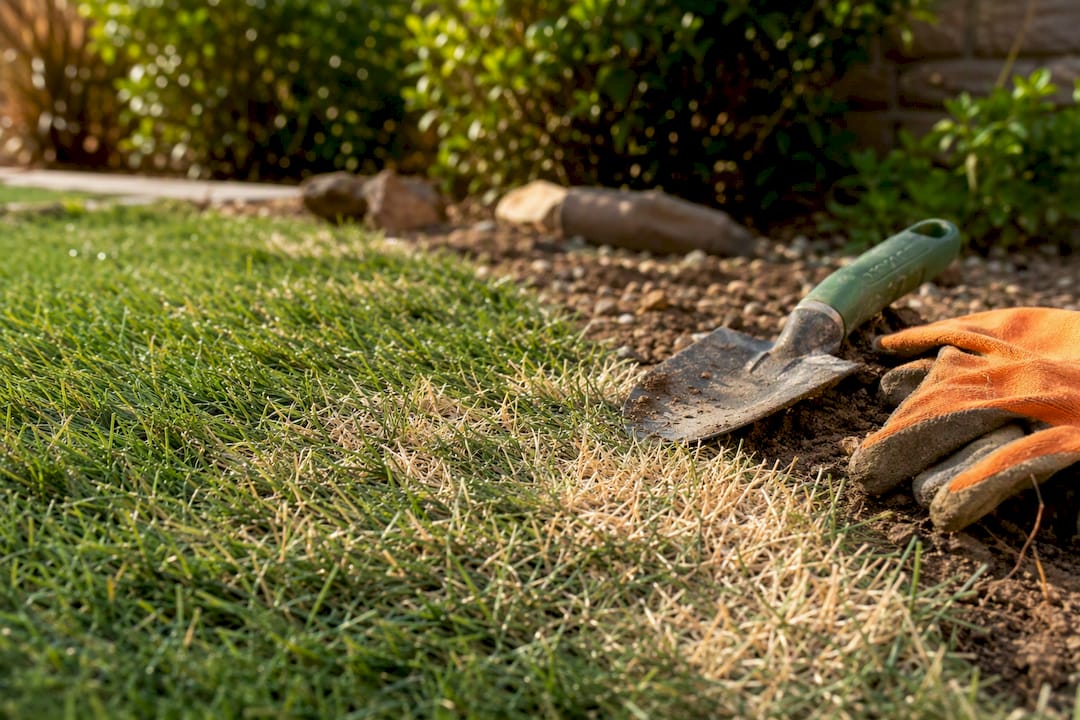
Mixing bleach with residual urine or ammonia-based cleaners can release chloramine fumes, a genuine respiratory hazard in an enclosed space. Bleach also strips colour from fabric, degrades memory foam, and breaks down artificial turf fibres and infill over repeated use, leaving brittle, discoloured patches exactly where you needed a clean fix.
What not to mix, and how to stay safe while cleaning
Never combine bleach with ammonia, vinegar, hydrogen peroxide, or any enzyme-based cleaner. Each pairing risks a chemical reaction, and bleach plus ammonia (which is present in urine itself) is the most dangerous combination in an average home.
- Work in a ventilated space, open windows or doors before you start.
- Wear gloves and avoid splashing bleach on skin or into eyes.
- Keep pets and children off the treated area until it’s fully dry, longer for bleach than for enzyme products.
- Never layer one cleaning product over another without rinsing thoroughly first.
- If odour persists after repeated treatment, especially on porous flooring, underlay, or turf infill, call a professional rather than escalating the chemicals yourself.
Persistent smell after multiple attempts usually means contamination has spread beneath the visible surface, which no amount of extra bleach or enzyme product applied on top will fix.
Choosing the right product for your surface
Matching the product to the material stops you creating a bigger problem than the one you started with.
- Carpet and upholstery: Enzyme cleaner only. Bleach will discolour fabric and won’t touch the odour source underneath.
- Artificial grass: A turf-formulated enzyme cleaner is essential. Bleach and oxygen bleach degrade fibres and infill, and vinegar can trap odour rather than remove it.
- Hard, sealed floors (tile, sealed concrete): Bleach is acceptable for disinfecting once organic residue is already gone; enzymes still handle the odour source better.
- Mattresses and foam: Enzyme only, applied sparingly to avoid oversaturating foam.
Always test a hidden patch first, a corner of turf or an inconspicuous cushion seam, and wait to check for discolouration before treating the visible area.
The correct dwell-time protocol for fresh and set-in stains
Fresh stains respond fastest, but even old ones recover fully with the right sequence.
Fresh urine:
- Blot up excess liquid; don’t rub it in.
- Rinse the area with cool water.
- Apply the enzyme cleaner generously, covering the full stained area.
- Keep it moist and let it dwell, typically 15 to 30 minutes for a fresh spot.
- Blot dry or allow to air dry naturally.
Set-in or repeat-offender stains:
- Pre-rinse to remove surface debris.
- Apply enzyme cleaner liberally, more than feels necessary.
- Let it dwell for several hours, the single biggest factor in whether odour actually disappears rather than fading temporarily.
- Repeat if the smell returns once dry.
- Rinse or brush per the product label.
Pro Tip: Check back once the area is completely dry, not while it’s still damp. A treated spot can smell “fine” wet and reveal it needs a second pass only after full drying.
If odour keeps returning after multiple full treatments, especially outdoors, the contamination has often spread into the substrate beneath the surface. That’s the point to consider a professional deep clean rather than another bottle.
Why Turftails is built specifically for this problem
Turftails is an enzyme-powered cleaner engineered for the exact scenario this article covers: dog urine trapped in artificial grass, patios, decking, concrete, kennels, and fabric. It targets urine compounds at the molecular level rather than masking them, contains no harsh chemicals or artificial perfumes, and is formulated to be safe once applied around pets and children.
One bottle of the concentrated formula covers a large area suitable for typical garden use, and the no-rinse design fits the dwell-time principle covered earlier: apply, let it work, no follow-up rinse required. That matters on turf specifically, where incomplete rinsing and short dwell times are the most common reasons owners report the smell coming back. Customers report a noticeable difference after switching, though as with any product, results depend on correct application and consistent use rather than a single treatment fixing years of build-up.
Why the “just use bleach” advice refuses to die
The instinct to reach for bleach is understandable. It smells strong, it’s cheap, and it feels like it’s “working” the moment you pour it. That’s precisely the problem: the smell you’re noticing is the bleach itself, not evidence that the underlying uric acid has gone anywhere. Once the bleach scent fades, usually within a day or two, the original odour often comes back stronger because moisture and heat can actually help uric acid crystals recrystallise and spread further into whatever they’ve soaked into.
What gets underestimated is how much dwell time matters with enzymes, and how often people undermine their own results by rinsing too early or by pre-treating with a bleach-based product out of habit. You end up deactivating the very enzymes you just paid for. If there’s one piece of conventional wisdom worth throwing out entirely, it’s the idea that a stronger-smelling product is a more effective one. On uric acid, it’s usually the opposite.
The real gap isn’t between enzyme cleaners and bleach as products, it’s between people who give enzymes time to finish the job and people who rinse, judge, and move on too soon.
— Caroline
Get your garden back with Turftails
Turftails gives you a way to sort urine odour at the source instead of fighting it every weekend with a hose and a bottle of something that only works for a day. It’s built specifically for artificial grass, patios, decking, and concrete, so you’re not guessing whether a general household cleaner is safe to use around pets and children.
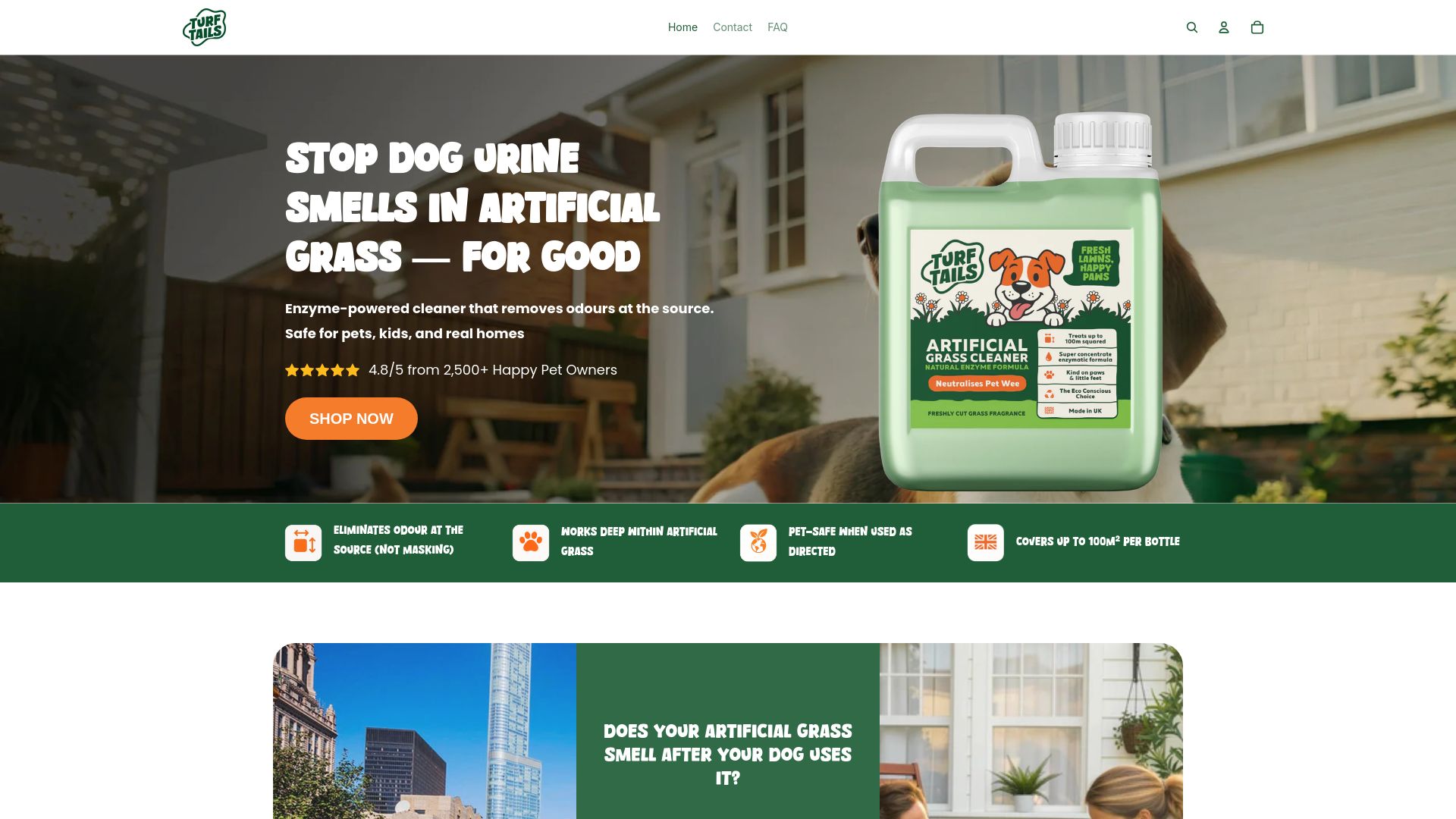
One bottle of concentrate covers up to 100m², there’s no rinsing step to remember, and the formula is eco-friendly with no harsh chemicals or artificial perfumes to worry about near paws or bare feet. If your outdoor space has been the reason you avoid inviting people round, that’s exactly the problem this was made to fix. Head to Turf Tails to order the concentrate and get your garden smelling right again before the weekend.
Sources
Claims here draw on Enviroliteracy’s bleach and urine analysis, Enzyme Cleaners’ pet stain guide, Turfresh’s artificial turf cleaning advice, and WigglyBums’ bleach effectiveness review.
- Does bleach disinfect dog urine?
- How to Remove Pet Stains and Odors (Every Surface) | Enzyme Cleaners
- How to Clean Fake Grass from Dog Urine: 3 Mistakes to Avoid
FAQ
Is white vinegar an enzymatic cleaner?
No. Vinegar is a mild acid that can temporarily mask odour, but it contains no enzymes and doesn’t break down uric acid, and on artificial turf it can trap urine rather than remove it.
What should you never mix with an enzyme cleaner?
Avoid combining enzyme cleaners with bleach, hydrogen peroxide, or hot water, all of which can deactivate the enzymes before they finish breaking down the stain.
What can I use instead of an enzyme cleaner?
Hydrogen peroxide mixes or baking soda can help lift stains or absorb odour, but both carry risks like fabric bleaching, so test a hidden area first. For artificial grass specifically, Turftails is formulated as a direct enzyme-based option rather than a workaround.
Is baking soda an enzymatic cleaner?
No, baking soda works by absorbing odour and mildly neutralising acidity, not by digesting uric acid the way enzymes do, so it’s better as a supporting step than a standalone fix.
Is bleach safe for cleaning artificial grass?
No. Bleach and oxygen bleach can degrade turf fibres and infill over repeated use, and they do nothing to remove the uric acid causing the odour in the first place.