

Blot up the liquid immediately, apply an enzymatic cleaner, then let the mat dry fully in the sun. That single routine clears most doormat urine smell problems, whether the culprit is a puppy who didn’t quite make it outside or a cat marking the front step.
Here’s what to do in the first ten minutes:
- Press paper towels or a clean cloth over the wet patch. Don’t rub.
- Lift the mat if you can and check whether liquid has reached the floor underneath.
- Soak the affected area with an enzyme cleaner, following the label’s contact time.
- Leave the mat to dry somewhere ventilated, ideally outdoors in daylight.
Pro Tip: Test any cleaner on a hidden corner first. Some dyes and backings react badly to enzyme formulas or vinegar, and you’ll want to know that before you treat the visible half of the mat.
Key Takeaways
Fresh urine responds to prompt blotting and enzyme treatment, while aged or repeated staining usually needs several enzyme cycles or, ultimately, replacement.
| Point | Details |
|---|---|
| Act within minutes | Blot liquid immediately before it reaches the backing or subfloor; speed matters more than product choice. |
| Choose enzymes over masking agents | Enzymatic cleaners break down uric acid and proteins; ammonia and bleach can mask smell or worsen marking. |
| Dry fully between treatments | Sun and airflow finish the job that cleaning agents alone can’t, and prevent bacterial regrowth. |
| Match the method to the material | Coir needs spot treatment and never soaking; washable textiles can go in the machine; synthetics can be hosed down. |
| Replace when treatment stops working | Persistent odour after full drying and repeated enzyme cycles usually means the mat needs replacing. |
| Reach for a dedicated pet-urine formula | Turf Tails’ enzyme cleaner targets urine compounds directly and works on doormats, decking, and kennels alike. |
Table of Contents
- Why does urine smell linger on a doormat?
- How do you clean a fresh urine accident on a doormat?
- What removes old, dried-in urine smell from a doormat?
- Which cleaning method suits your type of doormat?
- Do enzyme cleaners work better than vinegar or baking soda?
- How do you stop your pet using the doormat as a toilet?
- When should you replace a doormat instead of cleaning it?
- A cleaner built for exactly this problem
- Sources
- FAQ
Why does urine smell linger on a doormat?
Fresh urine barely smells. The stench builds as urea breaks down into ammonia and, in aged deposits, into uric acid crystals that bind tightly to fibres and resist ordinary washing. Bacteria feed on the residue and release volatile organic compounds (VOCs), and it’s these VOCs, not the liquid itself, that your nose actually detects.
Cat urine is often worse than dog urine because of a protein called cauxin, which increases adhesion to surfaces and boosts the emission of pungent compounds. Sulphur compounds are frequently the main offenders behind the sharpest, most “off” notes in aged cat urine.
- Uric acid crystals don’t dissolve in water, which is why plain washing rarely finishes the job.
- Trapped moisture inside mat fibres feeds the bacteria that generate fresh VOCs days after the original spot dries.
- Porous materials such as coir hold odour compounds far deeper than synthetic fibres.
A 2020 laboratory study tracked cat urine odours on carpet and subfloor over 15 days and found that standard cleaning products masked several VOCs on the day of application but failed to remove the odours that emerged later. That’s the core problem with quick fixes: they can hide a smell today and let it resurface next week.
Pro Tip: If a mat can go outside, ten minutes of direct sun does more to finish off lingering odour than an extra spray of air freshener.
How do you clean a fresh urine accident on a doormat?
Speed matters more than product choice in the first few minutes. Liquid that reaches the backing or subfloor is far harder to treat than liquid caught on the surface.
- Blot immediately with several layers of paper towel or an old towel, pressing down for 30 to 60 seconds rather than wiping.
- Repeat with dry layers until no more moisture transfers.
- Apply an enzymatic cleaner generously enough to reach as deep as the urine soaked.
- Leave it to work for the contact time stated on the bottle, usually 10 to 15 minutes, though some formulas need longer.
- Blot again, then leave the mat to air dry fully before anyone walks on it.
A few things to avoid along the way:
- Don’t rub. Rubbing pushes liquid deeper into fibres and spreads the stain sideways.
- Don’t reach for ammonia-based cleaners. The smell is chemically close enough to urine that it can actually encourage repeat marking on the same spot.
- Don’t skip the drying step. A damp mat left indoors is exactly the environment that breeds fresh odour-producing bacteria.
Diluted white vinegar can work as a stopgap for a very fresh, small accident, since its acidity neutralises some odour compounds on contact. It won’t touch uric acid crystals once they’ve formed, though, which is usually within a few hours. For anything beyond a minor splash, go straight to an enzyme cleaner and skip the vinegar step entirely.
Pro Tip: Dry outdoors in direct sun rather than indoors near a radiator. High heat can set residual proteins into the fibres before the enzymes finish breaking them down.
What removes old, dried-in urine smell from a doormat?
Dried urine is a different problem to a fresh accident. Once uric acid crystallises, it becomes insoluble in water and effectively locks itself into the fibre structure, which is why a quick surface wipe never seems to finish the job on an old stain.
That’s also why a single treatment often isn’t enough. Enzymes need direct, sustained contact with the crystals to break them down, and a mat that’s been soiled repeatedly over weeks may have layers of contamination at different depths.
A realistic deep-clean routine looks like this:
- Saturate the affected area with enzyme cleaner and let it sit for the maximum time the label allows, often 20 to 30 minutes for aged stains.
- Agitate gently with a soft brush to help the solution penetrate deeper fibres.
- Blot out as much liquid as possible, then repeat the whole application a second time.
- Rinse only if the material and backing can tolerate it without trapping water underneath.
- Dry completely between treatments and again at the end, ideally over a full day outdoors.
Expect two to three treatment cycles for a heavily soiled mat, spread across a couple of days to allow proper drying between each one.
Pro Tip: Once the mat is bone dry, do a smell test at close range and, if you have one, check under UV light in a dark room. Old urine fluoresces under blacklight, which reveals patches you might otherwise miss.
Which cleaning method suits your type of doormat?
Not every mat responds the same way to the same treatment, and using the wrong method can ruin one faster than the urine itself would.
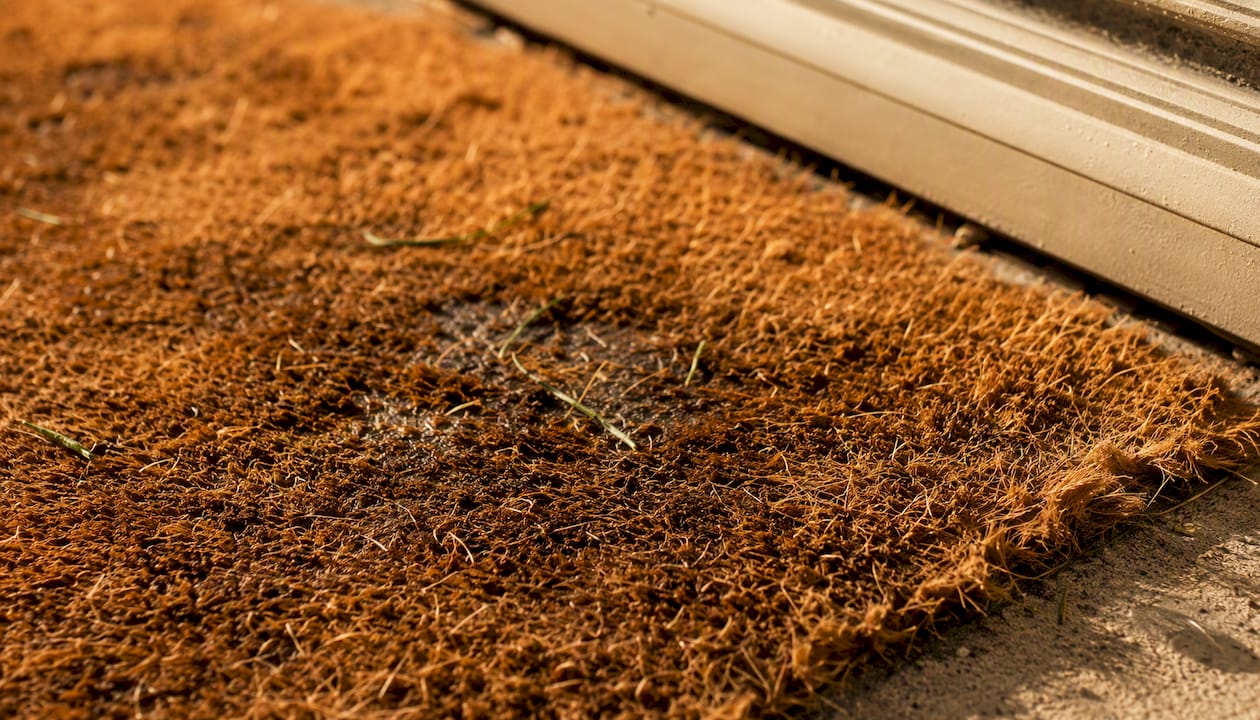
Coir mats are highly absorbent natural fibre, which makes them terrible at containing liquid and hard to clean once it’s soaked through. Never submerge coir. Blot immediately, apply enzyme cleaner as a spot treatment or dry powder rather than a soak, and accept that a mat with deep, repeated contamination probably needs replacing rather than rescuing.
Rubber-backed mats trap moisture between the fibre top and the rubber layer, so surface treatment is safer than saturating the whole mat. Lift the mat regularly during cleaning to check whether liquid has pooled against the backing, and don’t leave a rubber-backed mat sitting on a damp subfloor while it dries.
Washable textile mats are the easiest category. Most tolerate a machine wash on a warm cycle (check the label for the exact temperature limit) with a standard detergent, though adding an enzyme pre-treatment to visible stains before washing gives a noticeably better result than detergent alone.
Synthetic and vinyl mats can usually be hosed down outdoors and treated directly with an enzyme spray, since the non-porous surface doesn’t trap odour the way natural fibres do. Rinse, then stand the mat upright somewhere with good airflow to dry both sides evenly.
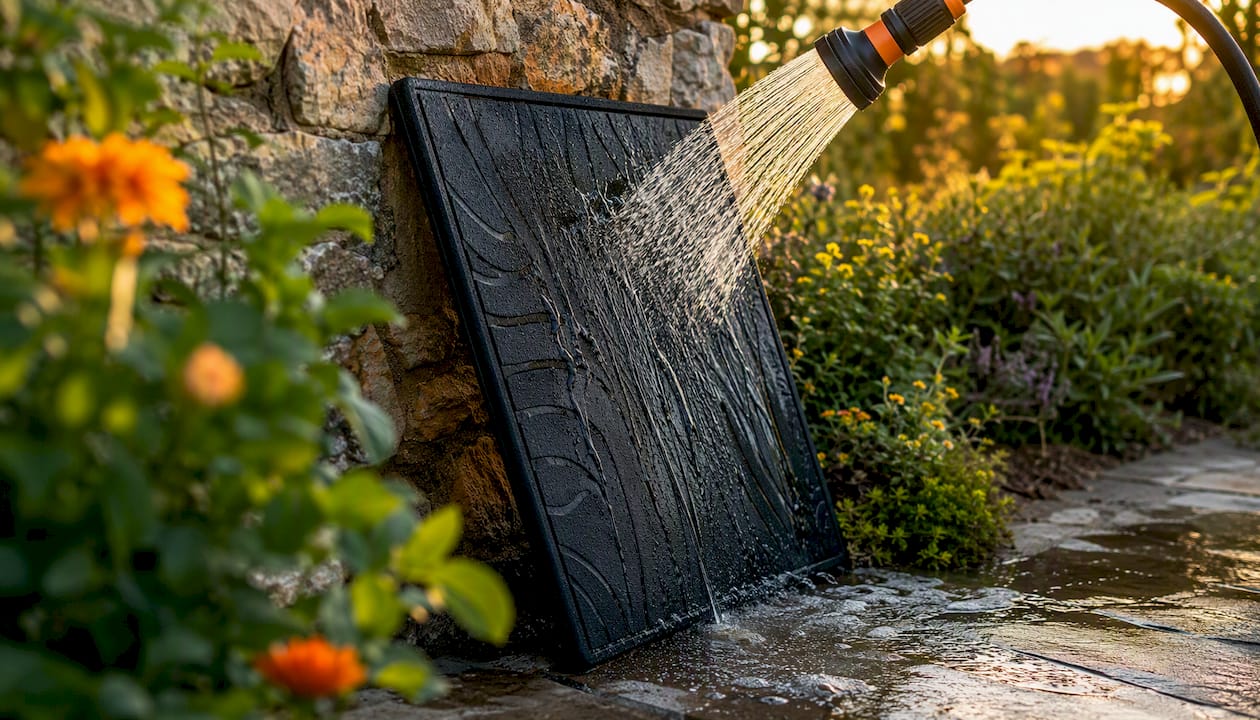
Pro Tip: A washable barrier tray or removable insert under an outdoor mat catches accidents before they reach the mat itself, which saves you a cleaning cycle altogether.
Do enzyme cleaners work better than vinegar or baking soda?
For anything beyond a fresh, minor accident, yes. Enzyme cleaners contain bacterial cultures that produce enzymes specifically to break down the proteins and uric acid in urine, rather than just masking the smell chemically.
Vinegar and baking soda have a role, but a limited one. Vinegar’s acidity can neutralise some odour on a still-wet stain, and baking soda absorbs residual moisture and mild smells afterwards. Neither dissolves uric acid crystals once they’ve set, which is usually the difference between a stain that lifts in one go and one that keeps coming back.
A few safety points worth taking seriously:
- Never mix cleaning products together, particularly bleach with anything else. The combinations can produce genuinely dangerous fumes.
- Avoid ammonia-based cleaners for the reason mentioned earlier: the chemical similarity to urine can prompt repeat marking rather than deterring it.
- Test any new product on a small hidden area first, and check the label for pet and child safety if the mat sits somewhere paws or hands will touch it while damp.
Pro Tip: Keep a dedicated enzyme cleaner by the front door rather than reaching for whatever’s under the sink. Treating an accident within the first few minutes makes every later step easier.
How do you stop your pet using the doormat as a toilet?
Cleaning solves today’s problem. Stopping repeat incidents means addressing why it’s happening in the first place.
Start with the environment. Block the sightline to whatever’s triggering the behaviour, whether that’s another animal outside or noise through the letterbox, and consider swapping the mat’s texture or moving its position slightly if it’s become an established spot. Territorial marking often responds better to removing the trigger than to any amount of repeat cleaning.
Training helps for genuine housetraining gaps: reward outdoor toileting immediately, keep a consistent walk schedule for dogs, and make sure litter trays are clean, accessible and plentiful enough for every cat in the household.
See a vet promptly if the behaviour is new, sudden, or increasingly frequent, particularly alongside straining, blood, or apparent discomfort. Recurrent inappropriate urination is a recognised sign of urinary tract issues as well as stress, and ruling out a medical cause first saves weeks of guessing at a behavioural fix.
Pro Tip: Residual scent, even after cleaning, can draw a pet back to the same spot. Thorough enzyme treatment matters for prevention, not just for getting rid of today’s smell.
When should you replace a doormat instead of cleaning it?
Some mats reach a point where cleaning stops being worth the effort. Watch for these signs:
- Odour persists after a full enzyme treatment and complete drying, more than once.
- Visible staining remains set into the fibres despite repeated attempts.
- You notice mould, a musty smell that won’t lift, or a backing that’s started to soften or separate.
At that stage, replacing the mat is usually cheaper and more hygienic than another round of treatment. For the replacement itself, a low-absorbency synthetic or a fully machine-washable textile mat will cause far fewer problems down the line than another coir mat in a household with pets.
A practical note from someone who’s dealt with this problem
Persistent doormat odour is almost always solvable with the right enzyme routine and patience through a couple of treatment cycles. If a pet’s toileting habits change suddenly, though, treat that as a vet visit first and a cleaning problem second. Products built specifically for pet urine, like the enzyme formulas covered throughout this guide, consistently outperform generic sprays because they target the actual chemistry rather than the smell sitting on top of it.
A cleaner built for exactly this problem
There are plenty of general household cleaners on the shelf, and diluted vinegar or a supermarket carpet spray will handle a very fresh, very small accident. Where they fall short is anything that’s dried in, been repeated, or soaked into a porous mat, which is precisely where an enzyme formula earns its keep.
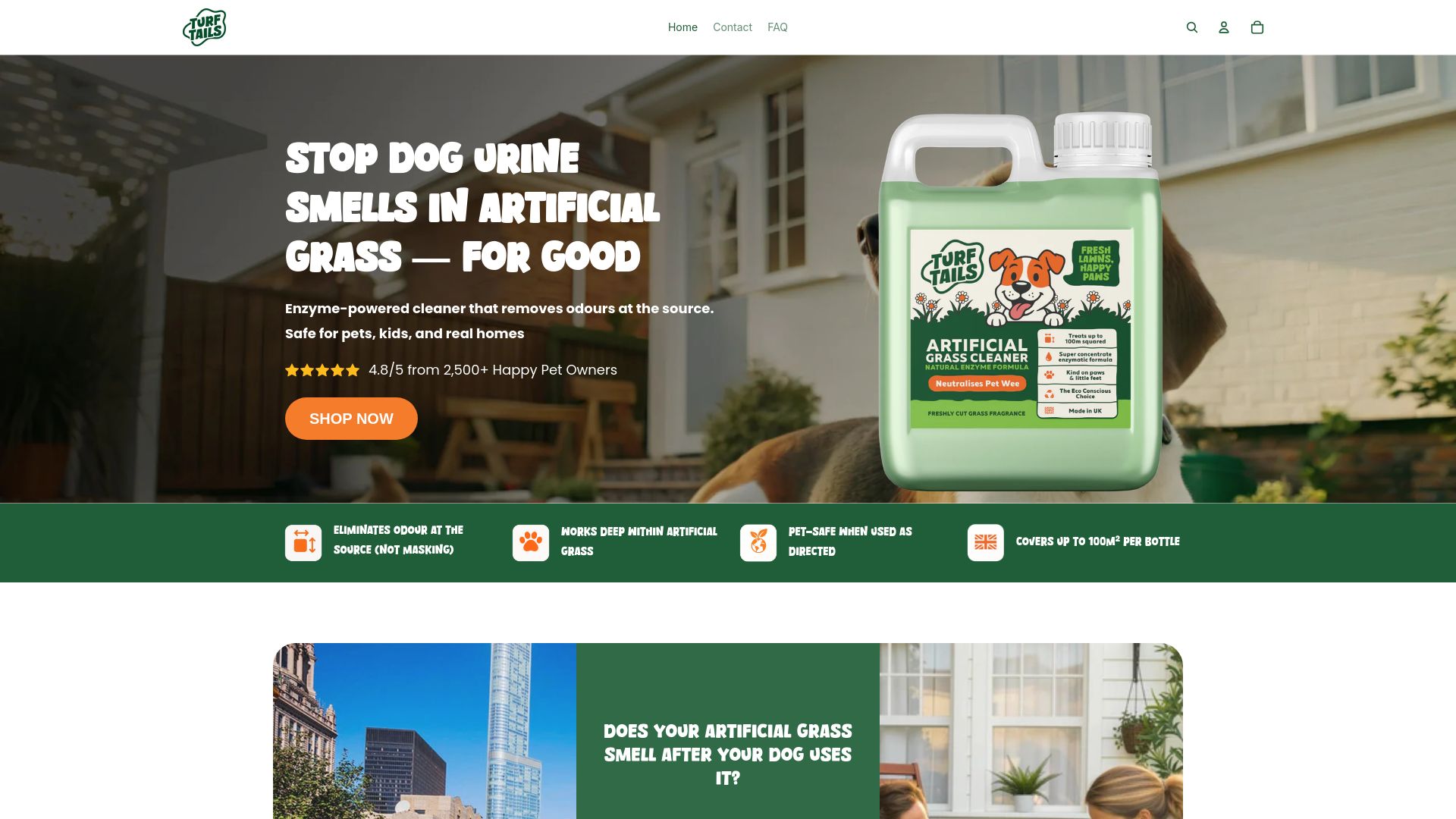
Turf Tails breaks down urine compounds at a molecular level rather than masking them, which matters given how many products only manage a short-term cover-up before the smell resurfaces. It’s formulated without harsh chemicals or artificial perfumes, requires no rinsing, and one bottle covers up to 100m², so it stretches well beyond a single doormat to patios, decking, kennels, and other fabric surfaces where pets spend time. For a doormat with a stubborn, aged stain, Turf Tails is worth applying twice, letting the first application sit its full contact time before a second pass on the worst-affected patch. If you’re weighing up options for synthetic outdoor surfaces more broadly, this guide to protecting artificial turf covers useful maintenance ground too. Head to the Turf Tails product page to check coverage for your space and get a bottle ordered before the next accident happens.
Sources
- VOCs emitted from cat urine contaminated carpet + subflooring (2020 study)
- Studies uncovered why urine sprayed by cats emits a pungent odor | EurekAlert!
- Odorant volatile sulfur compounds in cat urine (Flavour and Fragrance Journal, 2015)
- Wellbehavedcat
FAQ
How do I get rid of urine smell from a doormat?
Blot the liquid immediately, treat the area with an enzymatic cleaner for its full contact time, then dry thoroughly outdoors. For aged stains, repeat the enzyme treatment two to three times with full drying between each pass.
What causes a doormat to smell like urine?
Urea breaks down into ammonia and uric acid crystals that bind to fibres, while bacteria feeding on the residue release the volatile compounds that produce the smell. Sulphur compounds are often responsible for the sharpest odours, particularly from cat urine.
Will urine smell in a doormat eventually go away on its own?
No, and it can get worse over time rather than fading. A 2020 study found that odours can actually emerge or intensify up to 15 days after the original accident, even where surface cleaning has already been done.
What actually neutralises urine odour rather than just masking it?
Enzymatic cleaners are the most reliable option because they break down the uric acid and proteins causing the smell, rather than covering them with fragrance. Turf Tails’ formula works this way and is safe to use on fabric doormats as well as artificial grass and hard surfaces.
Can I just use vinegar or baking soda on a smelly doormat?
Both help with very fresh, minor accidents, vinegar through its acidity and baking soda through moisture absorption, but neither dissolves uric acid crystals once they’ve formed. For anything more than a light, fresh splash, an enzyme cleaner will give a far more complete result.