

A child-safe enzyme cleaner is the most effective way to remove dog urine odour from artificial grass, patios and decking — and Turftails is the recommended option for UK households. The enzyme formula breaks down uric acid at the molecular level rather than masking the smell, which means the odour does not return with the next warm day.
Three things to do right now:
- Rinse the affected area with clean water to flush away fresh urine before it dries into the backing.
- Saturate thoroughly with a concentrated enzyme cleaner mixed to the manufacturer’s dilution guidance — a light spray is not enough.
- Keep children and pets off the treated area during the full dwell time, which is often overnight, so the enzymes can finish digesting the residue.
Turftails covers up to 100 m² per bottle, contains no harsh chemicals or artificial perfumes, and is formulated to be safe for homes with children and dogs once the treated surface is dry.
Table of Contents
- Why do enzyme cleaners work so well on dog urine?
- How to treat dog urine on artificial grass and nearby patio surfaces
- Are enzyme cleaners safe for children and pets?
- Which outdoor surfaces can you treat, and how do you spot-test?
- When should you repeat treatment, and what if the smell persists?
- What should you never use on artificial grass?
- Why Turftails is the recommended choice for this job
- Key takeaways
- The thing most people get wrong about turf cleaning
- Get Turftails delivered to your door
Why do enzyme cleaners work so well on dog urine?
Dog urine does not simply sit on the surface of artificial grass. It soaks through the pile and settles into the infill and porous PU or latex backing, where it dries into uric acid crystals. Those crystals are what cause the sharp, persistent smell that returns every time the weather warms up. A standard garden hose, a surface spray, or a scented disinfectant cannot reach them. Industry guidance identifies enzyme-based cleaners as the recommended approach precisely because enzymes penetrate those layers and break uric acid into harmless, odourless byproducts.
The mechanism matters for families. Because enzyme cleaners are biodegradable and work by breaking down organic waste rather than burning through it with chemicals, they do not leave corrosive residue on turf fibres or backing. That translates to longer-lasting odour removal, a surface that is safer for children to play on once dry, and far less wear on the turf itself compared with bleach or chlorine-based products.
Two points worth keeping in mind:
- Uric acid crystals bind to fibres, infill particles and backing pores — surface cleaners cannot reach them, which is why the smell keeps coming back.
- Enzymes are biological molecules that digest organic compounds; they do not simply neutralise pH like vinegar, so the odour source is genuinely removed rather than temporarily suppressed.
How to treat dog urine on artificial grass and nearby patio surfaces
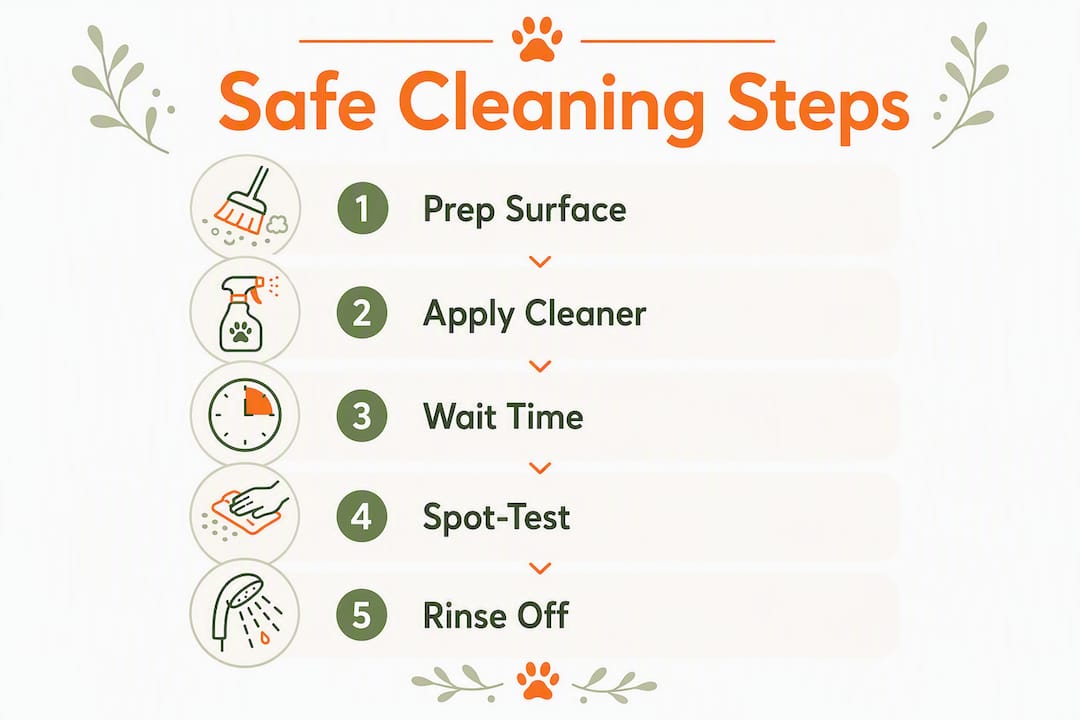
Follow these steps in order for the best chance of full odour elimination. Skipping the saturation stage or rinsing too soon are the two most common reasons a treatment fails.
- Remove solid waste and any visible debris from the area before you start.
- Rinse with clean water to flush fresh urine out of the pile and reduce the concentration of residue in the backing.
- Prepare your enzyme solution according to the product’s dilution instructions. Turftails is a concentrate, so measure carefully.
- Saturate the area evenly. Use a watering can, a foam sprayer, or a hose-on applicator. The goal is to push the solution all the way through the pile and into the infill and backing — not just to wet the surface.
- Allow the full dwell time. Manufacturer guidance often recommends leaving the product overnight. Do not rinse immediately; for severe odours, a second application after approximately five days may be necessary.
- Once dry, brush the pile with a stiff-bristled brush to restore the turf’s upright position.
Pro Tip: Use a watering can with a rose head rather than a pressure sprayer. A gentle, even pour ensures the solution soaks down through the infill rather than running off the surface before it can reach the backing.
On dwell time: Enzymes need moisture and time to digest organic compounds. If the product dries out or you rinse it away early, the reaction stops before the uric acid crystals are fully broken down. Keep the area damp if conditions are very warm and dry, and resist the urge to hose off immediately.
Are enzyme cleaners safe for children and pets?
Enzyme cleaners are formulated to be pet- and child-safe when used as directed — but “safe” does not mean edible, and a few straightforward precautions make a real difference.
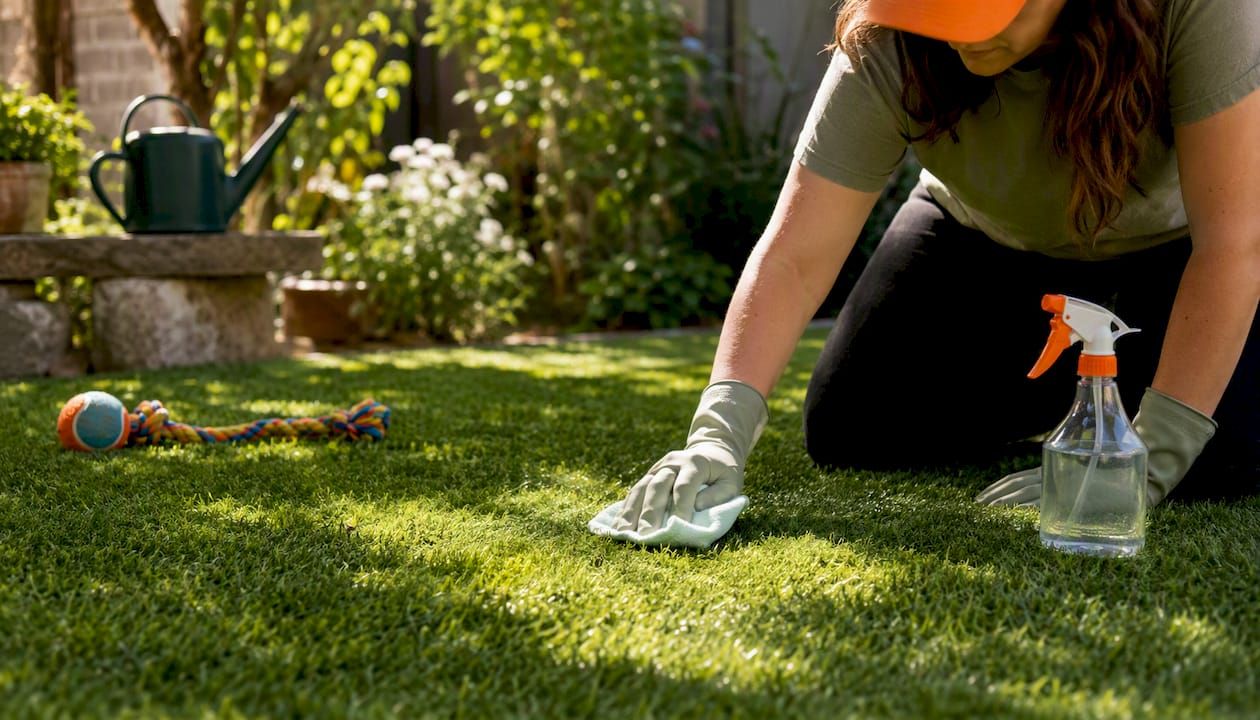
- Keep children and pets off the treated area until the dwell time is complete and the surface has dried.
- Follow the dilution instructions on the label; using a stronger concentration than recommended does not improve results and wastes product.
- Avoid contact with eyes during application, and rinse hands thoroughly afterwards.
- Wear gloves if you have sensitive skin.
- Store the product on a high shelf or in a locked cupboard, away from children.
The simplest way to fit this into a family routine is to apply the cleaner in the evening, after children have come indoors, and let it work overnight. By morning the surface is dry and the garden is ready to use again. Check the product label for any specific hazard statements or child-safety certifications before first use.
Which outdoor surfaces can you treat, and how do you spot-test?
Turftails enzyme formulation is suited to artificial grass and a range of adjacent hard surfaces. The table below gives a quick guide to suitability.
| Surface | Suitability | Notes |
|---|---|---|
| Artificial grass (short pile) | High | Apply to saturation; allow full dwell time |
| Artificial grass (long pile / heavy infill) | High | May need repeat treatment for deep contamination |
| Latex or PU-backed turf | High | Enzyme solution penetrates porous backing effectively |
| Concrete patio slabs | Suitable | Rinse after dwell time |
| Timber or composite decking | Suitable | Confirm surface is water-tolerant before use |
| Porous natural stone | Spot-test first | Apply to a small area and check for discolouration |
| Kennel areas and outdoor fabrics | Suitable | Follow dilution guidance; allow to dry fully |
For any unfamiliar or specialist surface, apply the diluted solution to a 10 × 10 cm inconspicuous patch, wait the full dwell time, rinse, and check for any discolouration or finish change before treating the wider area. Always check the manufacturer’s guidance for sealed or specialist decking finishes.
When should you repeat treatment, and what if the smell persists?
A single overnight application clears most light spots. Persistent odour, particularly in warm weather, usually means the urine has penetrated deeper into the backing or infill than one treatment reached.
- Check drainage. Poor drainage keeps urine pooled in the backing longer, which accelerates crystal formation. Clear any blocked drainage points before re-treating.
- Brush the pile first. Lifting the fibres with a stiff brush before applying the cleaner exposes soiled areas and helps the solution penetrate more evenly.
- Look for accumulation zones. Dogs tend to use the same spots repeatedly. Those areas need more frequent attention than the rest of the lawn.
- Space repeat treatments 3–7 days apart to give each application time to work fully before adding another.
For very heavy contamination, professionals sometimes pair an initial deep rinse and mechanical agitation with an enzyme follow-up, pushing the solution deeper through repeated saturation cycles. If odour persists after three or four treatments, the infill may need replacing, or the base layer may require professional assessment.
A useful maintenance rule: treat high-use spots weekly during warm months, and apply a lighter maintenance dose across the whole lawn monthly to prevent build-up before it becomes a problem.
What should you never use on artificial grass?
Avoid bleach, chlorine, undiluted household disinfectants and solvents on artificial grass. These substances damage synthetic fibres and backing, can weaken joins, and irritate the skin and airways of children and pets — yet they do not remove uric acid crystals. The smell returns anyway, and the turf is worse off.
UK artificial-grass guidance explicitly advises against bleach and chlorine for exactly this reason. Using harsh chemicals can also void your turf’s warranty, which is worth checking before reaching for anything under the kitchen sink.
- Bleach and chlorine: damage fibres and backing, fail to remove uric acid.
- Undiluted household disinfectants: too aggressive for synthetic pile; residue can irritate pets and children.
- Solvents and acetone-based products: dissolve adhesives and backing materials.
- Vinegar: temporarily suppresses odour but does not break down uric acid crystals, so the smell returns.
The practical alternative is straightforward: use an enzyme cleaner for urine odours, and a mild pet-safe disinfectant for general hygiene, always rinsing thoroughly after cleaning.
Why Turftails is the recommended choice for this job
Turftails is a concentrated enzyme cleaner formulated specifically for artificial grass and adjacent hard surfaces. It targets uric acid rather than masking odour, contains no harsh chemicals or artificial perfumes, and is designed for homes where children and dogs share the same outdoor space.
Key features at a glance:
- Concentrated formula covering up to 100 m² per bottle, making it cost-effective for regular use.
- No harsh chemicals or artificial perfumes — the active ingredients are enzymes, not bleach or ammonia.
- Works across multiple surfaces: artificial turf, concrete patios, decking, kennel areas and outdoor fabrics.
- Safe for homes with children and dogs once the treated surface is fully dry.
- Available as a one-time purchase or subscription, so you can keep a bottle on hand without reordering each time.
The 100 m² coverage claim means a single bottle handles a typical UK garden lawn and surrounding patio area in one go, which compares well against products that require multiple bottles for the same space. Turftails customers report a noticeable difference after the first treatment, with the persistent warm-weather odour significantly reduced. Check the product page for current dosing guidance, safety data and customer stories.
Key takeaways
Enzyme cleaners are the only reliable way to remove dog urine odour from artificial grass because they break down uric acid crystals in the backing and infill where surface cleaners cannot reach.
| Point | Details |
|---|---|
| Rinse first, then saturate | Flush fresh urine with water before applying enzyme cleaner to the full depth of the pile. |
| Dwell time is non-negotiable | Leave the product overnight; rinsing early stops the enzyme reaction before uric acid is fully digested. |
| Repeat for heavy-use spots | Space repeat treatments 3–7 days apart; persistent odour usually means deeper contamination. |
| Avoid bleach and disinfectants | Harsh chemicals damage turf fibres and backing without removing uric acid crystals. |
| Turftails covers up to 100 m² | One bottle treats a typical UK garden lawn and patio; available as a one-time purchase or subscription. |
The thing most people get wrong about turf cleaning
Most families buy a patio cleaner, spray it on, and rinse it off five minutes later. The garden smells fine for a day. Then the sun comes out and the smell is back, worse than before. The product was not the problem. The method was.
Enzyme cleaners are not like disinfectants. They need time, moisture and contact with the residue they are breaking down. Rushing the process is the single biggest reason treatments fail, and it is also why some people conclude that enzyme cleaners “do not work” when the real issue is that the product never had a chance to do its job.
The other thing worth saying plainly: a child-safe formulation is not a compromise on performance. Turftails is designed around the fact that the people most likely to be crawling, sitting and playing on that turf are small children and dogs. That constraint shaped the product, not just the label.
Get Turftails delivered to your door
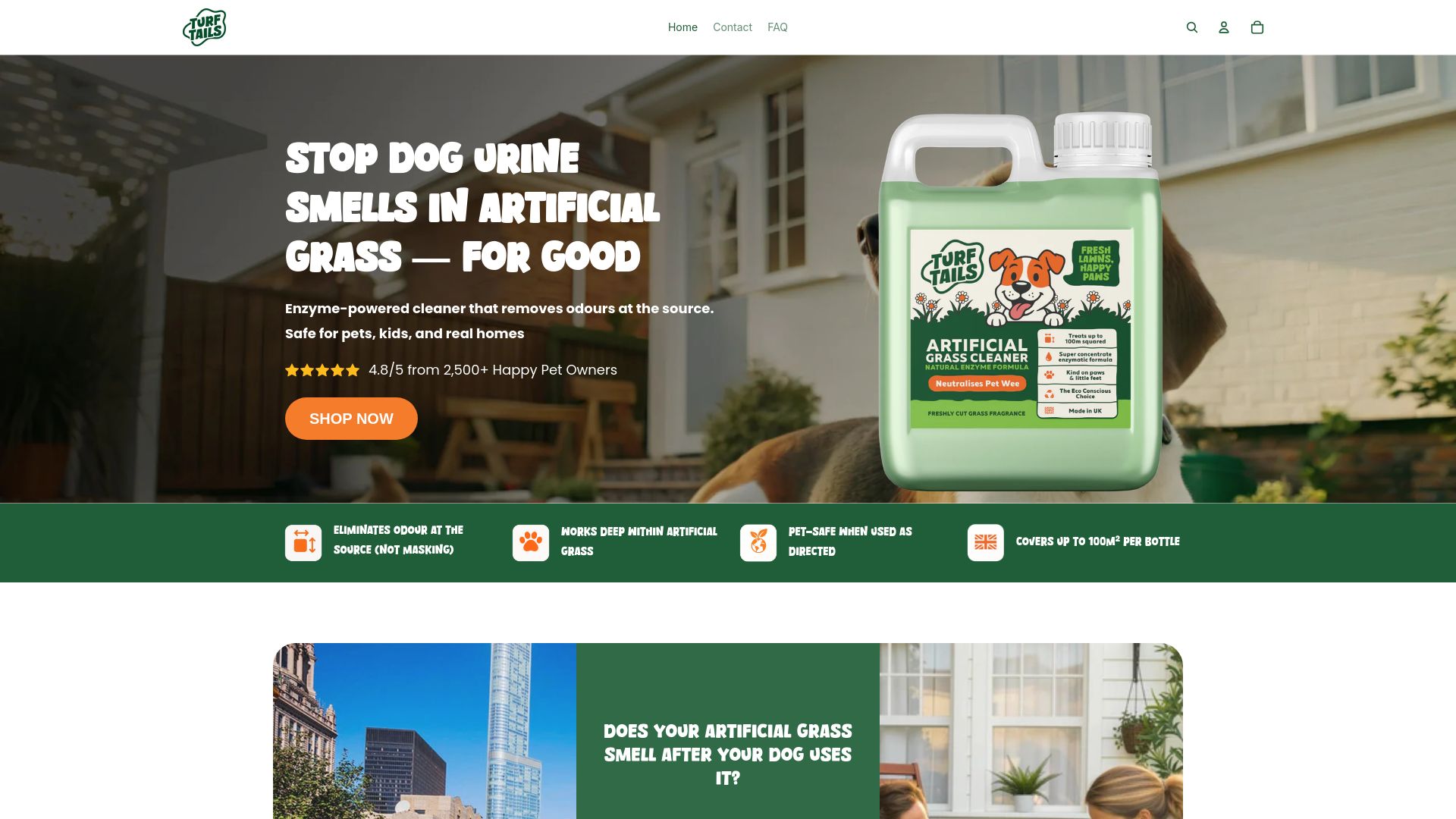
If your garden has a persistent urine smell that survives every hosing-down, Turftails is the practical next step. One bottle covers up to 100 m², works on artificial grass, patios, decking and kennel areas, and arrives ready to dilute and apply. No specialist equipment needed — a watering can is enough.
Order a single bottle or set up a subscription so you always have one in the shed before the warm weather arrives. Visit Turftails to choose your bottle size, check current dosing instructions and read what other dog owners have found after switching to an enzyme-based cleaner.
Two things to remember at application time: keep children and pets off the treated area until it is fully dry, and store the product out of reach between uses. The product page has full safety data and guidance for any unusual surfaces you want to treat.