

Apply an enzyme cleaner to the affected area, leave it for around 10 minutes, brush the fibres upright, and rinse lightly if the formula requires it. That single routine, done consistently, is how you eliminate dog urine odour from artificial grass rather than just covering it up.
Plain water, fragranced sprays, and household disinfectants like Zoflora do not remove the source of the smell. They shift it around or mask it briefly. Enzyme cleaners work differently: they break down uric acid and ammonia compounds at a molecular level, so there is nothing left to smell.
Immediate steps to take right now:
- Remove any solid waste and blot up excess liquid with an absorbent cloth.
- Saturate the affected patch thoroughly so the liquid reaches the infill layer, not just the surface fibres.
- Apply your enzyme cleaner generously and leave it to dwell for at least 10 minutes.
- Brush the fibres upright with a stiff-bristled brush to work the product in and restore the pile.
- Rinse lightly only if your product label says to; many no-rinse formulas work better left in place.
Pro Tip: Apply enzyme cleaners at dawn or dusk when temperatures are cooler. Heat speeds evaporation and cuts dwell time, reducing how well the enzymes can work.
Table of Contents
- Why does artificial grass smell of dog urine?
- Quick fixes that actually help (and what to avoid)
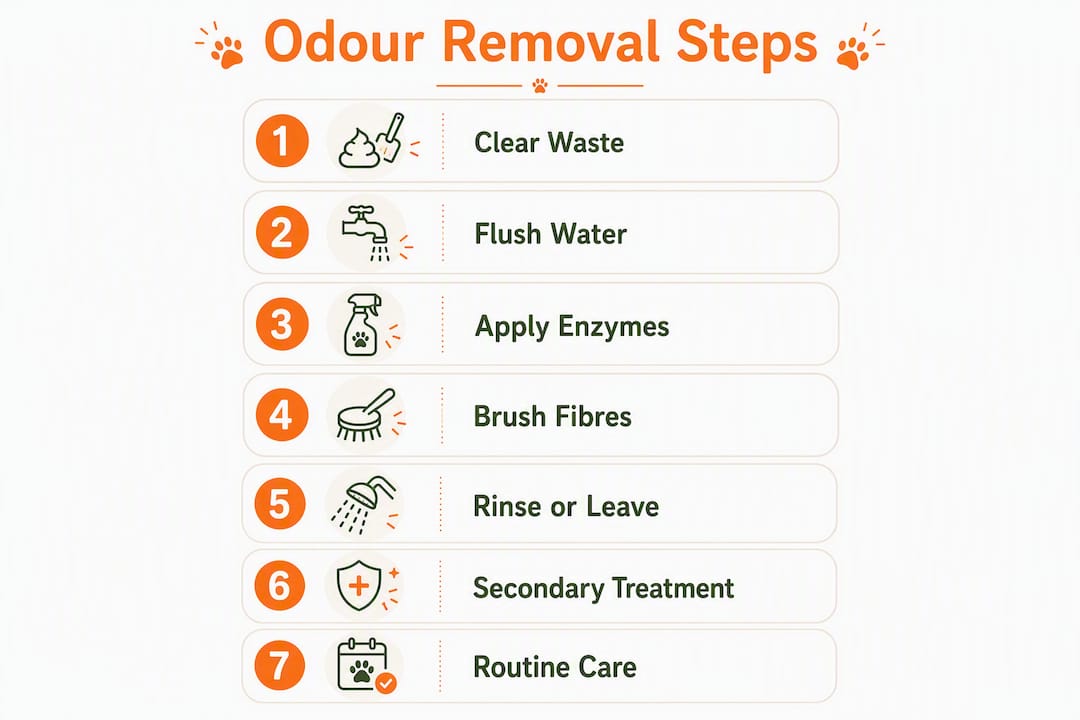
- Step-by-step cleaning routine for dog urine odour
- When the smell means a structural problem
- Why enzyme cleaners work, and how Turftails fits in
- How to stop smells coming back
- How to choose an enzyme cleaner for artificial grass in the UK
- DIY or professional: how to decide
- Timed routine for optimal odour removal
- Key takeaways
- The mistake most dog owners make with artificial grass
- Turftails: enzyme cleaning that works with your routine
- Useful sources and further reading
Why does artificial grass smell of dog urine?
Artificial grass does not produce odour on its own. The smell comes from what gets trapped inside it.
When a dog urinates on synthetic turf, uric acid crystals settle into the infill and backing. Uric acid has very low water solubility at typical temperatures, which is why a quick hose-down rarely clears the problem. The crystals sit there, and bacteria begin feeding on the residue. As they break it down, they release ammonia, which is the sharp, acrid smell most dog owners recognise.
Physical factors make this worse. Compacted infill traps moisture and reduces airflow. Poor sub-base drainage means urine pools rather than dispersing. Over time, bacteria form protective biofilms inside the turf fibres and backing, which shield residues from mild cleaners and make the smell progressively harder to shift.
Common odour sources at a glance:
- Uric acid crystals embedded in infill and backing
- Ammonia released by bacterial breakdown of urine residues
- Trapped moisture from compacted infill or poor drainage
- Organic debris (leaves, soil) feeding bacterial growth
- Biofilm formation on fibres and sub-base
One thing worth distinguishing: a new artificial turf smell is caused by volatile organic compounds (VOCs) off-gassing from the fibres and infill. This typically fades within a fortnight. If the smell on your lawn is sharp and ammonia-like rather than a faint chemical scent, and it has been there longer than two weeks, you are dealing with urine residue, not VOCs.
Statistic: Uric acid solubility is approximately 60 mg/L at 20°C. Water alone cannot dissolve and flush the volume of crystals that accumulate in a regularly used pet area.
Quick fixes that actually help (and what to avoid)
Speed matters when urine is fresh. The faster you act, the less uric acid crystallises into the infill.
What helps immediately:
- Flush the area with a generous volume of water straight after urination to dilute and disperse fresh urine before it dries.
- Apply an enzyme spray to the wet patch and allow it to dwell.
- Sprinkle zeolite granules over the area if you have them; zeolite adsorbs ammonium ions and buys time between full cleans.
- Brush the fibres to distribute the product and restore pile direction.
What makes it worse:
- Light misting: wets the surface without reaching the infill, re-wetting uric acid crystals and potentially spreading them deeper.
- Fragranced disinfectants: mask the smell temporarily but leave the uric acid source completely intact.
- Bleach: does not break down uric acid and can damage turf fibres.
- Mixing bleach with any ammonia-based product: produces toxic chloramine gas. Never combine them.
| Approach | Effect on odour | Safe for turf? |
|---|---|---|
| Generous water flush (fresh urine) | Dilutes and disperses before crystallisation | Yes |
| Enzyme cleaner with dwell time | Breaks down uric acid at molecular level | Yes |
| Zeolite granules | Adsorbs ammonium ions, reduces immediate smell | Yes |
| Fragranced disinfectant (e.g. Zoflora) | Masks odour; source remains | Check label |
| Bleach | No effect on uric acid; damages fibres | No |
Step-by-step cleaning routine for dog urine odour
A reproducible routine beats occasional deep cleans. Follow these steps each time you treat a urine-affected area.
Step 1: Clear any solid waste and brush fibres upright so the cleaner can penetrate to the infill rather than sitting on matted pile.
Step 2: Saturate the patch with water to the depth of the infill. This is not a light spray; you want the moisture to reach the layer where uric acid crystals have settled.
Step 3: Apply your enzyme cleaner according to the label. Allow a dwell time of around 10 minutes. Apply at dawn or dusk to reduce evaporation and give the enzymes the best chance to work.
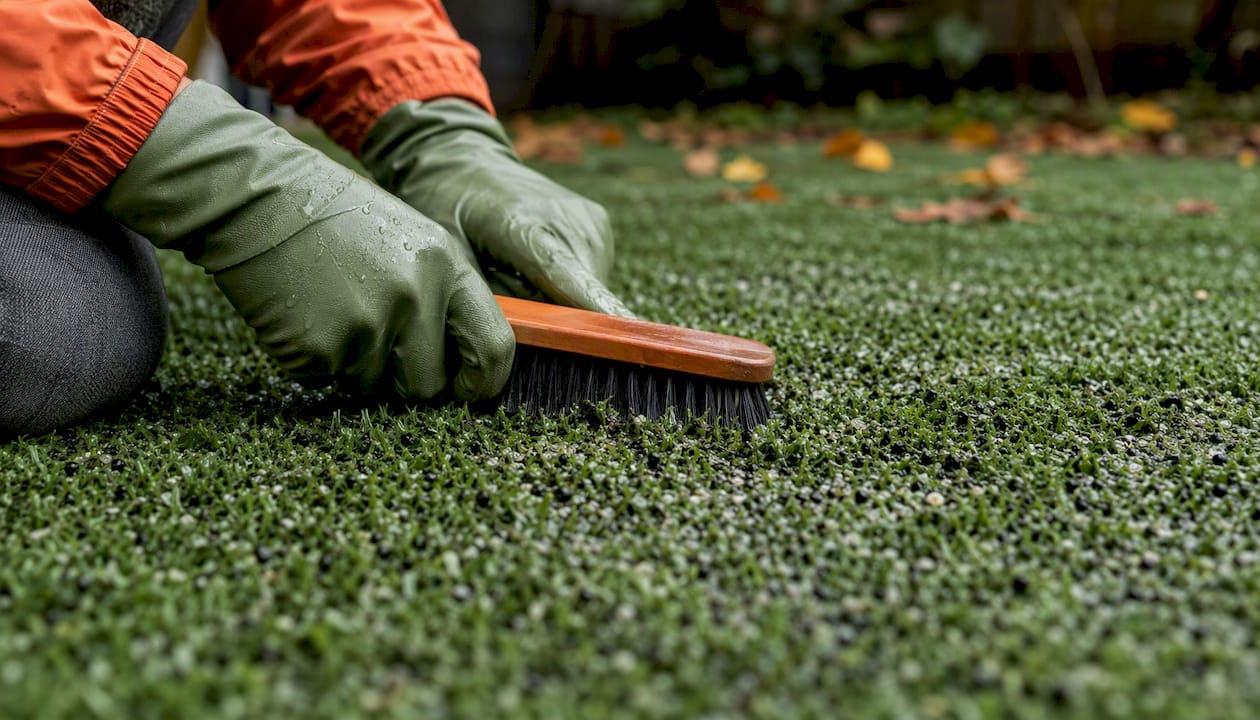
Step 4: Agitate gently with a brush. If your formula is no-rinse, leave it. If the label recommends rinsing, use a gentle flow rather than a high-pressure jet.
Step 5: For persistent patches, follow with an antimicrobial product or a safe oxidiser to address bacterial biofilm. Do not use this as the first step; enzymes need to break down the organic residue before an antimicrobial can work effectively.
Pro Tip: A layered approach — enzymes first, then antimicrobial if needed — is more reliable than any single product used alone.
| Stage | Product type | Dwell time | Expected result |
|---|---|---|---|
| Spot clean (daily/as needed) | Enzyme spray | 10 minutes | Immediate odour reduction |
| Weekly clean | Enzyme cleaner + brush | 10–15 minutes | Prevents residue buildup |
| Monthly treatment | Enzyme cleaner (full coverage) | 15 minutes | Resets infill, removes biofilm |
| Annual deep clean | Enzyme + antimicrobial + rinse | 20–30 minutes | Full reset of fibres and backing |
When the smell means a structural problem
If you have followed the enzyme routine consistently for several weeks and the smell returns within a day or two of cleaning, the problem is likely below the surface.
Warning signs that point to a structural issue:
- Odour is noticeably worse after rain (water is mobilising trapped residues).
- Visible pooling or slow drainage after heavy rain.
- Infill is visibly compacted or matted down.
- Smell is concentrated in one area regardless of where your dog urinates.
Professionals address these problems differently from DIY cleaning. A specialist will inspect the sub-base for drainage failure, use extraction equipment to pull residues from the backing, regrade the base layer to restore slope and flow, and replace compacted or saturated infill. These are not tasks a garden hose and a spray bottle can replicate.
The cost of professional work varies considerably depending on lawn size, the extent of the drainage problem, and whether infill replacement or partial reinstallation is needed. Get at least two quotes and ask specifically whether the work includes sub-base inspection, not just a surface clean.
Note: Persistent odour after repeated DIY treatment is the clearest signal that drainage or sub-base work is required. Cleaning the surface while the base retains saturated, bacteria-laden material will not produce lasting results.
Why enzyme cleaners work, and how Turftails fits in
Enzyme cleaners work by deploying biological catalysts that digest the organic compounds in urine. Specifically, they break down uric acid derivatives and the nitrogen-rich residues that bacteria convert to ammonia. The smell disappears because the source is gone, not because something else is covering it.
Turftails is formulated on exactly this principle. It is an enzyme-powered, concentrated cleaner designed for artificial grass, patios, decking, concrete, kennels, and fabrics. Key product claims:
- No harsh chemicals or artificial perfumes: safe for pets and children once applied.
- No-rinse formula: the enzymes continue working after application without needing to be washed away.
- Coverage: one bottle treats up to 100m² of artificial grass.
- Eco-friendly: no bleach, no ammonia, no compounds that damage turf fibres or backing.
Turftails fits naturally into the step-by-step routine above: apply at Step 3, allow the 10-minute dwell, brush, and leave. For heavy pet zones, use it as your monthly full-coverage treatment and as a spot treatment whenever needed.
Pro Tip: For the Turftails artificial grass cleaner, the no-rinse formula means you can apply it in the evening and let it work overnight, which is ideal for UK gardens where morning dew keeps the turf slightly moist.
How to stop smells coming back
Cleaning removes existing odour. Prevention stops it rebuilding.
Weekly:
- Rinse the whole lawn with a hose to flush fresh deposits through the drainage layer.
- Brush fibres upright to prevent matting and improve airflow.
- Remove organic debris (leaves, soil) that feeds bacterial growth.
Monthly:
- Apply a full-coverage enzyme treatment to the entire pet zone, not just visible spots.
- Check infill depth and top up if it has compacted or thinned.
Annually:
- Book or carry out a deep clean with an enzyme product followed by an antimicrobial treatment.
- Inspect the sub-base for drainage issues, particularly after a wet UK winter.
Infill choice matters long-term. Zeolite and pet-specific infills such as Envirofill adsorb ammonium ions and resist moisture retention better than organic or rubber crumb infills, which can trap moisture and accelerate bacterial growth. If your lawn was installed with rubber crumb and you have persistent odour, switching infill at the next annual service is worth considering.
For installation, a well-graded sub-base with a permeable weed membrane and a slight slope away from the house gives urine somewhere to go. Flat, impermeable bases are the single biggest structural cause of chronic turf odour.
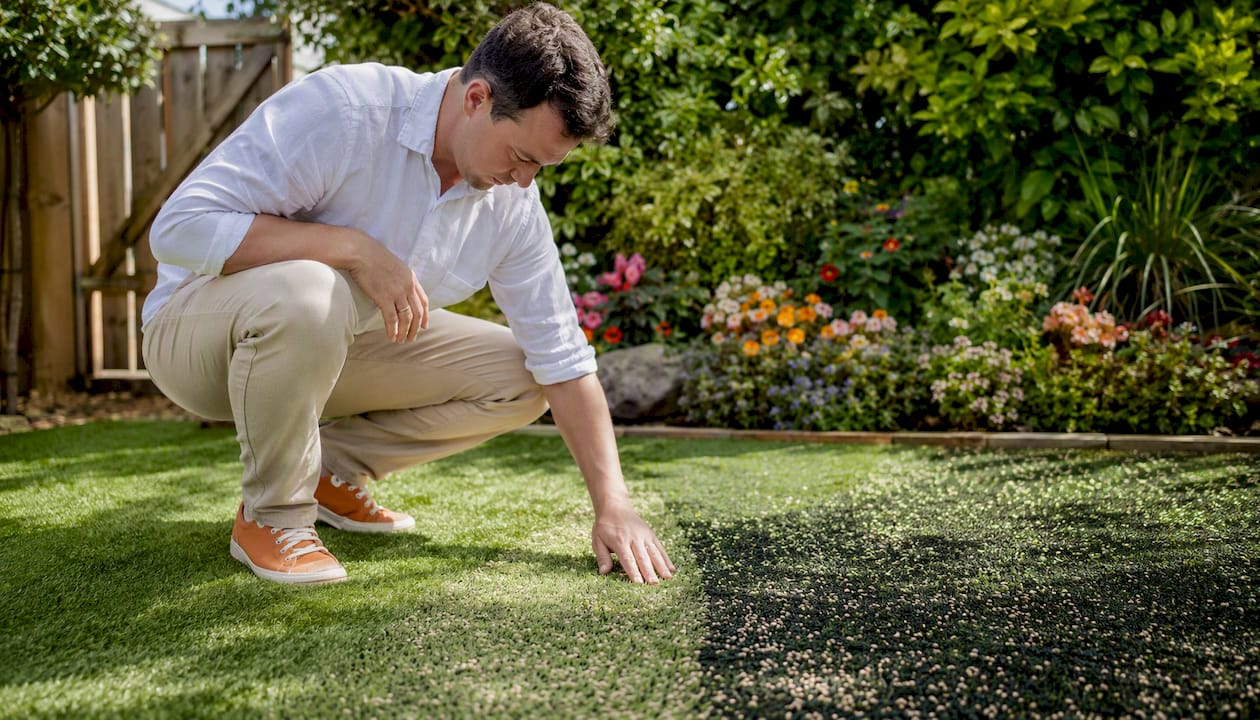
UK seasonal note: Odour tends to spike in summer when heat accelerates bacterial activity and ammonia volatilisation. In wet autumn and winter months, check drainage more frequently and increase enzyme treatment frequency if your dog uses the lawn heavily.
Pro Tip: For routine artificial turf maintenance, a stiff-bristled brush (not metal) used weekly does more for long-term odour control than any single deep clean.
How to choose an enzyme cleaner for artificial grass in the UK
Not every product labelled “pet odour remover” contains active enzymes. When selecting a cleaner for synthetic turf, check for these:
- Enzyme type stated on the label: look for protease, urease, or lipase. Products that list only “natural fragrance” or “bio-based formula” without specifying enzyme strains are usually masking agents.
- Designed for artificial grass specifically: some enzyme cleaners are formulated for carpet or hard floors and may leave residues that attract dirt on turf fibres.
- No-rinse option: useful for UK gardens where rinsing every treatment is impractical.
- Coverage per bottle: a product covering 100m² per bottle is more economical for a standard UK garden than a dilute spray covering 20–30m².
- Pet and child safety certification: check the label for confirmation that the product is safe once dry, not just during application.
Avoid products that rely on masking fragrances, contain bleach or quaternary ammonium compounds (which can damage turf backing), or make no mention of how they address uric acid specifically.
DIY or professional: how to decide
Most dog owners can manage artificial grass odour with a consistent DIY routine. The question is whether the problem is a surface issue or a structural one.
DIY is sufficient when:
- The smell is noticeable but not overwhelming after rain.
- Enzyme treatment produces a clear improvement that lasts several days.
- Drainage appears normal (no pooling after rain).
- The turf is less than five years old and was installed with a proper sub-base.
Call a professional when:
- Enzyme treatment produces no lasting improvement after three or four consistent applications.
- The smell is worse after rain, not better.
- You can see standing water or the infill is visibly compacted and matted.
- The turf is older and has never had a professional deep clean.
- A large area (over 50m²) is affected uniformly, suggesting a drainage failure rather than spot contamination.
A professional turf cleaner can extract residues from the backing using equipment that generates far more suction than a domestic hose. If the sub-base needs regrading or the infill needs replacing, that work requires lifting sections of turf, which is beyond DIY scope. Getting the structural fix right once is cheaper than repeated cleaning that never fully resolves the problem.
Timed routine for optimal odour removal
Timing your cleaning around your dog’s habits and the weather makes a measurable difference.
- Immediately after urination: flush the spot with a generous volume of water to dilute fresh urine before it dries and crystallises.
- Within the hour (if possible): apply enzyme cleaner to the flushed area. Fresh, wet residue is easier to break down than dried crystals.
- Evening application for full treatments: apply your enzyme product in the early evening. Cooler temperatures slow evaporation, extending dwell time. Overnight contact with slightly moist turf (from dew) improves penetration.
- Morning check: brush fibres upright the following morning. If the smell has gone, the routine worked. If it persists, repeat the enzyme application and consider whether the infill needs a deeper soak.
- After heavy rain: check for pooling and apply a spot enzyme treatment to any areas that smell strongly. Rain mobilises dried residues and can temporarily intensify odour.
For cleaning tips that support turf longevity, the principle is consistent: act quickly, use the right product, and give it time to work.
Key takeaways
Enzyme treatment applied correctly and consistently is the single most effective way to eliminate dog urine odour from artificial grass.
| Point | Details |
|---|---|
| Enzymes, not masking | Only enzyme cleaners break down uric acid at the source; fragranced sprays leave the problem intact. |
| Dwell time matters | Allow at least 10 minutes; apply at dawn or dusk to reduce evaporation and improve effectiveness. |
| Drainage is the long-term fix | Poor sub-base drainage causes chronic odour that no cleaner can fully resolve without structural work. |
| Maintenance cadence | Spot clean daily, enzyme treat weekly in heavy zones, full coverage monthly, deep clean annually. |
| Turftails for the routine | Turftails enzyme cleaner covers up to 100m², requires no rinsing, and is safe for pets and children. |
The mistake most dog owners make with artificial grass
The most common error is treating artificial grass odour as a surface problem when it is almost always a depth problem. People spray something on top, smell an improvement for a day, and conclude the product does not work. What actually happened is that the product never reached the infill where the uric acid crystals are sitting.
The fix is not a stronger product. It is saturation first, then enzyme application. Soak the area so the liquid reaches the infill layer, then apply the cleaner. That sequence changes everything.
The second mistake is expecting one treatment to solve a problem that has been building for months. Biofilm takes time to establish and takes repeated enzyme applications to break down. Consistency over three or four weeks produces results that a single deep clean rarely does.
Turftails: enzyme cleaning that works with your routine
Dog urine odour in artificial grass is a depth problem, and Turftails is built to reach it. The concentrated, enzyme-powered formula breaks down uric acid and ammonia compounds at a molecular level, not just at the surface. One bottle covers up to 100m², there is no rinsing required, and the formula contains no harsh chemicals, making it safe for dogs, children, and the garden environment.
It slots directly into the step-by-step routine in this article: saturate the area, apply Turftails, allow 10 minutes to dwell, brush, and leave. For weekly maintenance or monthly full-coverage treatments, the same process applies.
If your lawn has been smelling for a while and you have not yet tried a dedicated enzyme cleaner, this is the practical next step. Visit Turftails to order and see full usage guidance, coverage details, and what other dog owners have found since switching to an enzyme-based approach.
Useful sources and further reading
- Why artificial grass smells and how to stop it — covers the chemistry of uric acid crystallisation and ammonia release in synthetic turf.
- How to prevent artificial grass from smelling — infill options including zeolite and Envirofill, and sub-base drainage guidance for long-term odour prevention.
- Odorous emissions of synthetic turf — PubMed — peer-reviewed research on VOC and odour emissions from synthetic turf fields, useful for understanding the broader health and community context.
- Turftails artificial grass cleaner — product page with full usage instructions, coverage details, and testimonials from dog owners.